
Loading...

The best editing tips for bloggers boil down to one repeatable routine: wait 24 hours, then run five short passes, structure, clarity, copyedit, SEO, and proofread, before you hit publish. This order keeps you from polishing sentences you'll cut later and catches SEO gaps without breaking the voice that made someone subscribe in the first place. Tools like Semihuman and standards from Plainlanguage both support the same idea: readable wins over clever.
TL;DR:
- Waiting 24 hours before editing helps identify structural gaps and awkward phrasing that are invisible immediately after writing.
- Prioritizing the structure pass over sentence-level polishing saves time and prevents unnecessary rework on content that may be cut later.
- Conducting a clarity pass by reading aloud quickly checks readability and encourages simplification, aiming for a 7th to 8th grade level.
- Using tools like grammar checkers and SEO plugins as secondary supports ensures consistency and keyword integration without compromising your voice.
- Editors should focus on small habits like avoiding filler words, passive voice, and broken links, which significantly improve reader engagement and trust.
Most bloggers edit backward. They fix commas before they fix structure, then wonder why the post still feels off after three read-throughs. Flip that order and you'll cut your editing time nearly in half, because you stop wasting sentence-level effort on paragraphs that get deleted in the next pass.
Here's the sequence, in order, with what to actually check at each stage.
Pro Tip: Do your SEO pass with the post printed or on a second screen, not inline with your writing tool. Editing SEO and prose in the same window makes you tinker with keyword placement while you should be judging readability, and the two jobs pull your attention in opposite directions.
The structure pass matters more than bloggers give it credit for. Cutting a weak section before you've polished its sentences saves real time, and it's a habit borrowed directly from how professional editors work in layered passes to avoid wasted effort.
A checklist only works if it's short enough to actually use every time. A compact, repeatable pre-publish checklist beats a long theoretical one, mainly because you'll skip the long one after the third post.
Keep a core list for every post, and pull out an extended version only for cornerstone content or anything going into a newsletter.
Structure pass
Clarity pass
Copyedit pass
SEO pass
Final proofread
Print this checklist or pin it in your writing tool. The point isn't perfection, it's consistency across every post you publish.
Tools speed up mechanical work. They do not replace judgment, and treating them as a final authority is where a lot of blog editing goes wrong.
Break your toolkit into three categories, each with its own job:
The real weakness across all three is the same: none of them understand your intent, your audience, or the reason you wrote a paragraph a certain way. An automated grammar suggestion that "fixes" a sentence fragment you used on purpose for rhythm is a tool doing its job badly, not you writing wrong.
Pro Tip: If a grammar tool flags something and your gut says "that's actually how I meant it," trust your gut. Tools are trained on average sentences. Your voice isn't average, and it shouldn't be.
For anything with legal, financial, or medical stakes, or any post you expect to rank for years, get a second set of human eyes, either a peer editor or a paid proofread. No software substitute exists for someone who reads the whole piece and asks "does this actually make sense?"
Most blog posts don't fail because of one big error. They fail from five small habits repeated fifty times across the piece.
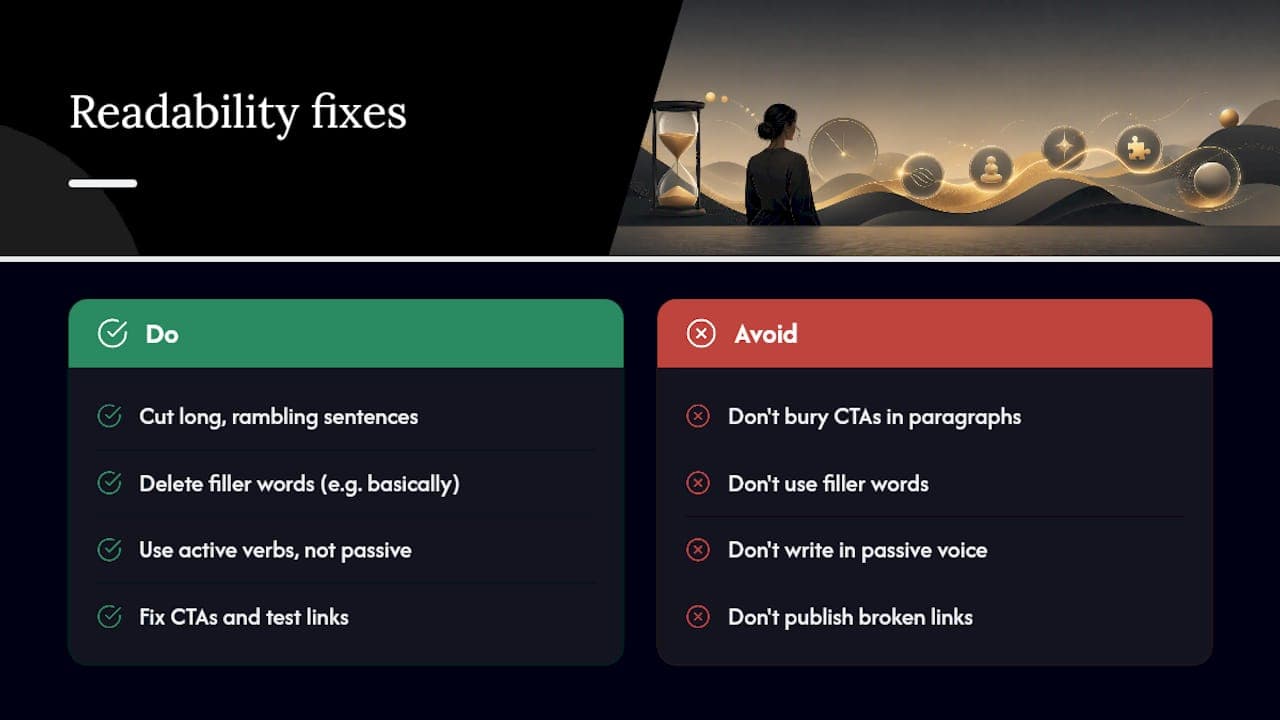
Rambling sentences. "In order to really understand why this matters for your audience, it's important to consider all of the different factors that go into the decision making process." Cut to: "Here's why it matters, and what to weigh before deciding." Same idea, half the words, twice the clarity.
Filler words. "Basically," "really," "actually," "in order to," "the fact that," "at the end of the day." None of these carry meaning. Search your draft for each one and delete it; the sentence almost always reads stronger without it.
Passive voice and weak verbs. "The report was written by the team" becomes "The team wrote the report." "Mistakes are often made when..." becomes "Bloggers often mess up when..." Active verbs put the actor first and cut word count at the same time.
Broken or lazy CTAs and dead links. A call to action buried at the end of a rambling paragraph gets ignored. A dead internal link erodes trust fast. Checking punctuation, link functionality, and formatting before publishing catches most of this in under ten minutes.
None of this is exotic advice. It's the boring, repeatable stuff that separates a post readers finish from one they abandon halfway through, and it's a bigger lever than most bloggers assume: content that reads clearly and holds attention correlates with meaningfully lower bounce rates, which search engines notice.
This guide leans on a mix of established editorial practice and plain language research rather than one person's opinion. The multi-pass structure mirrors what professional editors already do, separate structural review from line editing from proofreading, so effort never gets wasted polishing content that gets cut. The 24 hour wait period, the one-breath sentence test, and the grade 7 to 8 readability target all come from sources that specialize in exactly this: clear communication under real publishing pressure.
Where a tool like Semihuman fits is narrower than marketing copy usually admits. It's built to restructure text, integrate keywords naturally, and help AI-assisted drafts read as authentically human, useful after your clarity pass, when the ideas are locked and you're refining delivery, not before it. It's a supplement to the passes above, never a replacement for reading your own work out loud.
A few things worth keeping on hand as you build your own routine:
Editing tips for bloggers only work if they're repeatable under deadline pressure. That's the standard this routine was built to meet.
The biggest mistake I see bloggers make isn't skipping steps, it's editing for the algorithm before they've edited for the reader. A post can hit every SEO checkbox and still fail if a real person can't get through the second paragraph without rereading it.
Cadence matters more than perfection. A blog you update weekly with clear, well-structured posts will outperform one you update rarely with flawless ones, because consistency builds the habit that makes readers come back. Run your five passes, hit your grade 7 to 8 target, and stop there. Diminishing returns set in fast after the fourth read-through, and the eleventh comma tweak rarely changes whether a reader finishes the piece.
Clarity beats cleverness. Every time.
— Tilen
Semihuman isn't a replacement for the five passes above, it's the step that comes after your clarity pass, when your ideas are solid but you need the phrasing to read naturally and carry your target keywords without sounding stuffed. A common workflow: you write and edit the draft by hand, run it through Semihuman to restructure awkward AI-assisted sections and work in keywords smoothly, then finish with your own final proofread before it goes live.
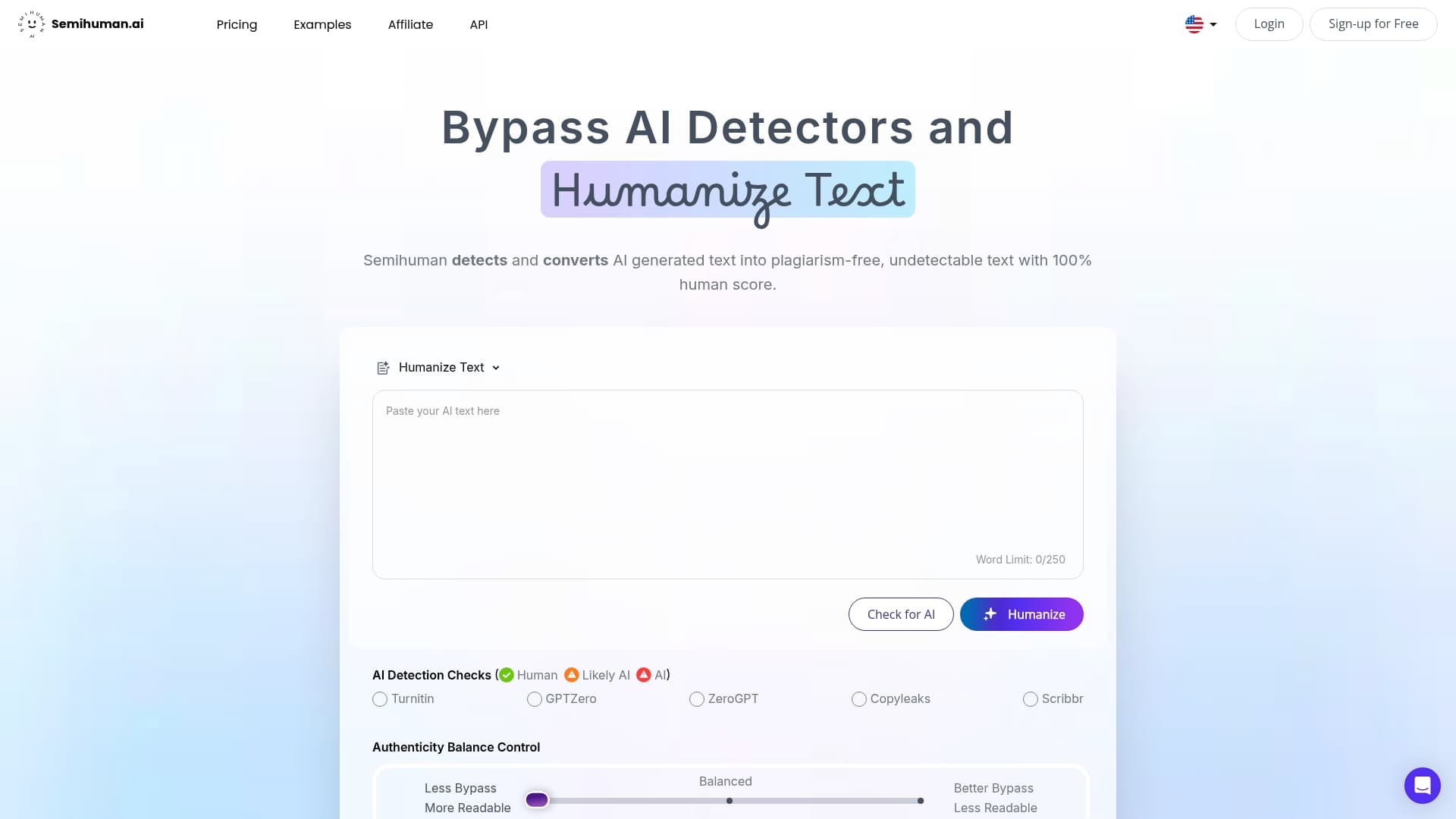
That order matters. Handing Semihuman a messy first draft just speeds up messy output; handing it a structurally sound, clarity-passed draft is where the restructuring and keyword integration actually earn their place. It works best as a supplement to your judgment rather than a substitute for it. If you're publishing often enough that the SEO pass has become the slowest part of your routine, check the SEO Text Generator page and see whether it fits into your next draft.
Wait at least 24 hours after drafting, then run a structure pass, a clarity pass, a copyedit and style pass, an SEO pass, and a final proofread in that order.
Edit in passes rather than all at once, and treat grammar and readability tools as a second opinion, not the final word, since automated suggestions can flatten a distinctive voice into something generic.
Aim for roughly a 7th to 8th grade reading level, per plain language standards, which improves comprehension without making the writing feel simplistic.
Read each sentence out loud; if you can't finish it in one breath, it's too long and should be split into two shorter ones.
No. Semihuman works best after your own clarity and structure passes, helping restructure phrasing and integrate keywords, but it supplements human judgment rather than replacing it.




Start
Humanizing
for Free!
Humanize