
Loading...

A persuasive introduction needs exactly three things: a hook that earns attention, one to three sentences of context, and a thesis that states both your position and how you'll defend it. Skip any of the three and the paragraph either bores the reader, confuses them, or leaves your argument feeling like a guess. Aristotle's rhetorical appeals, still the backbone of persuasive structure today, give you the tools to make that hook land, and current best-practice guidance on ethos, pathos, and logos confirms at least one appeal should show up in your opening lines. A tool like Semihuman.ai can later help you polish that paragraph so it reads naturally, but the structure itself has to come from you.
Here's the three-part shape in miniature: Hook (a startling fact), context (why it matters now), thesis (your stance plus your plan). One sentence each, in that order, and you've already outperformed half the intros a grader sees that day.
A persuasive introduction succeeds only when the hook earns attention, the context sets stakes concisely, and the thesis states both your position and your plan.
| Point | Details |
|---|---|
| Three required parts | Every introduction needs a hook, one to three sentences of context, and a thesis with position plus roadmap. |
| Thesis does two jobs | State your claim and hint at your supporting structure so readers get both the "what" and the "how." |
| One rhetorical appeal is enough | Lean on ethos, pathos, or logos based on your topic rather than forcing all three into one paragraph. |
| Concede before you pivot | A one-sentence concession followed by a pivot phrase builds credibility with skeptical readers. |
| Draft the thesis first | Writing the thesis before the hook makes the rest of the paragraph easier to build. |
| Polish with Semihuman | Running a drafted introduction through Semihuman's SEO Text Generator can tighten a wordy thesis and smooth transitions before submission. |
An effective introduction has three jobs, and it has to do all three in under a hundred words. It captures interest, it orients the reader to the topic's stakes, and it previews the argument's shape so the reader knows what's coming. Hamilton College's writing center frames this as the introduction's core function: interest, background, and thesis, working together rather than as separate boxes to check.
Each function earns something specific from the reader.
You can also plant early credibility signals: a sliver of evidence, a brief concession to an opposing view, or a clear authorial stance. None of these need more than a clause. A grader or a skeptical reader notices when a writer shows awareness of complexity in the first paragraph rather than pretending the issue is simple.
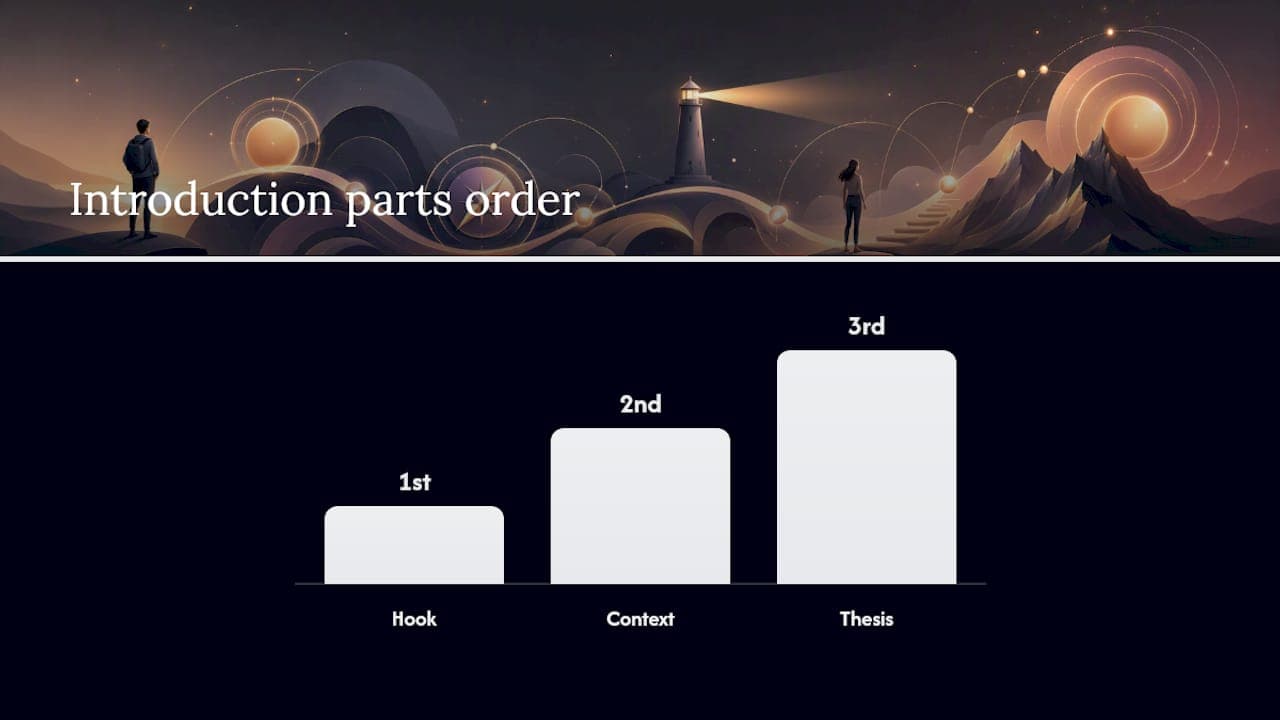
Every persuasive introduction is built from three parts, and the sentence order rarely varies. Get comfortable with each piece separately before worrying about how they flow together.
The hook is your opening move, and it should relate directly to your topic rather than being a generic attention grab. Three templates work across almost any assignment:
The context comes next, and it should run one to three sentences, no more. Cover the scope of the issue, define any term the reader might not know, and name the stakes. A simple framework: "This matters because [stakes]. Specifically, [scope or definition]." Skip the full history of the topic. Nobody needs three paragraphs of background before you tell them what you actually think.
The thesis closes the introduction, and it's the hardest sentence to get right because it has to do two jobs at once. It states your position (the "what") and signals how you'll support it (the "how"). Writing-center guidance from the University of Washington puts it plainly: readers need both the claim and a sense of the argument's shape before they commit to reading further. Three sample theses show the pattern:
To make the three parts read as one paragraph instead of three disconnected sentences, use a transition that narrows scope. Move from general topic to specific problem to your stance, a progression several writing guides recommend precisely because it mirrors how a reader's attention naturally narrows.
Ethos, pathos, and logos are the three classical levers for persuasion, and a strong introduction usually leans on at least one before the paragraph ends. Ethos establishes your credibility or fairness, often through a concession or a nod to expertise. Pathos appeals to emotion, usually through an anecdote or vivid image. Logos appeals to logic, usually through a fact, statistic, or clear cause-effect claim.
You don't need all three crammed into one paragraph. Pick the appeal that fits your topic, and let it do its work in a single sentence.
Combining a brief anecdote with an immediate sentence of factual grounding preserves the emotional pull of the story while keeping the paragraph credible. The anecdote earns attention; the fact earns trust.
That combination, drawn from practical persuasive-writing technique guides, solves the most common worry students have about pathos: that it will make the essay feel emotional rather than argued.
Choosing a hook shouldn't take longer than writing the rest of the paragraph. Here are six reliable types, each with a one-line example you can adapt to almost any classroom prompt.
Keep the hook to one sentence, or one sentence plus a short fragment for emphasis. Classroom strategies for persuasive writing consistently favor short, direct openers over elaborate scene-setting, since a long hook delays the thesis and risks losing the reader before you've made a claim. Avoid hooks that have been used in every essay on the topic. "Since the dawn of time, humans have debated..." tells your reader nothing and signals you didn't think hard about the opening.
A short concession, one that acknowledges an opposing view before pivoting to your own, builds trust with a skeptical reader faster than almost any other move available in an introduction. Guidance on handling opposing viewpoints treats this as standard academic practice: readers who sense you've considered the other side take your argument more seriously, even in a single sentence.
The pattern has two parts: acknowledge, then limit. "While some argue [opposing view], this position overlooks [limitation]." That's it. You don't need a full paragraph defending the opposing view; you need enough to show you know it exists and why it doesn't hold up.
Here's a short paragraph putting the pattern to work: Some parents worry that later school start times will disrupt family schedules and after-school jobs. That concern is real for a portion of working families. Still, the research on adolescent sleep cycles is clear enough that scheduling friction shouldn't override a reform proven to improve academic performance and mental health. The concession comes first, the pivot phrase carries the turn, and the thesis lands with more weight because it already answered an objection.
Pro Tip: Write your concession sentence last, after you've drafted the thesis. It's easier to spot the strongest counterargument once you already know exactly what you're arguing against it.
Most weak introductions fail for one of five predictable reasons, and every one of them is fixable in a single revision pass.
One revision-checklist habit fixes several of these at once: read your introduction aloud and ask whether the last sentence, standing completely alone, tells a stranger exactly what you believe and roughly how you'll prove it. If it doesn't, the thesis needs rework before anything else in the paragraph matters.
Prompt: Argue whether your city should invest in expanded public transit.
Weak: "Public transit is a very important topic that affects many people in our society today. There are a lot of pros and cons to think about. In this essay, I will discuss public transit and give my opinion on why it matters."
Improved: "Every weekday morning, thousands of commuters in mid-sized cities sit in traffic that a functioning bus system could eliminate. Public transit investment isn't just a convenience issue, it's a question of who gets access to jobs, schools, and healthcare. Cities should prioritize transit funding because it reduces congestion and expands economic opportunity."
Strong: "A single delayed bus can cost a minimum-wage worker their shift, and in cities without reliable transit, that happens every day. Some officials argue road expansion solves congestion faster than transit investment, but wider highways consistently fill back up within a few years. Cities should redirect road-expansion budgets toward public transit because it cuts commute times, lowers transportation costs for low-income residents, and reduces the traffic congestion that highway widening never actually fixes.
The difference between improved and strong isn't length. It's specificity: naming the counterargument and naming exactly how the essay will prove its case.
Three edits to upgrade a weak intro: replace a generic opening line with a concrete image or fact, cut any sentence that doesn't add context or stakes, and rewrite the final sentence so it names both your position and your supporting structure.

Write the thesis first. Draft it before you touch the hook, before you write the context sentences, before you worry about how clever the opening line sounds. Once the thesis exists in full, with both the position and the roadmap spelled out, the hook becomes a much easier problem: you're no longer hunting for an attention grabber in the dark, you're building a doorway that leads somewhere specific.
This habit saves time because it eliminates the most common stall point in drafting, staring at a blank hook sentence with no idea what you're building toward. A writer who drafts the thesis "Standardized testing fails because it rewards test-taking skill over comprehension, penalizes anxious students, and ignores alternative assessment models" already knows their hook needs to gesture at unfairness or misjudged ability, not just open with a random statistic about test dates.
Once the structure is right, the sentences still need to sound like you wrote them, not like a template. That's where a tool built for rewriting comes in handy: the SEO Text Generator from Semihuman restructures clunky sentences, tightens a wordy thesis into one clean line, and adjusts tone so a paragraph that started stiff reads naturally.

Picture a student who's drafted a thesis that technically covers position and roadmap but reads like a legal document. Running that paragraph through Semihuman surfaces a cleaner phrasing, keeps the "what" and the "how" intact, and smooths the transition from hook to context to thesis so the whole introduction reads like one connected thought instead of three stitched-together sentences. For students juggling deadlines, that's minutes saved on the paragraph that usually takes the longest to get right. Start with a draft, run it through Semihuman's SEO Text Generator, and see what a tightened thesis sounds like before you submit.
A handful of sources go deeper than any single article can on thesis construction, rhetorical appeals, and revision technique.
Consult at least one of these when you're revising for evidence or citations, since a thesis template only helps once you know what claim you're actually prepared to defend.
What are the three parts every persuasive introduction needs? A hook, one to three sentences of context, and a thesis that states your position along with how you'll support it. Leaving out any one of the three weakens the paragraph's ability to orient and persuade the reader.
How long should a persuasive introduction be? Most classroom-length persuasive essays call for an introduction of four to six sentences: one hook, one to three context sentences, and one thesis sentence. Longer introductions usually pack in unnecessary summary that belongs in the body paragraphs instead.
Should I use a quote to open my introduction? Only if the quote is specific and directly tied to your argument. A generic inspirational quote disconnected from your topic reads as filler and delays your actual point.
Do I need to include a concession in every introduction? Not always, but including one strengthens credibility whenever your topic has a reasonable opposing view. Skip it only when the counterargument is genuinely weak or irrelevant to your specific claim.
What's the fastest way to fix a weak thesis? Force it into one sentence that names your exact position and lists, even briefly, the two or three points you'll use to support it. If you can't compress it that far, you likely haven't settled on your actual argument yet.




Start
Humanizing
for Free!
Humanize