
Loading...

Ethical guidelines for AI-assisted writing come down to a short routine: a human owns every published word, AI use is disclosed when it could mislead, facts and sources are checked, and private data stays out of the tools. Most published frameworks agree on these points. The hard part is turning them into habits for your own drafts. This guide does that, and shows where a rewriting tool such as Semihuman fits when you want AI-drafted text to read like your own voice and still meet your disclosure and review duties.
There is no single rulebook. Dozens of organizations have published principles, so the useful question is what they share. A 2019 mapping study in Nature Machine Intelligence compared global guidelines and found convergence around five principles: transparency, justice and fairness, non-maleficence (avoiding harm), responsibility and privacy. The same authors found that organizations disagree on how to interpret and apply them. A principle on paper is not yet a practice.
The bodies you will see cited most often:
| Body | What it published | What it stresses |
|---|---|---|
| UNESCO | Recommendation on the Ethics of AI, adopted by 193 Member States in November 2021 | Four core values and ten principles, including transparency, human oversight, accountability, privacy and non-discrimination |
| OECD | AI Principles, adopted 2019 and updated 2024 | Transparency, robustness, security and safety, and accountability for those who deploy AI |
| European Commission expert group | Ethics Guidelines for Trustworthy AI, April 2019 | AI should be lawful, ethical and robust, with seven requirements including human agency and oversight |
| ISO | Responsible AI guidance | Fairness, transparency, non-maleficence, accountability, privacy, robustness and inclusiveness, with no fixed universal set |
These documents are written mostly for people who build and deploy AI systems. If you write, market or publish, you are on the user side. One line in the EU guidelines applies to you directly: people should know when they are interacting with AI and be told what it can and cannot do. Everything below is that idea applied to text.
Principles such as accountability are abstract. For anyone producing content with AI, they reduce to four questions you can ask of every piece before it goes out:
The rest of this guide takes each question in turn.
The most practical guidance on disclosure comes from publishers and universities, not from the big frameworks. Their rules are strikingly similar.
Newsrooms. CBC Newss November 2025 guidelines make disclosure mandatory when generative AI materially affects content, or when the content would not have been possible without it. A disclosure explains what the tool did, why it was used and how humans were involved. The test is simple: might the audience be misled without it?
Brand and communications teams. Emory Universitys communications guidelines require a professional communicator to review AI-assisted content before publication. They call for written disclosure when a law or platform policy requires it, when content cannot be checked before it goes live (a chatbot reply, for example), when images or video are AI-generated or materially altered, or when AIs contribution would normally earn a credit. Their suggested wording is plain: portions of the story were created or edited using generative AI.
Documentation. Tulane Universitys AI usage guidelines add a record-keeping habit. When AI plays a significant role, note which tools were used, which parts were AI-assisted and who reviewed and approved the final version.
Media organizations. The World Economic Forums April 2026 policy for Forum Stories requires a human author accountable for every piece, a human editor and a senior editor responsible for publishing. Contributors disclose, clearly and proportionately, where AI materially shaped substance, structure or presentation.
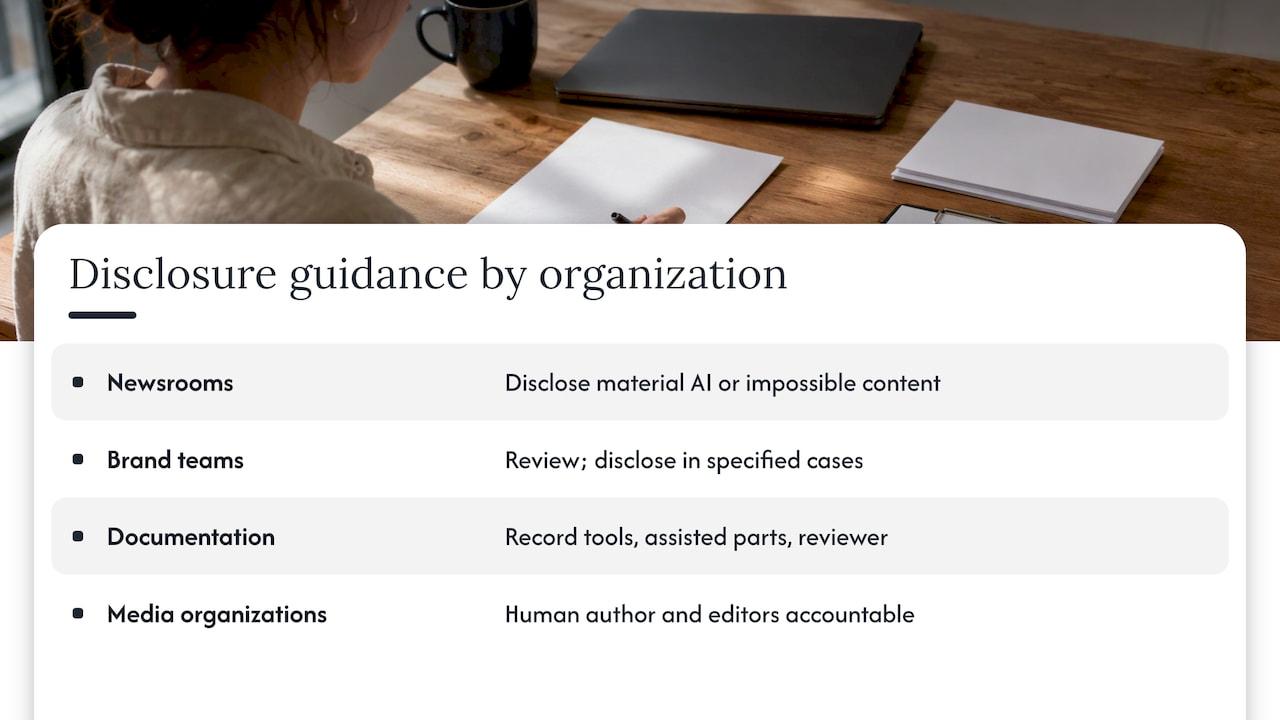
Put together, these policies suggest a rule of thumb you can adopt in a style guide:
The word materially appears again and again in these policies. It is the dividing line, and your own editor, client or institution decides where it falls.
Disclosure covers honesty about process. Safeguards cover the quality and safety of the result.
Check everything a model asserts. The European Commissions guidelines on generative AI in research tell users to critically assess outputs for bias, hallucinations (confident but invented statements) and inaccuracies, and to verify AI contributions. Tulanes guidance goes further: AI-influenced content should be fact-checked manually against reliable official sources.

Protect data. The same EC document advises protecting unpublished or sensitive work from reuse for AI training, checking a tools privacy options, ownership and hosting, and not giving third parties personal data to external generative AI systems without consent and a clear purpose. For a marketer, that means no customer lists, no client confidential material and no unreleased campaign details pasted into a tool whose data handling you have not read.
Watch for bias. UNESCOs October 2026 guidelines on generative AI for publications say human experts remain responsible for interpreting findings and conclusions, and should take particular care about gender bias, homophobia and racial stereotyping. Read AI drafts for stereotyped examples and one-sided framing, not just for typos.
Before you publish an AI-assisted piece:
General guidance is a floor. The institution that grades, publishes or employs you sets the actual rules.
The EC research guidelines are non-binding and complement existing requirements. They tell researchers to follow the discipline, journal, funder and institutional guidance that applies to them when they disclose AI use.
Several professional bodies are explicit on authorship:
If you are a student, read your courses AI policy before you start, and ask the instructor when it is unclear. Our guide to submitting AI work ethically walks through that process.
This is the question behind many searches for AI ethics guidelines. The frameworks above give a clear way to think about it: ethics attaches to what the audience is led to believe and who answers for the work, not to how smooth the sentences are.
A useful sorting test is the one CBC uses: would the audience be misled without disclosure? Rewriting an AI draft so it reads naturally, in your voice and for your readers, is an editing step. It is ethical when:
It becomes a problem when the goal is to hide AI use from someone who is entitled to know, for instance a course that bans it or a client contract that requires disclosure. That is a breach of the rule, and no tool changes it. Detector scores are a separate matter: they are a signal some institutions and platforms look at, not a verdict on who wrote a text. EASE itself notes that it can be hard to tell AI-generated-then-edited text from human-drafted-then-AI-edited text, so policies that depend on disclosure and process records are sturdier than ones that depend on guessing.
If you want a structured way to weigh a borderline choice, the classic ethical lenses help. Ask about consequences (who is helped or harmed), duties (what rules or promises apply), character (is this how an honest writer acts) and fairness (is anyone disadvantaged by what you did). Any answer that depends on the audience not finding out deserves a second look.
For marketers and SEO teams, the practical risk of raw AI output is rarely a moral one. It is sameness: flat rhythm, generic phrasing, no point of view. Readers disengage, and trust suffers. Our pieces on content authenticity for marketers and the risks of undetectable AI content cover that trade-off in more depth.
An ethical workflow that uses a humanizing step looks like this:
How AI should sit inside a broader plan is also a marketing question. This overview of the role of AI in content strategy and SEO shows how teams apply AI across marketing activities. For creative writers, there is a thoughtful take on using AI without losing your voice, which is the same principle as step 2 above: the tool serves your voice, never replaces it.
Semihuman is a web and API tool that detects AI-generated text, restructures it for natural readability, integrates keywords for SEO and humanizes the result. It also offers paraphrasing and plagiarism-risk minimization. The Free, Basic and Pro plans are on the plans page. Teams that want to build humanizing into their own publishing pipeline can look at the Developer, Business and Enterprise options on the API access page.
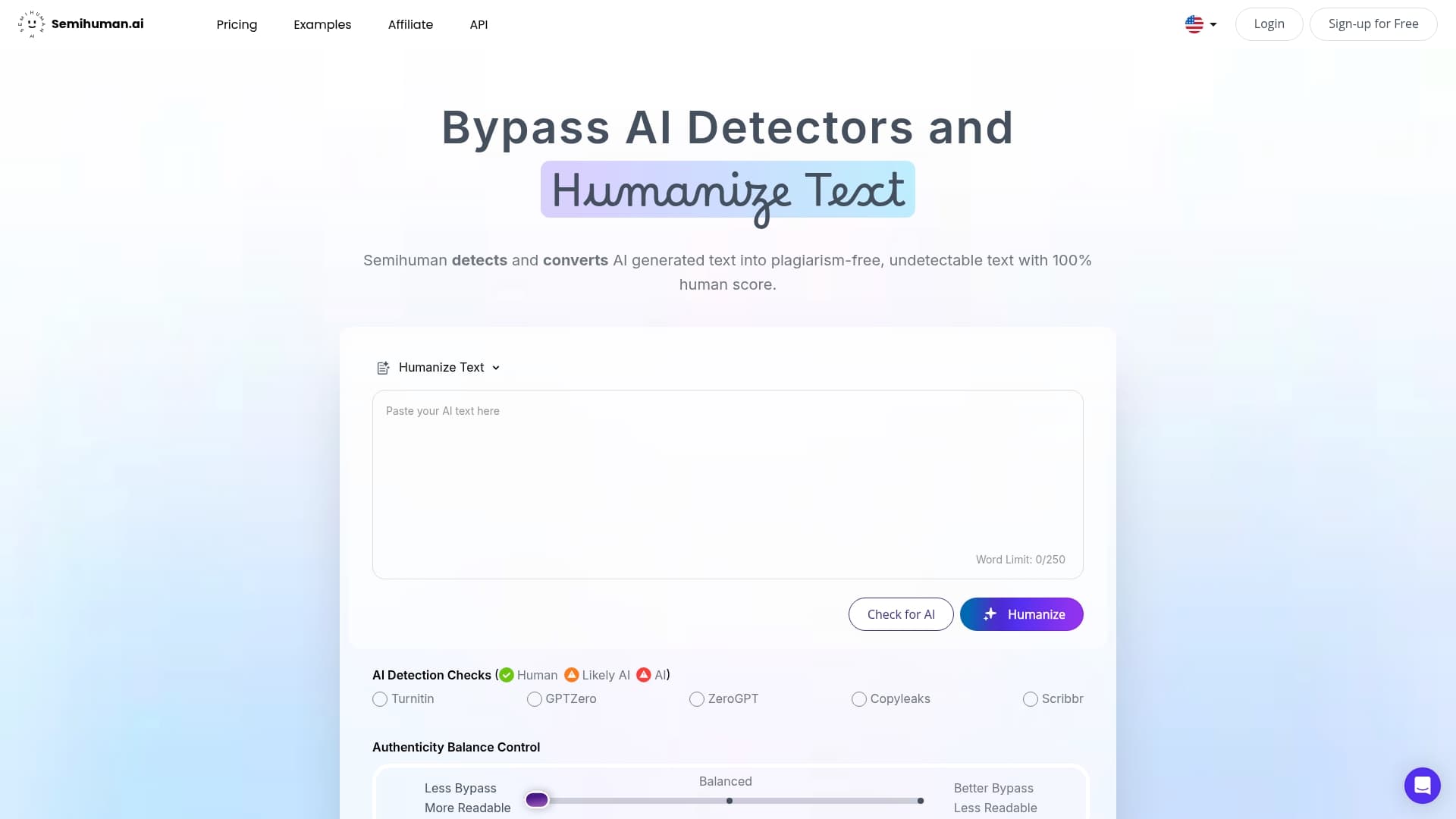
Use it at step 2 of the workflow above: after the draft, before the human review that makes you accountable for the final text.
We built Semihuman for people who already use AI and want the result to read like a person wrote it with care. Our approach is focused detection and rewriting, engineered to work on the patterns that major AI detectors recognize, while keeping the meaning of your text intact and supporting your SEO goals.
The ethical frameworks all point at the same place: a human stays in charge. We agree. A humanizing step makes that easier, because a draft that already reads naturally is a draft you can edit, fact-check and sign with confidence, instead of rewriting it from scratch.
Our advice to marketers, students and journalists is the same. Know your policy, disclose where it asks you to, verify what you publish, and use the tool to make the final text better. The API exists for teams that want that routine to run inside their own workflow, every time.
Tilen
The phrase usually refers to four lenses from moral philosophy: consequences (the outcome for everyone affected), duties (rules and obligations), virtue (the character of the person acting) and justice or fairness. For AI-assisted writing, they translate into questions about harm to readers, the rules you have agreed to follow, your honesty as an author and whether anyone is treated unfairly.
Not always, but often. Publishers such as CBC News and the World Economic Forum require disclosure when AI materially shaped the content. Light help such as grammar fixes is often exempt, though policies differ. Check the rules of your employer, publisher, platform or school, and when in doubt, disclose.
Start with the shared principles from UNESCO, the OECD and the EU: transparency, accountability, privacy, fairness and human oversight. Then write them into a short internal policy covering disclosure, review, data handling and record keeping, and add any rules from clients, platforms or regulators in your market.
No. Scholarly bodies such as EASE, citing the ICMJE position, say AI cannot be an author or co-author because it cannot take responsibility for accuracy, integrity and originality. The human author carries that accountability, and the EC research guidelines say the same.
Start
Texte vermenschlichen
kostenlos!
Humanisieren