
Loading...

The core ethical challenge of AI in academia is not that people use it. It is that the rules for using it are inconsistent, the tools used to police it are unreliable, and the person holding the pen is still fully accountable for the result. Students, researchers, journalists and content professionals who handle all three well do the same things: they know the disclosure rule that applies to them, they keep their own judgment in the loop, and they make sure the final text reads and checks out as their own work. That is also the idea behind Semihuman, a tool that detects AI-generated text and rewrites it so it reads naturally, with plans for individuals and for teams that integrate through an API.
A 2025 study of how university educators use AI sorted the ethical problems into six categories: privacy and data protection, bias and fairness, transparency and accountability, autonomy and oversight, governance gaps, and integrity and plagiarism. The authors argue that these are common, workable concerns rather than hypothetical ones, which is useful: it means each one can be handled with a concrete habit.
A Nature Human Behaviour study of 80 academic guidelines on generative AI from around the world reached a similar picture. It found misinformation and threats to academic integrity among the main challenges, and it recommended balanced approaches rather than blanket bans.
For most readers of this article, three of the six matter day to day: integrity and plagiarism, transparency (disclosure), and the reliability of the detectors that sit between you and a verdict. Privacy and bias come after that, and they are easier to handle once you know where the risks are.
A systematic review in AI and Ethics lists GenAI-facilitated plagiarism, cheating, fabricated references, data falsification and peer-review manipulation as integrity threats. It also notes that overreliance on generative AI may hinder students from acquiring essential skills, including critical thinking and creativity. A separate systematic review of AI writing tools points to authorship ambiguity and erosion of critical thinking, and finds ChatGPT and Grammarly the most frequently used platforms.
Two practical lessons follow:
The same review notes that unclear policies create a risk of unintentional plagiarism, and that cultural differences in integrity norms affect whether people see their AI use as misconduct. In other words, many violations are not planned. They happen because nobody told the writer where the line was. Our guide on academic integrity and AI walks through that line in more detail.
One point is settled. A policy analysis of 74 documents worldwide found a widespread consensus that AI cannot be listed as an author. The ICMJE recommendations, which many medical journals follow, say chatbots must not be listed as authors because they cannot be responsible for accuracy, integrity and originality. Authors must also assert that AI-produced text and images contain no plagiarism.
Everything after that varies. A narrative review of 6 institutions, 8 publishers and 139 journals found substantial disagreement on disclosure timing, location and content. Only some bodies require a disclosure at submission. Disclosure usually goes in Methods or Acknowledgments, but one major publisher requires a separate AI declaration section. Some bodies want the tool name, version and prompts.
Disclosure norms also differ by field. A critical review of 54 studies found AI disclosure policy adoption of 70% in nursing journals but 46.7% in plastic surgery journals.
Princetons scholarly integrity office offers a clear example for students. It says generative AI is not a citable source because a person did not produce its output. When use is permitted, you disclose it rather than cite it, and failing to disclose can be an integrity violation even in a course that allows AI. Its template asks for the tool, the purpose and the pages affected.
A good habit that works almost everywhere:
If you write for a brand or a publication, the same logic applies. Our guide to submitting AI work ethically covers the checks to run before you hand anything over. For marketers, authorship and attribution questions around AI content also affect SEO, since search visibility depends on content that is useful and original.
This is the challenge that surprises people most. Institutions rely on AI detectors, yet the evidence on their reliability is mixed at best.

A 2026 study in the International Journal for Educational Integrity tested four detectors on 160 documents with known origins and then applied one to 1,163 real masters theses. Only one detector held up across fully AI-written, hybrid and humanized texts, and the authors concluded that detectors should not be the sole evidence in high-stakes decisions.
A comparative evaluation covering GPTZero, Turnitin, Copyleaks, Originality.AI, ZeroGPT and others found that performance varied markedly by platform, generator model and text transformation. Paraphrasing substantially reduced sensitivity, and false positives in genuine human writing fell unevenly across linguistic groups.
A controlled study of published abstracts adds a sharper number. Light, guideline-compliant AI editing was flagged 38 to 80% of the time, unmodified originals from 2023 to 2025 were flagged at 9 to 15%, and non-STEM writing was flagged far more often than STEM writing.
What this means for you:
Two challenges rarely make headlines but matter to anyone feeding text into a tool.
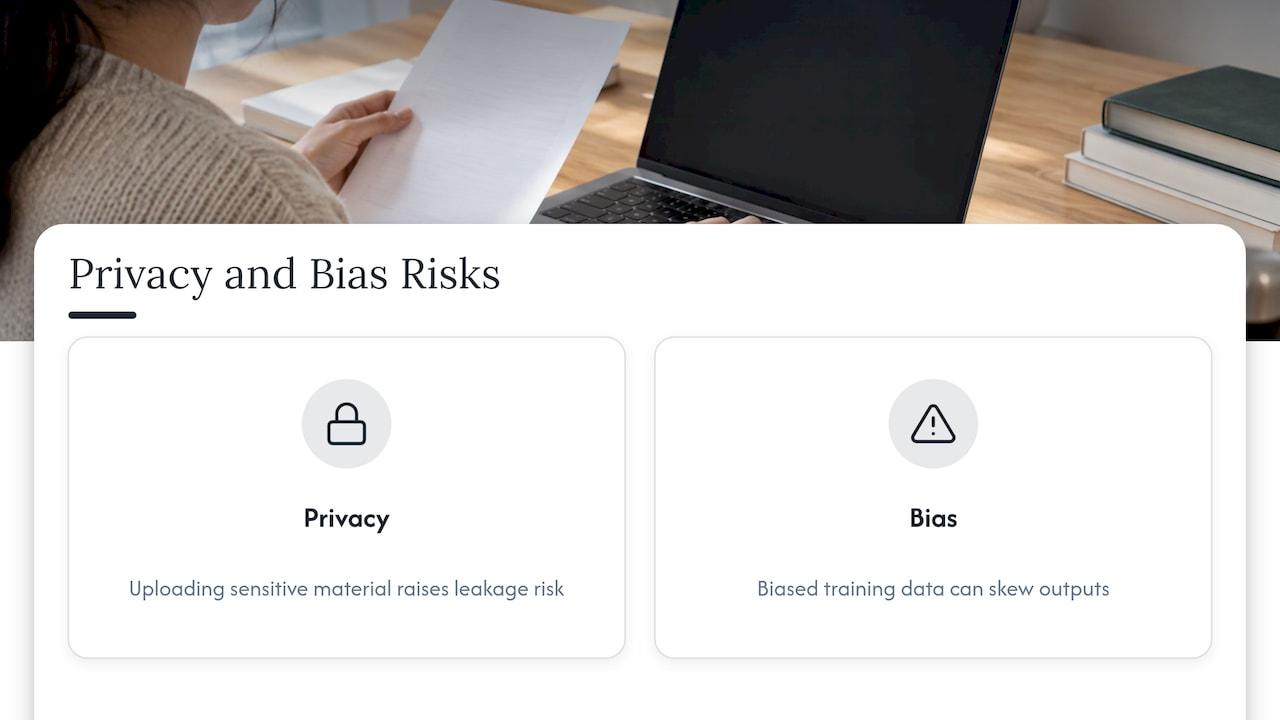
Privacy. The AI and Ethics review reports that generative AI tools collect large volumes of user data, and that uploading research or sensitive material raises the risk of leakage. The APRU whitepaper cites cases where confidential information reached AI vendors, potentially for training future models, because guidelines were unclear. Melbournes guidance lists entering confidential or protected information into tools without appropriate safeguards as an unacceptable use. Before you paste unpublished data, interview transcripts or student records into any tool, check what your institution allows.
Bias. The same review finds that outputs can reflect biased training data, producing skewed results and underrepresenting minority groups. A Delphi study of 12 international experts named data privacy, algorithmic bias, transparency and authorship as key concerns and called for clear ethical guidelines and institutional oversight. Read AI drafts the way you would read any unvetted source, and check the language for assumptions. Our note on inclusive language practices helps with the editing pass.
The University of Melbourne puts the principle simply: AI should support rather than replace your judgment, and you remain responsible for checking outputs. Here is how that looks as a routine.
Step five is where most people lose time and where machine-sounding patterns, repetitive rhythm and generic transitions tend to show. Our guide to content generation challenges covers the editing problems that come up most often, and the piece on AI-driven plagiarism issues explains how to keep text original.
Semihuman detects AI-generated text and humanizes it so it reads as authentically written. It restructures text for natural readability, integrates keywords for SEO, and offers paraphrasing and plagiarism-risk minimization. It is built for content creators, marketers, SEO professionals, writers, bloggers, students, academics and journalists.
There are two ways in. Individuals can choose among Free, Basic and Pro on the plans page. Teams and platforms that want to run the process inside their own workflow can use the API through the Developer, Business and Enterprise plans on the API access page.
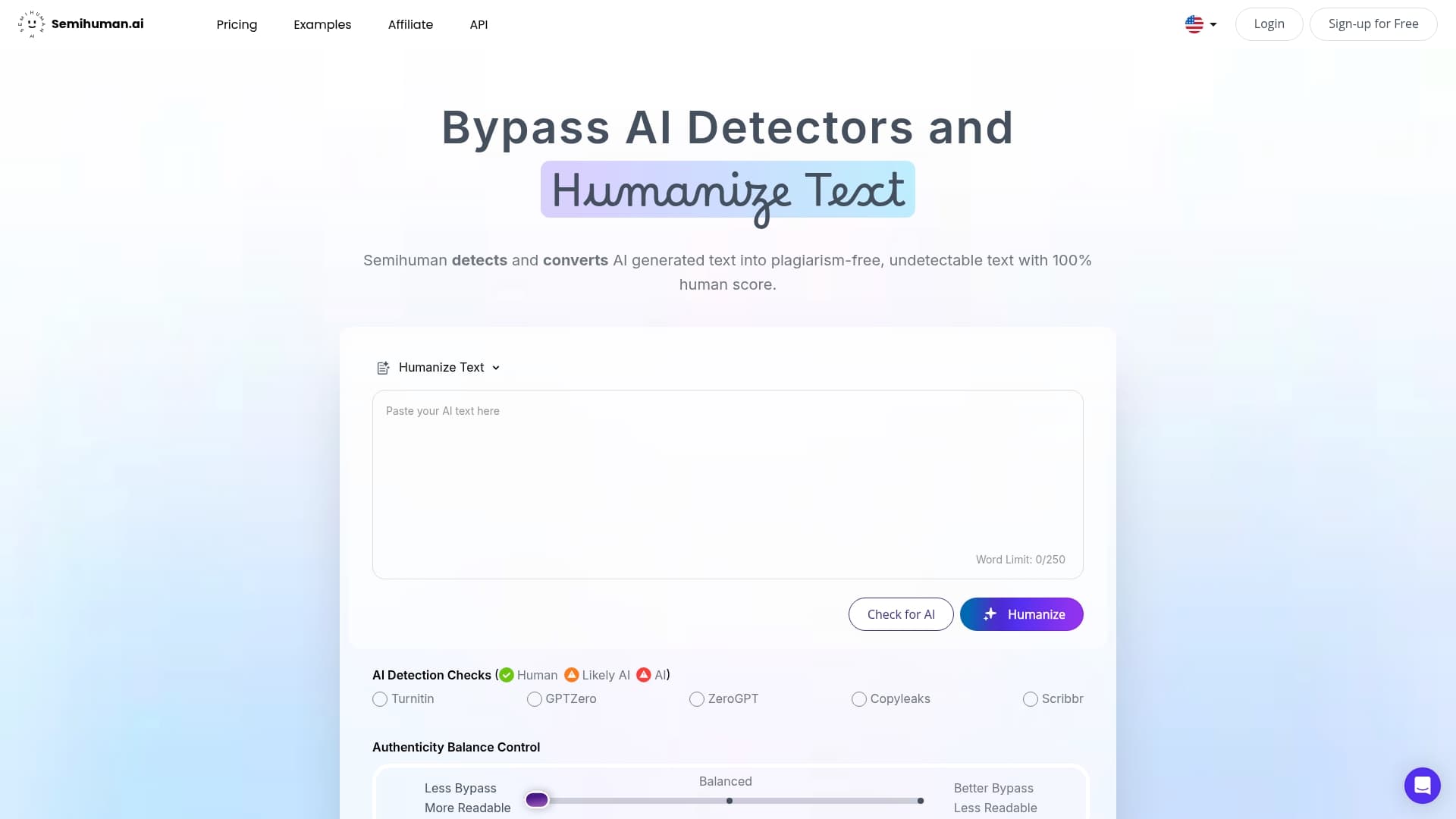
If you are drafting with AI and want the final text to read naturally while you keep the review, sourcing and disclosure under your control, start at semihuman.ai.
Most of the ethical trouble we see discussed around AI in academia comes down to one gap: people are told to be honest, but nobody gives them a dependable way to check their own work. Detectors disagree with each other, and the research says their scores should not stand alone as proof. That leaves honest writers exposed.
We built Semihuman for that gap. Our approach is to detect machine-sounding patterns and restructure the text so it reads naturally, while preserving what you meant to say and supporting your SEO goals. For teams, our API puts the same process inside the workflow they already use, so content is checked and refined before it is published or submitted.
The tool does not replace the habits that make work trustworthy: verify your sources, follow the disclosure rule that applies to you, and keep your drafts. Used alongside those habits, it helps your finished work look like what it should be, your own.
Tilen
Not by itself. Policies differ by institution, course and journal. Melbournes guidance, for example, treats AI use as acceptable when it supports the work without compromising integrity, confidentiality, accountability or originality, provided it is documented and disclosed. The line is crossed by presenting AI content as entirely your own where acknowledgment is required, or by fabricating data and references.
No. A review of 74 policy documents found broad agreement on this, and the ICMJE recommendations say chatbots cannot be authors because they cannot take responsibility for accuracy and originality. If AI helped with the writing, describe that in the acknowledgments or methods, as your venue directs.
Yes. Studies report false positives in genuine human writing, and in one controlled study of published abstracts, originals from 2023 to 2025 were flagged 9 to 15% of the time. Keep drafts, notes and sources so you can show how the work was made.
Only if your institution or publisher allows it. Research guidance warns against entering confidential or protected information into tools without proper safeguards, and privacy reviews or ethical approvals may apply. Check your data-handling rules before uploading anything sensitive.
Follow the instructors or institutions format. Princetons template, for instance, asks for the tool used, the purpose and the pages affected, and it treats disclosure as separate from citation. If no format is given, ask before you submit.
Start
Texte vermenschlichen
kostenlos!
Humanisieren