
Loading...

TL;DR:
- Maintaining brand voice with AI involves creating a detailed, machine-readable specification and embedding it as persistent system context. Regular human audits and updates ensure content remains on-brand and aligned with audience expectations. This structured approach prevents generic outputs and scales brand identity effectively across channels.
Brand voice maintenance with AI means codifying your brand's tone, vocabulary, and behavioral rules into machine-readable specifications that AI tools can execute consistently across every piece of content. Most marketers skip this step and wonder why their AI output sounds generic. The fix is not a better prompt. The fix is a documented voice system. These brand voice maintenance AI tips cover everything from building your first specification to auditing outputs monthly, so your AI-generated content sounds like you, not like everyone else.
Vague adjectives like "friendly" or "professional" fail in AI prompts. AI cannot act on abstract descriptions. Behavioral rules, banned words, and structural patterns give AI something concrete to execute.
Your specification needs four components:
This specification becomes the foundation for every AI interaction your team runs.
Pro Tip: Format your specification in markdown with clear headers and bullet points. AI tools parse structured text more reliably than prose paragraphs.

A specification tells AI what to do. A training set shows AI what success looks like. These two work together.
Short-form content requires 5–15 high-performing examples, while long-form training needs 15,000 or more words of exemplary brand content. That threshold matters because AI needs enough variation to recognize patterns, not just copy a single sample. After proper calibration, roughly 70% of AI drafts require only minimal editing. That is the payoff for doing the upfront work.
Your example library should include:
Scoring examples forces you to articulate what makes your brand voice work. That clarity transfers directly to better AI outputs.
Ad hoc prompts cause brand voice drift. Every time a team member starts a new chat session without loading the voice specification, the AI defaults to its generic training. The fix is embedding your specification as a persistent system prompt inside a dedicated AI environment.
Platforms like Custom GPT and Claude Projects allow you to set a system-level instruction that loads automatically in every session. Your voice specification lives there, not in individual prompts. This is the difference between a consistent content pipeline and a lottery.
A governed AI content pipeline with machine-readable voice specs and role-based prompt access typically takes 4–6 weeks to implement, with 15–25 annotated exemplar passages recommended. That timeline reflects real setup work. Budget for it.
Pro Tip: Create channel-specific configurations that reference your core voice DNA but adjust for format. Your LinkedIn system prompt differs from your email system prompt, even though both pull from the same brand voice specification.
Role-based access matters here. Not every team member should edit the master voice specification. Assign one or two people as voice owners. Everyone else uses the configuration without modifying it.
Human oversight is not optional. AI can follow your specification closely and still produce content that feels slightly off. A voice-only checklist catches those gaps before they reach your audience.
Checklists should contain 5–8 tone and vocabulary questions focused exclusively on voice, not grammar or factual accuracy. Those are separate reviews. Voice questions sound like: "Does this open with a direct claim?" "Does any sentence use passive voice?" "Are there any banned words present?" "Does the paragraph length match our structural fingerprint?"
The reviewer running the voice checklist should be a different person than the proofreader. Proofreaders look for errors. Voice reviewers look for alignment. Mixing the two tasks produces worse results on both.
Audits every 1–2 months keep your voice anchor library current. Audience language shifts. Your brand evolves. A specification written in january may feel stale by march. Schedule the refresh as a recurring calendar event, not a reaction to a problem.
Most organizations scale with AI before defining a distinct point of view. The result is generic content amplified at volume. More output does not fix a weak voice. It just makes the weakness louder.
The most effective ai branding strategies include a "what we refuse to say" list baked directly into the AI instructions. This is not a nice-to-have. It is the mechanism that prevents corporate speak from creeping into your content. If your brand never uses jargon, list the specific jargon terms. If your brand never makes vague promises, write an example of a vague promise and label it forbidden.
Distinctive voice comes from deliberate choices about what your brand refuses to say and do. "AI-powered" is not a positioning. Embedding those refusals directly into your AI instructions is what separates memorable brands from forgettable noise.
AI allows marketers to move from gut decisions to data-validated brand intuition, but only if the brand voice specification is treated as a living asset. Update it monthly based on audience sentiment, content performance data, and competitor shifts. A static PDF is not a brand voice system. It is a document that gets ignored.
Maintaining brand identity at scale also means building a brand online with deliberate choices about visual, verbal, and tonal consistency across every channel your AI touches.
Brand consistency directly supports business growth, and AI amplifies whatever voice you give it. If that voice is generic, AI scales generic. If that voice is specific and documented, AI scales your actual brand.
Tips for brand consistency with AI go beyond documentation. They require governance. Assign ownership. Set review cycles. Track which AI outputs required heavy editing and use those as new negative examples in your training set. Every edit you make is data. Capture it.
The brands that will win in an AI-saturated content environment are the ones that sound unmistakably like themselves. That does not happen by accident. It happens because someone documented exactly what "unmistakably us" means and embedded it into every AI tool the team uses.
Optimizing brand voice with AI is an ongoing process, not a one-time setup. Treat your voice specification the way a software team treats a codebase. Version it. Review it. Improve it.
Maintaining a consistent brand voice with AI requires a documented, machine-readable voice specification embedded as persistent system-level context, supported by human audits every 1–2 months.
| Point | Details |
|---|---|
| Document behavioral rules | Replace vague adjectives with banned words, intensity vocabulary, and structural fingerprints AI can execute. |
| Build a scored example library | Use 5–15 annotated examples for short-form content; include negative examples to prevent generic outputs. |
| Embed voice as system context | Load your specification into Custom GPT or Claude Projects so every session starts on-brand automatically. |
| Run voice-only checklists | Use 5–8 tone questions before publishing; keep this review separate from proofreading. |
| Audit and update monthly | Refresh your voice anchor library every 1–2 months based on audience sentiment and content performance. |
I have worked with content teams that spent weeks perfecting their AI prompts and still ended up with output that sounded like a press release from no one in particular. The problem was never the prompt. The problem was that no one had ever written down what the brand actually sounded like in operational terms.
The shift that changes everything is treating brand voice as infrastructure for AI writing, not as a creative brief. When you document behavioral rules and embed them at the system level, AI stops being a wildcard and starts being a reliable production tool. That is when content teams actually scale without losing their identity.
What I find most interesting is that the brands doing this well are not the ones with the biggest AI budgets. They are the ones with the clearest sense of what they refuse to say. That clarity is a competitive moat. AI cannot generate a distinct point of view. It can only amplify the one you give it. The teams that understand this early will produce content that is genuinely harder to replicate, because the voice itself becomes the differentiator.
The future of brand voice maintenance is not about controlling AI. It is about giving AI something worth repeating.
— Tilen
Keeping AI-generated content on-brand requires more than a good specification. It requires tools that work with your voice, not against it.
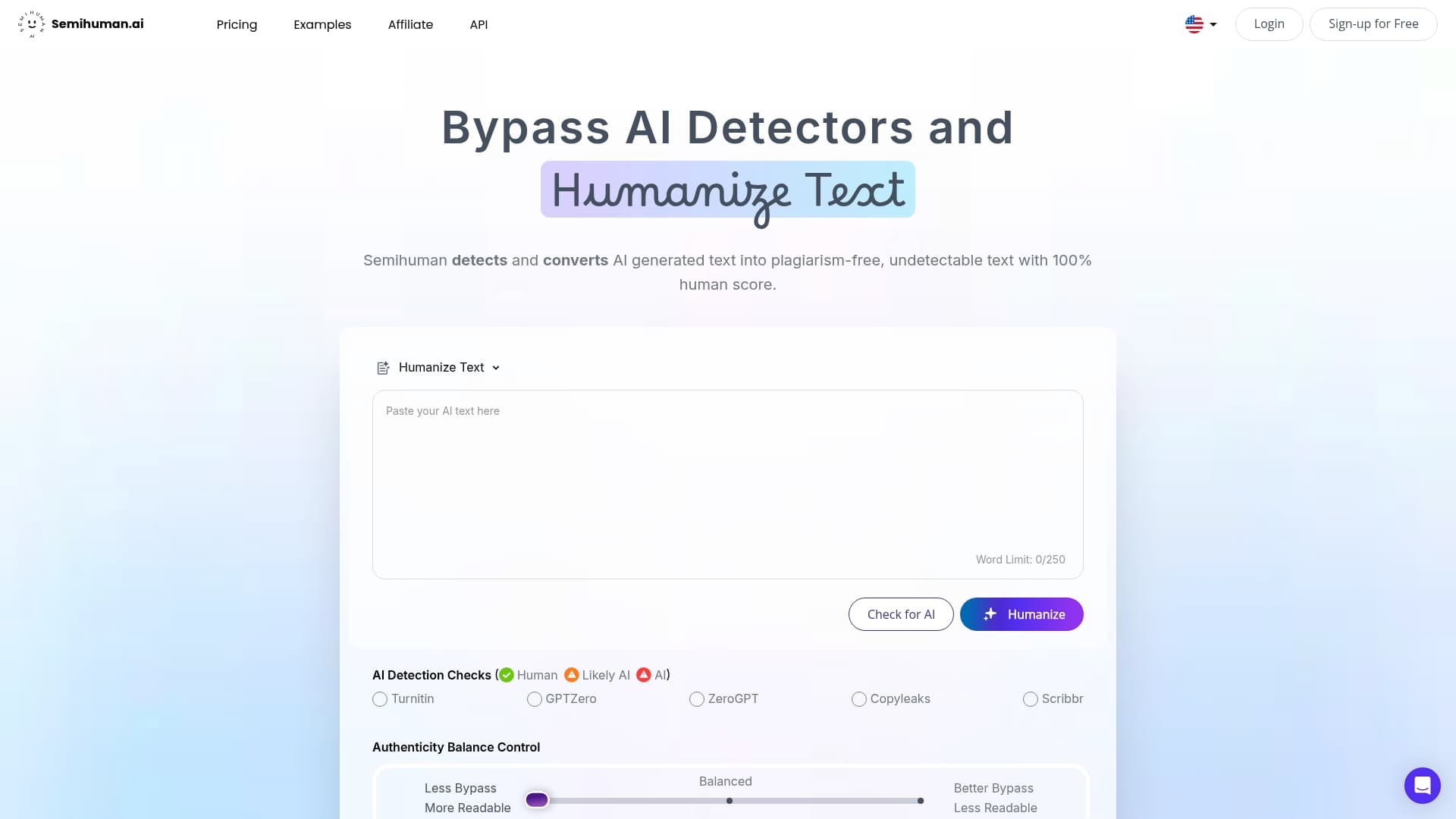
Semihuman's SEO Text Generator produces content that integrates your keywords while preserving the tone and structure your brand requires. The AI Proof Writing tool catches voice drift before it reaches your audience, functioning as a final alignment check on every piece. For content that needs reshaping without losing its core message, the AI Text Paraphraser restructures output while keeping your brand's phrasing intact. Semihuman is built for marketers who need authentic AI content that holds up under scrutiny and sounds like a real brand, not a machine.
A brand voice specification is a machine-readable document that defines your brand's tone rules, vocabulary preferences, banned words, and structural patterns. It replaces vague adjectives with behavioral instructions AI can execute consistently.
Short-form content requires 5–15 high-performing examples. Long-form training needs 15,000 or more words of annotated brand content to give AI enough variation to recognize and replicate your voice patterns.
Audits every 1–2 months keep your voice anchor library current. Audience language shifts over time, so a specification written in january can feel misaligned by march without regular updates.
Ad hoc prompts reset with every session and lack the depth to enforce voice consistency. Embedding your specification as a persistent system prompt inside platforms like Custom GPT or Claude Projects prevents this drift.
Add a "what we refuse to say" list to your AI instructions immediately. Negative examples and banned word lists reduce generic corporate tone faster than any other single change to your voice specification.



Start
Humanizing
for Free!
Humanize