
Loading...

Your personal brand is the clearest, fastest path to career opportunity when you define your purpose first, audit how others already perceive you, build a narrative from that data, then communicate it consistently. Start right now: rewrite your LinkedIn headline in the next 10 minutes to reflect what you want to be known for.
Your first 24 hours:
HBS frames personal branding as a strategic practice, not a content exercise. The sequence matters: strategy first, content second. Every section of this guide follows that order.
Building a personal brand works when you complete strategy before content: define your PVP, audit external perception, build a narrative, then communicate it consistently across one primary platform.
| Point | Details |
|---|---|
| Strategy before content | Define your PVP and run the external audit before publishing a single post. |
| External feedback is non-negotiable | The 25-person feedback loop gives you language and perception data you cannot generate alone. |
| One platform first | Master LinkedIn before expanding; focus where your audience already spends time. |
| Sustainable cadence | One flagship piece plus four repurposed posts per month is enough to build momentum. |
| Months, not weeks | Meaningful brand results require consistent activity over several months. |
Most people skip this step and go straight to posting on LinkedIn. That is the single most common reason personal brands feel hollow.
Start with three questions:
The overlap of those three answers is your Personal Value Proposition (PVP). Write it as one or two sentences: "I help [specific audience] achieve [specific outcome] by [your distinctive method or strength]." Keep it under 30 words. Vague language kills credibility before you even speak.
Three core brand descriptors (3–5 words each) support the PVP. Think of them as the adjectives a hiring manager or client should use when describing you to someone else. Examples: "clear communicator, systems thinker, growth-stage operator." These descriptors become the filter for every piece of content you publish and every profile you write.
Pro Tip: Avoid abstract virtues like "passionate" or "dedicated." Every candidate claims them. Instead, name the specific domain and the specific outcome: "turns messy data into board-ready strategy" beats "passionate about analytics" every time.
You cannot fix what you cannot see. A brand audit takes less than two hours and gives you the external perception data that self-reflection never will.
Quick audit checklist (15–30 minutes each):
Feedback loop (the longer task, 1–2 hours):
The 25-person feedback loop from Science of People is one of the most useful exercises in personal branding. Send a short anonymous survey to 25 people across three tiers: managers or senior colleagues, peers, and people you have mentored or led. Ask:
Collect the language people use, not just the sentiment. If five people independently call you "the person who makes complex things simple," that phrase belongs in your PVP.
Pro Tip: Read feedback for recurring language, not for the most flattering responses. One outlier calling you "visionary" means less than four people independently using the word "reliable." Signal is in the pattern.
Audit data gives you raw material. A narrative gives it shape.
Pull the two or three most consistent themes from your feedback. Those themes become the spine of your story. The structure is simple: where you started, what you learned, what you do now, and where you are headed. You do not need a dramatic origin story. You need a coherent through-line.
Build your elevator pitches in three lengths:
Practice each version out loud, not in your head. Record yourself once. The gap between how you think you sound and how you actually sound is usually where the pitch breaks down.
Tailor by audience:
Consistency is not about posting every day. It is about saying the same true thing in every context, from your LinkedIn headline to how you open a meeting.
Platform priority: Start with LinkedIn. For most professionals in the United States, it is where hiring managers, clients, and collaborators look first. Add a personal website as your second priority. Pick one additional social channel only after both are solid.
LinkedIn profile checklist:
Personal website: WordPress gives you the most control and scales well as your brand grows. Squarespace and Wix are faster to launch and require no technical knowledge. For visual design, Canva covers logos, social graphics, and presentation templates without a designer's budget. Pick one color palette, one or two fonts, and use them everywhere.
Embodying the brand offline: Your brand is also how you show up in a Monday morning meeting, how you write a follow-up email, and whether you deliver what you promise. Authenticity in branding is not a content strategy. It is the gap between what you say and what you do, and people notice that gap faster than any inconsistent logo.
Pro Tip: Write a one-paragraph "voice guide" for yourself: three adjectives that describe your tone, one sentence you would never write, and one sentence that sounds exactly like you. Use it every time you draft a bio, post, or email.
The U.S. Chamber of Commerce advises focusing on the primary platform where your audience spends time rather than spreading thin across every channel. That advice holds whether you are a consultant, a job seeker, or an executive building thought leadership.
One flagship piece per month plus four short repurposed posts is a content engine most professionals can maintain without burning out.
Monthly content flow:
| Week | Activity | Format | Time estimate |
|---|---|---|---|
| Week 1 | Write flagship piece (article, case study, or how-to) | LinkedIn article or blog post | 3–4 hours |
| Week 2 | Repurpose into two short posts (key insight + one takeaway each) | LinkedIn posts | 1 hour |
| Week 3 | Repurpose into a comment thread or short video script | Comment or short video | 1 hour |
| Week 4 | Repurpose into a newsletter section or slide carousel | Email or carousel | 1 hour |
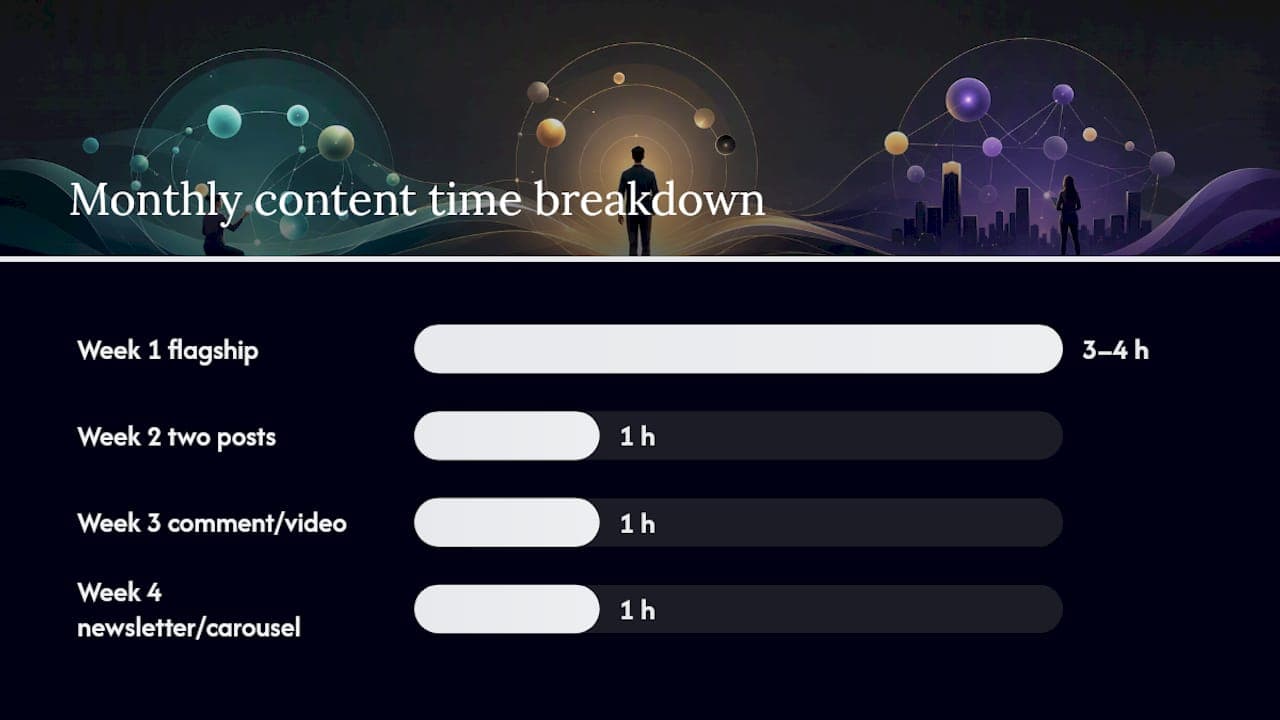
Total: roughly 6–7 hours per month. That is sustainable. Forty posts a month is not.
Content types that build career credibility fastest:
Northeastern's content strategy guidance recommends this flagship-plus-repurpose model specifically because it maximizes reach without requiring daily production. Batching content on one afternoon per week keeps quality higher than writing one post at a time under deadline pressure.
Content gets you visibility. Relationships get you opportunities. You need both.
Outreach templates that work:
Audience segmentation for networking:
Think in three tiers: gatekeepers (people who control access to opportunities), promoters (people who mention you unprompted), and peers (people who grow alongside you). Invest time in all three, but prioritize promoters. One person who mentions your name in a room you are not in is worth more than ten LinkedIn connections who never engage.

Growing reach without heavy promotion:
Comment substantively on posts by people in your target community before you publish your own content. Contribute to industry groups, Slack communities, or professional associations. Speak at local events or webinars. Each of these builds credibility faster than broadcasting your own content to a cold audience.
Shopify's guidance on personal branding is direct: meaningful results take months of consistent activity, not weeks. Set expectations accordingly.
90-day timeline:
| Phase | Weeks | Key activities |
|---|---|---|
| Foundation | 1–3 | PVP, audit, narrative, profile updates |
| Content build | 4–8 | First flagship pieces, repurposing flow, outreach begins |
| Network activation | 9–12 | Endorsements, community engagement, speaking or guest posts |
| Ongoing | Month 4+ | Monthly content cadence, quarterly brand review |
Estimated costs (DIY vs. supported):
Sample metrics to track:
Escalate to paid help when your time cost exceeds the dollar cost of outsourcing, or when you have a clear opportunity that requires faster execution than your current pace allows.
The most damaging mistake is starting with content before finishing strategy. Publishing 20 posts before you know your PVP produces incoherent messaging that confuses your audience and dilutes your signal. The YouRefactor breakdown of the HBS framework documents this pattern repeatedly: practitioners who skip the identity and audit phases waste months on content that does not convert attention into opportunity.
Red-flag checklist:
Forbes synthesizes expert advice that over-promotion is one of the most cited failure modes. Valerie Sokolosky frames it as self-sabotage: the moment your audience feels sold to rather than informed, trust erodes and engagement drops.
If you face a brand crisis (a negative post goes viral, a former employer leaves a damaging public comment, or a misquote circulates), respond once with a clear, factual correction. Do not delete and disappear. Silence reads as guilt. A calm, specific response followed by a return to consistent, high-quality content is the fastest recovery path.

Pro Tip: Before publishing any post that takes a strong position, ask: "Would I say this in a job interview?" If the answer is no, either soften the framing or save it for a context where the audience already trusts you.
The HBS 7-step framework is the most cited and most operationally sound structure available. It moves through: define identity, conduct external audit, build narrative, choose channels, create content, engage community, and evolve. The sequence is not arbitrary. Each step depends on the one before it.
The 5 C's checklist from Science of People gives you a quick weekly review:
Tool map by task:
That last point matters more than most guides acknowledge. AI writing tools speed up content production, but they produce a recognizable generic register that undercuts personal brand authenticity. Semihuman's text humanization tools restructure AI-generated drafts to match your voice and pass detection tools, so your content reads as genuinely yours. For writing for digital audiences, that distinction between generic AI output and voice-matched content is the difference between content that builds trust and content that reads like everyone else's.
Pro Tip: Use AI to draft, then rewrite the opening sentence and the closing sentence yourself. Those two positions carry the most voice signal, and human-written bookends make the whole piece feel authentic.
Weeks 1–2: Foundation
Weeks 3–4: Narrative and profiles
Weeks 5–8: Content build
Weeks 9–12: Network activation and measurement
Adapting for your goal:
Your personal brand only works if it is aimed at someone specific. "Everyone" is not an audience.
Start with the job title or role of the person whose opinion of you matters most for your next career move. Then layer in: what publications do they read, what events do they attend, what problems keep them up at night, and what language do they use to describe those problems? The answers shape every content decision you make.
For professionals targeting corporate hiring managers, LinkedIn is the primary channel and long-form articles outperform short posts for credibility. For consultants targeting small business owners, a combination of LinkedIn and a personal website with case studies tends to convert better. For creatives targeting agency clients, a portfolio site plus Instagram or Behance carries more weight than any written content.
Once you know your audience, content examples that boost brand visibility show how to match content format to audience behavior. The principle is simple: publish where your audience already spends time, in the format they already consume.
Negative content online falls into three categories: factually wrong, contextually misleading, or legitimately critical. Each requires a different response.
Factually wrong content: Contact the publisher directly with a correction request and documentation. If the content is on a platform you control (a comment on your post), respond once with the correct information, then stop engaging. Prolonged back-and-forth amplifies the original post.
Contextually misleading content: Add context publicly, once. A single clear statement that provides the missing information is more credible than a defensive thread.
Legitimately critical content: Acknowledge it, address the underlying concern if you can, and let your ongoing body of work provide the counter-evidence. One bad review or critical post rarely defines a brand. A pattern of them does.
For proactive reputation management, set up a Google Alert for your full name. Check it weekly. Address issues early, before they accumulate. If a crisis escalates beyond what you can manage alone, a PR consultant or online reputation management service is worth the cost. The longer negative content sits unaddressed, the more it shapes first impressions for people who find it through search.
Recruiters and hiring managers routinely search candidates before scheduling interviews. What they find either confirms their interest or creates doubt. A coherent personal brand removes that doubt before the first conversation happens.
Specifically, a well-built brand does three things in a job search. First, it makes you discoverable: a keyword-optimized LinkedIn profile and a personal website with relevant work samples increase the likelihood that recruiters find you through search rather than waiting for you to apply. Second, it provides social proof: recommendations, published content, and community engagement signal that other professionals already vouch for your expertise. Third, it gives you a ready-made narrative for interviews: your PVP becomes the answer to "Tell me about yourself," and your core descriptors become the thread that connects your experience to the role.
The practical implication: update your LinkedIn headline and About section before you apply anywhere. Hiring managers often look at your profile the moment they receive your application, not after the interview. A generic headline ("Marketing Manager at XYZ Corp") tells them nothing. A PVP-based headline ("Helping B2B SaaS companies turn content into pipeline") tells them exactly why they should read further.
Personal branding involves publishing content, using images, and sometimes referencing employers or clients. A few legal basics apply.
Copyright: Everything you write is yours the moment you write it, with no registration required. However, images, logos, and graphics you use in your content must be licensed for commercial use or created by you. Canva's free and paid libraries include commercially licensed assets. Stock photo sites like Unsplash and Pexels offer free commercial licenses. Using a random image from Google search is not legally safe.
Employer agreements: Many employment contracts include clauses about publishing content related to your employer's business, clients, or proprietary information. Review your agreement before publishing case studies, process breakdowns, or any content that references your employer's work. When in doubt, anonymize the client and the specific figures.
Testimonials and endorsements: The FTC requires disclosure when you receive compensation (including free products or services) for endorsing something. If a brand pays you or gives you something of value to mention them, disclose it clearly. "Paid partnership" or "#ad" satisfies the requirement.
Your name and likeness: You own your name and image. If someone uses your photo or name in a way that implies endorsement without your consent, that is a potential right-of-publicity claim. Document it and consult an attorney if the misuse is commercial.
This is general information, not legal advice. For contracts, IP disputes, or FTC compliance questions specific to your situation, consult a licensed attorney.
Most personal branding advice focuses on tactics: post more, optimize your headline, get more recommendations. Those things matter, but they are downstream of a decision most people avoid making: deciding what they actually want to be known for and committing to it publicly.
The Harvard framework's insistence on external validation before narrative construction is not academic caution. It is the most practical advice in the entire field. You cannot write a credible story about yourself using only your own perception of yourself. The feedback loop is not optional.
One principle worth holding onto: authenticity is not a content strategy. It is the alignment between what you claim and what you deliver. Mica Perez of the U.S. Chamber of Commerce puts it plainly: share true beliefs, focus on educational value, and earn trust over time rather than demanding it through promotion. That is the version of personal branding that compounds.



Start
Humanizing
for Free!
Humanize