
Loading...

The repeatable pipeline that works is generate, lock, humanize, detect, fact-check, publish. Draft with AI for speed, freeze your SEO skeleton before anything else touches the text, then humanize with prompt-level rules rather than a paraphraser, run at least two detectors as a signal rather than a verdict, fact-check every number and name, and put a named human's sign-off on it before it goes live. A platform like Semihuman.ai can run the humanize-and-detect stages for you, but the accountability step still needs a person.
TL;DR:
- Lock the SEO structure immediately after AI draft generation to prevent regressions during humanization and rewrites.
- Run at least two detector tools and verify all flagged content against primary sources before publishing.
- Use prompt-level rules to make AI writing less predictable by varying sentence length, using contractions, and avoiding common AI tell-tale words.
- Keep separate, backed-up versions of raw drafts, humanized versions, and final files to ensure traceability and facilitate audits.
- Automate routine pipeline steps with integrated tools like Semihuman.ai to save time on formatting and structural edits at high volume.
Most teams skip straight from "AI wrote it" to "publish it" and wonder why rankings drop or a detector flags the piece. The fix isn't more editing time. It's sequencing the right checks in the right order, so you catch problems when they're cheap to fix instead of after the piece is live.
Here's the six-step version that holds up under real deadlines:
Total time runs around an hour for a standard-length post, depending on how technical the subject is and how many rounds of detector flags you hit. That's slower than "generate and publish," but far faster than writing from scratch, and it's the version that survives an editor's second look.
Detectors don't read for meaning. They read for statistical patterns like perplexity and burstiness, essentially how predictable your word choices and sentence lengths are. Humans write unevenly. AI, left alone, writes with suspiciously consistent rhythm. Fixing that rhythm at the prompt level works better than fixing it after the fact, because prompt-level rules change the underlying structure rather than just swapping words, and that structural change is what actually moves detection scores.
A few rules do most of the work:
Here's a compact prompt template that bakes these rules in at generation time instead of fixing them afterward:
"Write in a conversational but authoritative tone. Vary sentence length aggressively, mix short punchy lines with longer ones. Use contractions. Do not use em dashes, en dashes, or the words 'moreover,' 'furthermore,' 'seamless,' or 'robust.' Do not open two paragraphs the same way."
Pro Tip: Save this template as a reusable snippet in whatever AI tool you draft with, so every new piece starts humanized instead of getting retrofitted later.
For existing drafts that already read stiffly, aggressive rewriting works, but it carries a tradeoff. The more you restructure a sentence, the more likely a number, name, or figure drifts. Never let a rewrite touch a statistic, a proper noun, or a direct quote without checking it against the original draft afterward.
A clean detector score means nothing if the content is wrong, unattributed, or quietly misleading. Editorial frameworks built around AI-assisted content call for a named reviewer, explicit disclosure, and a fact-check protocol precisely because detectors alone can't catch those problems.
The bylined responsibility test is simple: someone with a name attached has to be willing to stand behind every claim in the piece. If no one on your team can do that, the piece isn't ready, regardless of what a detector says.
Run these checks before anything goes live:
Detectors are diagnostic tools, not judges. A flagged paragraph tells you where to look again. It doesn't tell you the piece is unpublishable, and it definitely doesn't replace the fact-check step.
A manual, lock-first workflow works fine at low volume: you freeze the skeleton yourself, humanize by hand, and run detectors one at a time. At higher volume, that manual locking step becomes the bottleneck. Integrated platforms that preserve SEO structure automatically inside the humanization pass cut time-to-publish from the 15 to 30 minute range down to under 5 minutes per piece, because you're not manually re-checking headings and keyword placement after every rewrite.
Three integration points matter most:
Track these numbers at the 30 and 60-day marks: ranking movement on your target keywords, detector scores across two tools, average time spent per piece, and engagement metrics like time on page.
If you're publishing fewer than five pieces a week, manual edits with a lock-first checklist are enough. Past that volume, tool-based humanization with automatic skeleton preservation, and research-heavy workflows can cut prep time by roughly 60% when the tooling handles structure automatically, stops being optional.
Writer's block inside an AI-assisted workflow looks different than the blank-page kind. Usually the AI draft exists, but every attempt to humanize it feels forced, or the structure locked in step two doesn't actually fit the argument you're trying to make.
The fix is almost never "write harder." It's backing up one step. If the humanized version keeps sounding stilted, the problem is often the AI draft's underlying logic, not your prose. Regenerate the draft with a sharper prompt instead of manually forcing sentences to work.
If you're stuck on a specific section rather than the whole piece, skip it. Write the sections you do have a clear angle on, then come back. A half-finished middle section is far easier to write once the piece already has a beginning and an end pulling it into shape.
Talking through the argument out loud, even to no one, often unsticks a paragraph faster than staring at it. If you can explain the point in one spoken sentence, that sentence is usually your fix. Keep a running list of "structural fallback" moves: swap the order of two sections, cut the weakest example, or open with the counterargument instead of the claim. Having three pre-decided moves ready beats reinventing your process every time you stall, and it keeps the six-step pipeline moving instead of stalling out at step one.
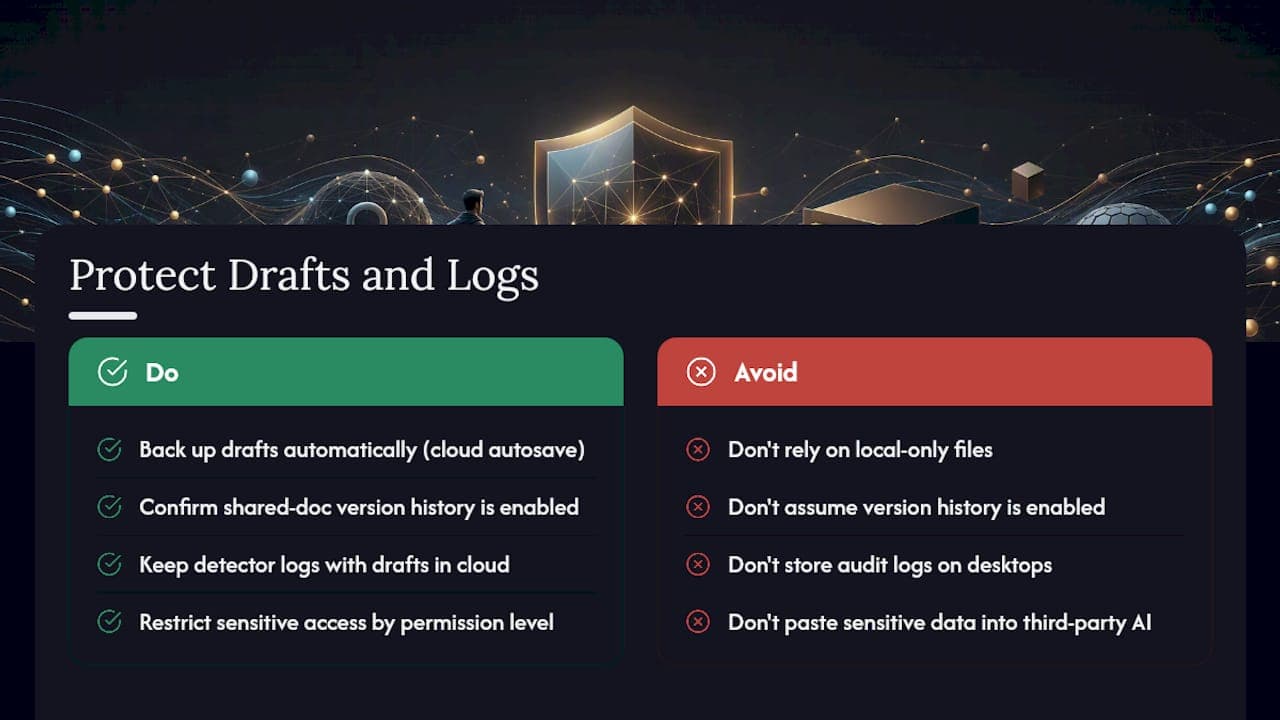
Everything in this workflow, from raw AI drafts to detector logs to fact-check notes, is working data you'll want to reference later, and losing it mid-project costs real time. Treat your drafts the way you'd treat any client deliverable: back them up automatically, not manually.
Cloud-based drafting tools that autosave and version automatically remove the single biggest risk, a local file that vanishes when a laptop dies. If your team works in shared documents, confirm version history is actually enabled, not just assumed. Most platforms keep it on by default, but a surprising number of teams find out it was disabled only after they needed it.
Detector logs and fact-check notes deserve the same treatment as the draft itself. If your audit trail lives in a spreadsheet, keep it in the same cloud environment as your drafts, not on someone's desktop. When a piece gets challenged months later, for accuracy or for AI-disclosure compliance, that log is your evidence the workflow was actually followed.
For anything involving client data, unpublished research, or embargoed information, restrict access by permission level rather than by password sharing. A workflow that's fast but leaks a client's unreleased numbers isn't actually a good workflow. Set a simple rule: nothing sensitive gets pasted into a third-party AI tool without checking that tool's data retention policy first.
A workflow only holds up across a team if everyone runs the same six steps in the same order. That means writing the process down, literally, in a shared document, rather than trusting that everyone remembers the version discussed in a meeting three weeks ago.
Assign clear ownership at each gate. One person locks the SEO skeleton before drafting starts. Another runs the detector checks. A third, ideally someone with subject knowledge, does the fact-check pass. Splitting these roles prevents the common failure mode where one overloaded editor tries to do all six steps alone and skips the ones that feel optional under deadline pressure.
Communicate status with something simpler than a meeting. A shared status column, "drafted," "skeleton locked," "humanized," "detector-checked," "fact-checked," "published," tells anyone on the team exactly where a piece stands without a Slack thread. When a piece gets stuck at "detector-checked" for three days, that's visible immediately instead of surfacing during a deadline scramble.
Disagreements about tone or claims should go through the named reviewer, not get resolved by whoever edits last. That's part of what the bylined responsibility test protects: one person's name is attached, so one person has final say, and everyone else knows who to flag concerns to before publishing rather than after.
Keep the raw AI-generated draft untouched somewhere before humanizing it. This sounds obvious, but teams routinely overwrite the original the moment they start editing, which means there's no baseline left to compare against when a detector flags something or a client asks what changed.
A simple three-file convention solves most of this: the raw draft, the humanized version, and the final published version, each saved separately rather than as edits layered on top of one file. Version history inside a shared document can substitute for this if it's reliable, but a distinct file for each stage is easier to reference months later.
Name files consistently: date, topic, and stage (0312_writing_workflow_v1_raw, _v2_humanized, _v3_final). It's unglamorous, but it means anyone on the team can find the right version in seconds instead of guessing which file is current.
Log detector scores and fact-check notes alongside the version they apply to, not in a separate untracked document. If a piece gets challenged later, you want to trace exactly which version cleared which check, and a mismatched log is worse than no log at all.
Time management inside this workflow isn't about writing faster. It's about not letting one step eat the budget meant for another. The generation step should take minutes, not an hour of prompt tinkering. If you're rewriting the AI prompt five times to get a usable draft, that's a signal the topic needs more upfront research, not more prompting.
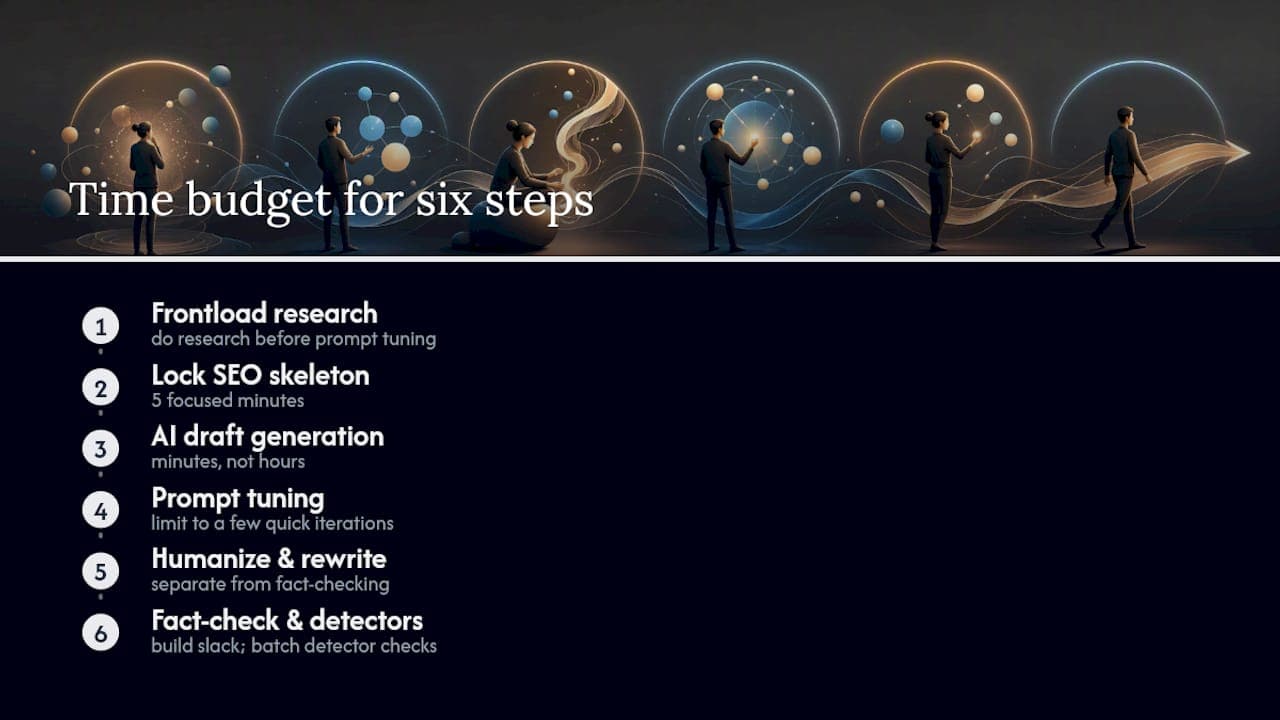
Block the six steps as separate calendar items rather than one long "writing time" slot. Locking the SEO skeleton takes five focused minutes and gets skipped constantly when it's folded into a vague hour of "writing," because it feels less urgent than the prose itself.
Batch similar steps across multiple pieces when you're producing at volume. Run detector checks on three drafts back to back instead of one at a time between other tasks. Context switching between "humanize" and "fact-check" mode costs more time than the tasks themselves.
Build in slack for the fact-check step specifically. It's the one that most often runs long, especially on technical topics, and it's also the step teams cut first under deadline pressure. That's backward. Skipping the fact-check step to save ten minutes is exactly how a wrong figure or misattributed quote ends up published under someone's byline.
I use this workflow because it saves time in exactly one place: the mechanical parts. Locking a skeleton, running a first humanization pass, flagging risky paragraphs. It does not save time on judgment, and pretending otherwise is where teams get burned.
The gate levels should differ by stakes. A quick internal blog post can tolerate a lighter fact-check pass and a single detector run. A piece making financial, medical, or legal claims needs the full sequence, two detectors, primary-source verification on every figure, and a named reviewer who actually understands the subject, not just someone rubber-stamping a draft.
What I'd push back on is the idea that a clean detector score means a piece is done. It means the piece is ready for a human to look at it seriously. Treat that distinction as the whole point of the workflow, not a footnote to it.
— Tilen
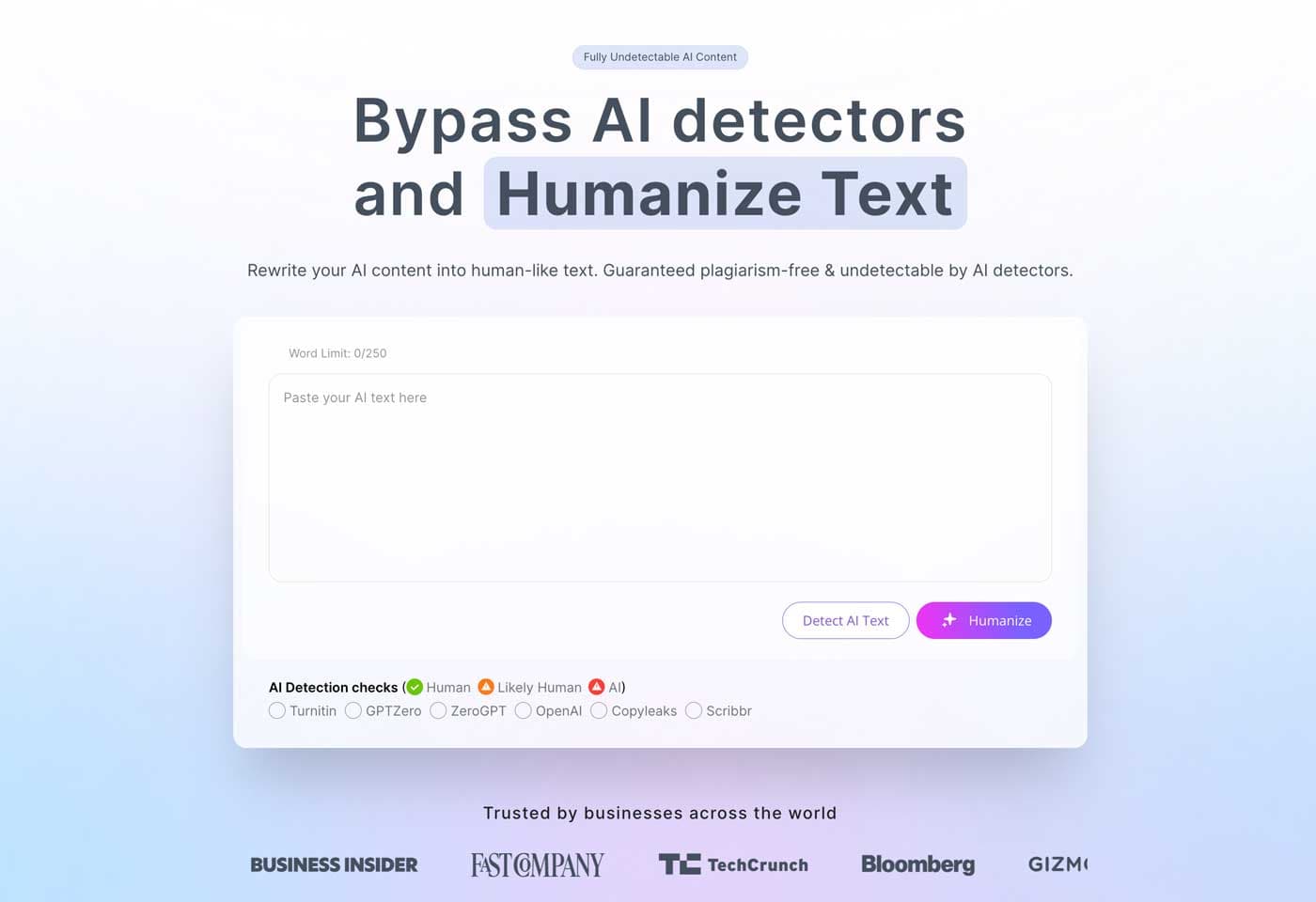
Semihuman.ai is built to run the mechanical middle of this pipeline so your team spends its time on judgment instead of formatting. It handles prompt-level humanization, structural rewriting that targets the actual signals detectors measure rather than swapping synonyms, and built-in checks against tools like Turnitin, GPTZero, and Copyleaks, all inside one pass instead of five separate tools.
For agencies producing at volume, or students who need academic compliance without spending an hour per assignment rewriting by hand, that consolidation matters more than any single feature. The API and CMS integration mean the SEO skeleton locking that usually eats five manual minutes per piece happens automatically, which is where the real time savings compound across dozens of posts a month.
If your current process still means bouncing between a humanizer, a detector, and a separate SEO checklist, Semihuman are worth testing on your next draft before you publish it.



Start
Humanizing
for Free!
Humanize