
Loading...

TL;DR:
- Using a human-directed, AI-assisted workflow ensures content authenticity by adding real evidence and editorial judgment. Automated tools have high bypass rates and cannot guarantee content integrity or compliance with Google's standards. Proper pre-publishing checks and a structured editorial pipeline improve quality, accountability, and search engine performance.
The single best practice for publishing AI-origin drafts is a human-directed, AI-assisted workflow: use AI to generate the scaffold, then add first-hand evidence, editorial judgment, and a final polish before anything goes live. Automated humanizer tools tested in 2026 show bypass rates of 58%–82%, which means no tool guarantees clean passage through Turnitin, GPTZero, or Copyleaks. Google's E-E-A-T framework penalizes anonymous, low-substance text regardless of how it was produced. Run the checklist below, then follow the workflow.
Before you open a detector, fix the draft itself. These eight steps cover the highest-impact moves.
Pre-publish checklist (tick each before submitting):
Quick yes/no pre-publish gate:
Pro Tip: Use an automated humanizer like Semihuman as a final statistical scrub after your human edits are done. It handles surface-level signal patterns. It cannot add the specific detail, the real example, or the editorial judgment that actually makes content rank.
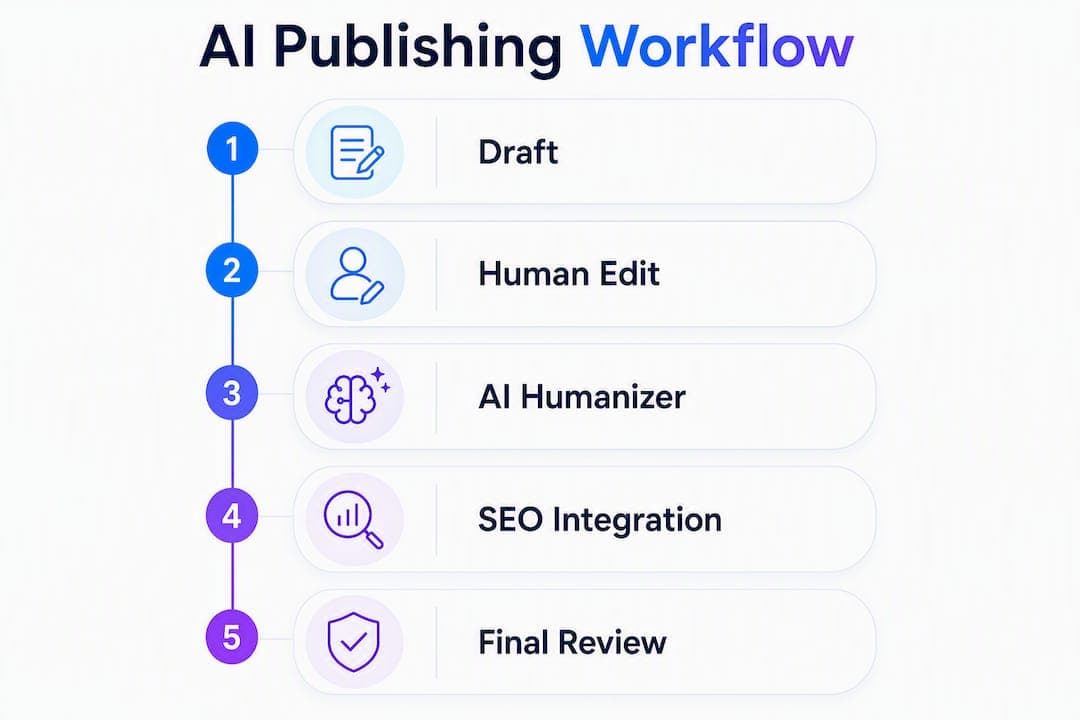
Follow this pipeline from brief to publish. Each step has a clear owner and a pass/fail gate.
Brief and planning. Define the topic, target keyword, audience, and required first-hand evidence. Identify at least one original data point or observation you can include. Gate: brief approved by editor.
Prompt design. Write a generation prompt that bakes in structural rules: sentence-length variation, banned phrases, contraction use, and a required evidence placeholder. Prompt-level rules reduce detection rates more reliably than post-hoc paraphrasing, because they shape the statistical fingerprint at generation rather than trying to sand it off afterward.
Draft generation. Generate the scaffold. Treat the output as a first draft, not a finished article.
Research and sourcing (RAG pass). Use a retrieval tool or manual search to pull primary sources, statistics, and quotes. Replace any AI-generated figures you cannot verify.
Substantive human edit. This is the most important step. Add first-hand evidence, rewrite thin sections, cut repeated phrases, and inject your editorial voice. Industry guidance requires one verifiable first-hand evidence item per section for content that earns genuine rank.
Line edit. Vary sentence rhythm, swap generic nouns for concrete ones, remove AI-marker connectives, and add contractions where natural.
Automated QA pass. Run Semihuman for a final humanizer scrub, then run GPTZero and Copyleaks as signal checks. Log the scores.
Human verification gate. Check every number, name, date, and citation. Rewriting tools introduce factual inaccuracies in approximately 12% of cases on technical content, so this step is non-optional after any automated pass.
Publish. Add byline, Person schema, metadata, and internal links. Confirm canonical URL.
Before/after example:
AI draft: "Furthermore, it is important to note that content marketing has numerous benefits for businesses of all sizes."

After substantive edit: "Content marketing drives compounding organic traffic. A blog post that ranks in month three can still pull readers in month thirty-six, which paid ads never do."
Pro Tip: Write your generation prompt the way a copy editor would brief a junior writer: specify tone, banned phrases, required evidence, and sentence-length rules. You will spend less time on the line edit.
AI text has measurable statistical patterns: low perplexity (predictable word choices), low burstiness (uniform sentence lengths), and heavy reliance on discourse markers. Fix those three things and the prose changes character.
Core micro-edits:
Before/after examples:
Before: "Additionally, there are various methods that can be utilized to improve content quality." After: "Three edits do most of the work: cut the discourse markers, vary the sentence lengths, and replace one generic noun per paragraph with something specific."
Before: "Furthermore, it is important to ensure that all facts are verified prior to publication." After: "Verify every number before you publish. One wrong statistic in a bylined article costs more credibility than the whole piece earns."
Pro Tip: Read the draft aloud. Your ear catches uniform rhythm faster than your eye does. If you find yourself breathing at the same intervals, the sentences are too similar in length.
Keywords and metadata are where many editors accidentally reintroduce AI patterns. The fix is to treat SEO as a structural layer, not a word-replacement exercise.
On-page SEO checklist:
Paraphrasing alone fails the helpful content test because it does not add information gain. Keywords placed inside original, specific sentences rank better than the same keywords dropped into generic prose.
| SEO Element | Requirement | Tool |
|---|---|---|
| Title tag | 50–60 characters, primary keyword | Yoast SEO, Rank Math |
| Meta description | 150–160 characters, benefit-led | Yoast SEO, Rank Math |
| H1 | One per page, keyword-natural | CMS heading field |
| Person schema | Author name, title, URL | Schema markup plugin |
| Alt text | Descriptive, under 125 characters | CMS media library |
| Internal links | Minimum two per article | Manual or CMS plugin |
Pro Tip: Run a Flesch-Kincaid readability check in Hemingway Editor after your SEO pass. If the grade level jumped more than two points, the keyword integration made the prose stiffer. Rewrite those sentences.
Detectors are a signal check, not a verdict. Use them to identify sections that still read as statistically AI-like, then edit those sections. Do not treat a passing score as proof of quality.
Testing methodology:
2026 bypass rates: 58%–82%. Automated humanizer tools tested in 2026 show bypass rates in the 58%–82% range, meaning a meaningful share of automated passes still fail detection checks. Human editing closes that gap more reliably than any tool.
| Detector | Primary signal | Best use |
|---|---|---|
| GPTZero | Perplexity and burstiness | General content check |
| Turnitin | Originality and AI probability | Academic and formal publishing |
| Copyleaks | Plagiarism and AI origin | Multi-source content |
The 12% factual-error rate introduced by automated rewriting tools means every automated pass needs a human verification step afterward. Check every number, every name, and every citation.
Pro Tip: If a section scores high for AI probability after your human edit, that section probably lacks a concrete, specific detail. Add one real example or one verified data point. The score usually drops.
| Stage | Typical duration (800-word article) |
|---|---|
| Brief and planning | 15–20 minutes |
| Prompt design and draft generation | 10–15 minutes |
| Substantive human edit | 20–45 minutes |
| Line edit | 15–20 minutes |
| QA and detection check | 10–15 minutes |
| Metadata and publish | 10–15 minutes |
| Total | 20–45 minutes |
Manual humanization of a 1,000-word article takes 20–45 minutes for an experienced editor; automated passes take minutes but require verification time on top.
Cost heuristics:
The tradeoff is straightforward. Automation saves time on the statistical scrub. Human editing is where the information gain happens, and information gain is what determines whether the piece ranks.
Pro Tip: Budget the substantive edit as a fixed cost per piece, not a variable one. Cutting it to save time is where quality debt accumulates fastest.
Example 1: Adding first-hand evidence
Before: "Content marketing is an effective strategy for driving organic traffic and building brand awareness over time."
After: "A product review we published in March held the featured snippet for its target keyword for eleven months without a single update. That kind of compounding return is what separates content from paid traffic."
Editor note: The original sentence is true but generic. Any AI model could write it. The revision adds a specific, verifiable detail that only someone with real publishing experience could include. That specificity is what creates information gain.
Example 2: Removing AI-marker phrases and varying burstiness
Before: "Furthermore, it is important to note that sentence variety is a key component of human-sounding prose. Additionally, writers should consider varying their paragraph lengths as well."
After: "Sentence variety is the fastest fix. Short sentences punch. Longer ones give you room to build a point, add a qualifier, or land on a specific detail that earns the reader's trust."
Editor note: Removed "Furthermore," "it is important to note," and "Additionally." Replaced uniform sentence length with deliberate variation. The revised version reads faster and sounds like a person.
Pro Tip: Keep a "banned phrases" list in your style guide. Add to it every time you catch a new AI-marker pattern in your drafts. After three months, the list becomes a training document for new editors.
Semihuman handles the parts of this process that are genuinely mechanical: restructuring text to break statistical AI patterns, integrating keywords without disrupting sentence flow, and running a humanizer pass that reduces detector flags before final review.
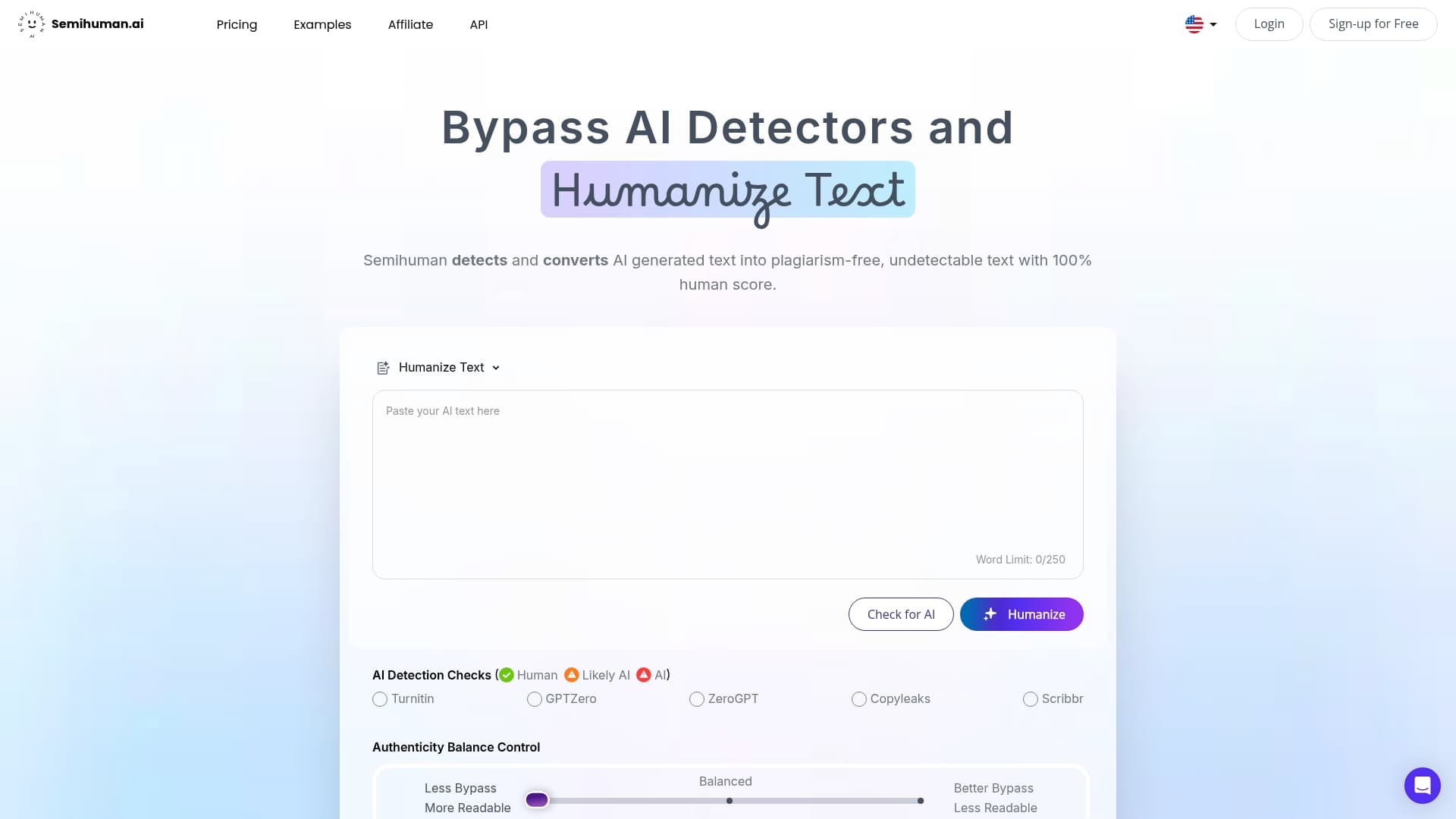
The platform's core features map directly to the workflow above. The text restructuring engine addresses perplexity and burstiness at the structural level. The keyword integration tool places terms inside natural sentence constructions rather than forcing exact-match phrases. The AI detection bypass pass works best as a final scrub after your human edits are complete, not as a substitute for them. An API is available for teams integrating humanization into a CMS pipeline.
Use Semihuman after the substantive human edit, not before. The platform cannot add first-hand evidence, verify facts, or make editorial judgments. Those steps stay with the human editor. What Semihuman does is reduce the time spent on the statistical layer so editors can spend more time on the substance layer.
To get started, paste your edited draft into Semihuman, run the humanizer pass, verify the output against your original facts, and then publish with your byline and Person schema in place.
A human-directed, AI-assisted workflow is the only approach that satisfies both AI detectors and Google's E-E-A-T requirements: AI handles the scaffold, humans add the evidence and judgment.
| Point | Details |
|---|---|
| Human edit is non-negotiable | Add one piece of first-hand evidence per section; paraphrasing alone fails the helpful content test. |
| Remove AI-marker phrases | Cut "Furthermore," "Additionally," and "In conclusion" from every draft before publishing. |
| Detectors are signal checks | 2026 bypass rates run 58%–82%; treat scores as editing guidance, not a publication gate. |
| Budget realistic time | A 1,000-word article takes 20–45 minutes for manual humanization by an experienced editor; automated passes are faster but require verification time after the tool pass. |
| Semihuman as final scrub | Use Semihuman after human edits to handle statistical patterns; verify all facts after any automated pass. |
The conventional advice is to run an AI draft through a humanizer, check the detector score, and publish. That pipeline skips the one step that actually determines whether content ranks and earns trust: adding something a real person knows.
Anonymous text at volume is the most consistent trait of demoted, AI-heavy sites. A byline and Person schema are not optional extras. They are the minimum signal that a real person is accountable for what is published. Teams that skip author attribution because "it's just a blog post" are the same teams that wonder why their traffic dropped after a core update.
The deeper issue is that balancing automation with genuine editorial judgment is a governance question, not a tooling question. Which editor owns the substantive edit? Who verifies the facts? What is the cadence for auditing published content? Those decisions determine quality over time. No humanizer tool answers them.
Treat AI as a fast first-draft machine and a statistical scrub tool. Treat your editors as the people who make the content worth reading. That division of labor is what the 2026 professional consensus actually recommends, and it is the only approach that holds up when detection methods improve.
The sources and tools below back the claims in this article and give you a starting point for building your own editorial standards.
Research and guidance:
Recommended tools by workflow stage:
| Stage | Tool | Purpose |
|---|---|---|
| Draft generation | Any major LLM | Scaffold and first draft |
| Research and sourcing | Perplexity, manual search | RAG pass and fact verification |
| Humanizer scrub | Semihuman | Statistical pattern reduction |
| Detection check | GPTZero, Copyleaks, Turnitin | Signal check (not a gate) |
| Grammar and style | Grammarly, Hemingway Editor | Line edit and readability |
| SEO metadata | Yoast SEO, Rank Math | Title, meta, schema |
| Plagiarism | Copyscape | Originality check |
On first-hand evidence: every section of a published article should contain at least one detail that only a person with real experience or access could provide. Document that evidence in a shared editorial log: the source, the date you verified it, and the editor who added it. That log becomes your audit trail if a piece is ever challenged.



Start
Humanizing
for Free!
Humanize