
Loading...

Effective storytelling comes down to a few repeatable moves. Open with a hook. Ground the reader in a specific time, place and person. Introduce a problem that matters. Build tension toward a payoff. Use concrete detail so people can picture what you describe. The rest of this guide shows how each move works, when to use it, and how to adapt it for blog posts, marketing, journalism and drafts that began with AI.
A story is a chain of cause and effect with people inside it. That is why it is easier to follow and remember than a list of claims. According to the Association for Psychological Science, stories engage audiences through transportation and identification with characters, and their causal sequences help people encode and understand information. Readers also relate the story to their own lives, which is where a message starts to feel personal.
Two practical consequences follow. First, a story needs a character the audience can care about, even if that character is a customer, a patient or you. Second, the sequence matters: events must lead to each other, not just sit side by side.
A third point is easy to miss. A Stanford Graduate School of Business piece quotes Paula Moya on how what makes a story good is shaped by culture and education. A joke, a metaphor or a hero that lands with one group can fall flat with another. Before you pick a technique, decide who is listening.
The first lines decide whether anyone reaches the second paragraph. BBC Bitesize suggests opening with a plot hook, such as giving away the ending, starting in the middle of the action, or asking a question. Each one creates a gap the reader wants closed.
Here is how the three look on the same story, a small bakery that nearly closed:
Pick the one that fits the audience and the channel. A reveal works well for case studies. Mid-action suits social posts and talks. A question works for short intros, but only when the answer is not obvious.
A short, true moment from your own life is one of the most reliable hooks, because it is specific and no one else has it. Keep it brief, tie it to the point of the piece within a few lines, and drop it if it does not serve the audience. A story about you that never connects to the reader's problem is a detour.
The classic skeleton is simple. BBC Bitesize describes it as a hook, then the time, place and situation, then an inciting problem, rising action, a climax, and a conclusion that ties up loose ends or leaves a lingering question.
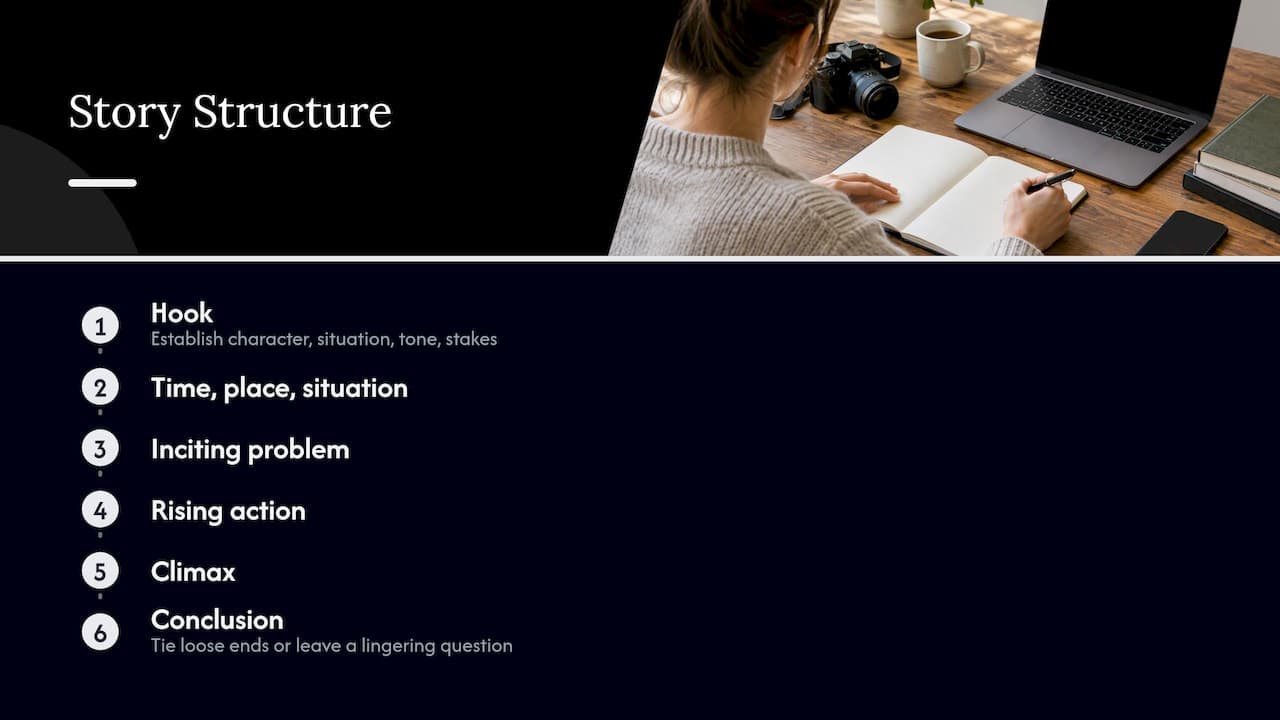
Writer's Digest contributor James Scott Bell adds a useful note: the beginning and ending need to be strong, and the middle has to keep earning attention. He recommends that the opening establish character, situation, tone and stakes before a "doorway of no return" commits the protagonist to solving the main problem.
Different formats call for different shapes. A guide from Ingo Studio pairs them like this: the Hero's Journey for big transformations, the Three-Act Structure for drama, Save the Cat for screenwriting, and the Inverted Pyramid for journalism and web content.
| Structure | Best for | How it works |
|---|---|---|
| Three-act | Talks, videos, case studies | Setup, confrontation, resolution |
| Hero's Journey | Brand origin stories, transformation stories | A character leaves the familiar, faces trials, returns changed |
| Inverted pyramid | News, explainers, web content | Most important facts first, details after |
| Fichtean curve | Short, fast stories | Start near the crisis and escalate |
The last row deserves a closer look. Dabble's explanation of the Fichtean curve says to reach the inciting incident quickly, escalate through increasingly hard obstacles with rising stakes, concentrate tension in a climax and then use falling action to resolve the questions. It is a good fit for a blog post or a pitch, where you cannot afford a slow warm-up.
SAPIENS, a public-writing training resource, stresses that structure is not a rigid formula. The framework works because it follows what readers need intellectually and emotionally, and it leaves room for creative choices. If a beat does not help your reader, cut it.
Telling says "the customer was frustrated." Showing gives you the customer pressing the refund button for the fourth time while the page spins. The second version lets readers draw their own conclusion, and that is where the feeling comes from.
The Association for Psychological Science lists showing rather than telling and making stories concrete with vivid detail among the core narrative techniques, because those details help transport people into the story world.
Three habits make this easy to apply.
Tension is the engine of attention. A 2022 research summary describes how organizing a story around suspense, surprise or curiosity induces narrative tension, with curiosity helping trigger and organize the other two. In plain terms: make the reader want to know what happens, hold the answer for a beat, and then deliver it.
Pacing is how you manage that wait. Slow down at moments that matter, with more detail and shorter sentences. Speed up through the connective tissue. Ingo Studio also highlights the Rule of Three, which gives rhythm, emphasis and memorability: three examples, three beats, three short sentences. It works because it feels complete without dragging.
A quick test: read your draft aloud. Wherever you rush or lose interest, the pacing is off.
Tension without payoff feels like a trick. Robert McKee argues that a writer should shape events to express an individual vision while also satisfying the audience's desire for meaningful progression and payoff, as quoted in his book Story. If you raise a question in the opening, answer it by the end, even if the answer is "it's complicated."
Searchers often ask about the 5 C's, 4 P's or 5 P's of storytelling. There is no single official list. Different teachers publish different versions. One common set of C's runs Characters, Conflict, Context, Cause and Consequence. Another runs Character, Context, Conflict, Climax and Closure. The P's vary even more.
Treat them as memory aids. They all point at the same few ideas covered above: who the story is about, where and when it happens, what gets in the way, how it builds, and how it ends. Use whichever list helps you remember, and do not worry about which one is "correct."
The techniques stay the same. The packaging changes.
SAPIENS recommends six elements for articles in English-language popular media: an intriguing lead, a nut paragraph, background and context, details, counterpoints or challenges, and a conclusion. The lead captures attention. The nut paragraph says what the story is about and why it matters. The details support the central issue with anecdotes and evidence. The counterpoints acknowledge complexity. The conclusion leaves a memorable takeaway.
That structure also works well for thought-leadership posts and white papers, where credibility depends on admitting what does not fit.
Online, the story has to survive scanning, search and social feeds. A European journalism training manual on digital storytelling says to consider users' needs, choose a suitable format and channel, and craft content for search engines and social media. In practice: put the hook in the headline and first screen, use subheads that carry the arc on their own, and add visuals where they carry meaning. If you want to see how narrative and search performance connect, this piece on storytelling's impact on engagement and SEO is a good next read. Our own notes on how visuals in blog posts boost engagement cover the visual side.
A related point for online nonfiction: a Routledge book on writing online and audio stories describes combining techniques from short stories and screenwriting with journalistic practices like fact checking and verification. A vivid story you cannot verify is a liability.
In marketing, the customer is the hero and your product is the guide, not the other way round. Show the before, the obstacle, the turning point and the result, with real details from real customers. If you also use formulas for short copy, our overview of copywriting formulas and authenticity explains how to keep them from sounding canned. For newsletters, where a story has to work in a few paragraphs, see AI content for newsletters.
Skill comes from repetition with feedback. A University of Colorado exercise packet suggests practicing by telling personal stories, recalling childhood stories and working through exercises about meaningful experiences, passions and ideas, while keeping each story concise, specific and shaped with a beginning, middle and end.
A simple weekly routine:
After a month you will have a bank of small stories you can drop into articles, talks and emails.
We build tools for people who write with AI, so we see the same pattern constantly. A model produces a clean, competent structure, and then the draft reads like everyone else's. The skeleton is fine. What is missing is the gleaming detail, the specific number, the opinion, the moment only you witnessed.
Our view is that AI is a good drafting partner and a poor narrator of your life. Use it to get a first outline, to try alternate hooks, or to tighten a messy paragraph. Then put the human parts back in: your experience, your examples, your point of view. Rewriting for rhythm and natural phrasing matters too, and we have written about it in humanizing AI-generated text and examples of humanized text.
A story that readers trust is one they can believe. That means real details, honest framing, and facts that hold up. For more on that, see our piece on content authenticity for marketers.
— Tilen
Authenticity is a craft question and an ethics question. Journalism guidance from Technical.ly recommends that storytellers using AI disclose their process, defer to humans when in doubt, and have at least two people review AI work before publication.
The risks are concrete. The BBC/EBU News Integrity in AI Assistants Toolkit lists failure modes including fabricated quotes, lack of context, failure to signpost opinion versus fact, and inappropriate use of partisan sources. The same toolkit reports that 45% of AI responses it examined had significant issues, so treat every AI-written anecdote, statistic or quote as unverified until you have checked it.
A short checklist before you publish:
That last point matters most for students and academics. Policies differ by institution, so follow your own rules and disclose AI use where they require it.
If you draft with AI and want the result to read like you wrote it, Semihuman can help with the rewriting step: restructuring text for natural readability, working in your keywords, and offering an API for teams that want it inside their workflow. You can start on the Free, Basic and Pro plans, or look at the Developer, Business and Enterprise options if you need API access. Run your draft through it, then add your own details and review it as described above. The tool handles the polish. The story is still yours to supply.
Here is a before and after, using the techniques above.
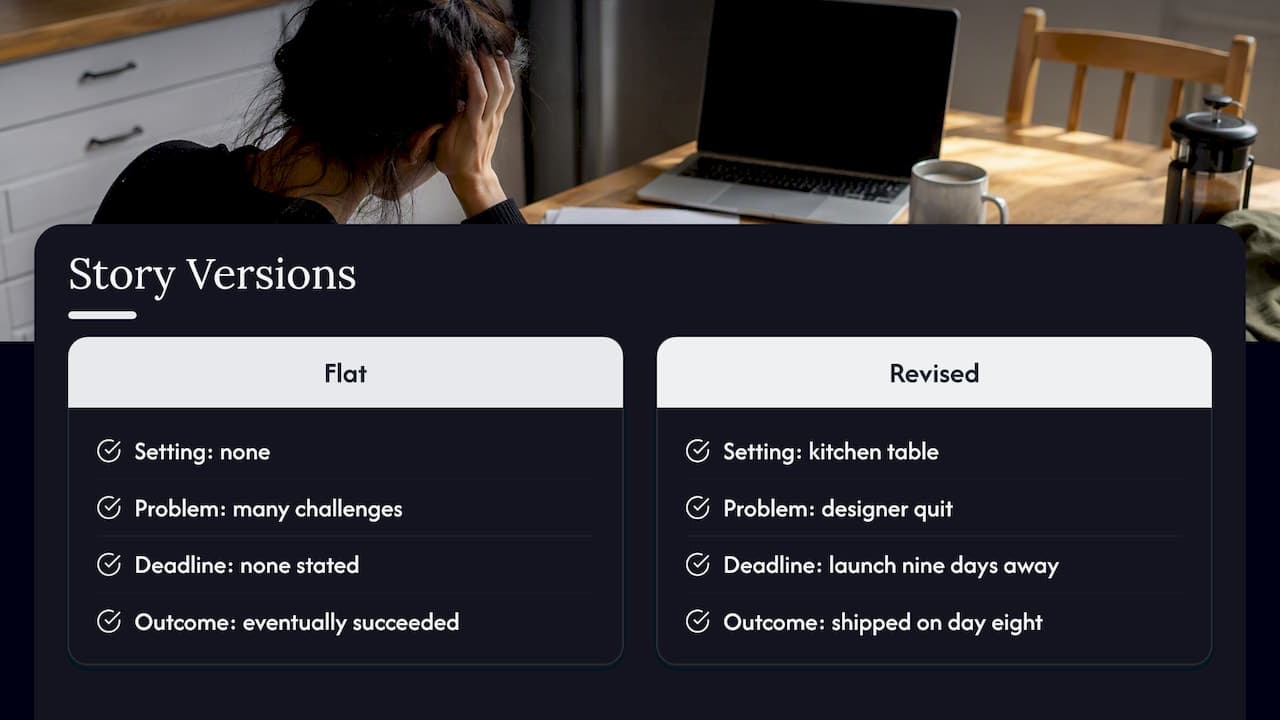
Flat version: "Our company faced many challenges when we started. We worked hard and eventually succeeded, and now we help customers achieve their goals."
There is no person, no place, no problem and no detail. It could describe any business.
Revised version: "In March, our only designer quit, and a client's launch was nine days away. I spent a weekend at my kitchen table rebuilding the landing page with a template and a lot of coffee. It shipped on day eight. The client never knew, but I learned we needed a backup plan."
What changed? The hook starts in the middle of a problem. The setting is specific, the stakes are clear, and the number gives it texture. There is a small payoff and a takeaway. The revised version is also only a few sentences longer.
To apply the same edit to your own work, mark every sentence that could appear in a competitor's copy unchanged. Replace each with a detail only you could write.
The ones that appear in almost every credible guide are a strong hook, a clear structure with rising tension, concrete sensory detail, and a payoff that answers the question you raised. Showing rather than telling and the Rule of Three add immersion and rhythm. Start with those before you try anything more elaborate.
There is no official list, and teachers publish different versions. Common ones include characters, conflict, context, cause and consequence, or character, context, conflict, climax and closure. They are memory aids for the same basics: who, where, what goes wrong, how it builds and how it ends.
Use one specific, ordinary detail that captures the whole moment, keep the cause-and-effect chain clear, and end with a takeaway the audience can repeat. Stories are easier to remember when readers can picture them and relate them to their own lives.
Yes, as a drafting and editing aid, as long as the experiences and facts are yours and verified. Disclose your process where it matters, have a second person review the draft, and never publish an AI-generated quote or statistic without checking the source.



Start
Humanizing
for Free!
Humanize