
Loading...

AI can make your writing more creative, but only if you treat its output as raw material instead of a finished draft. Controlled experiments show that AI ideas raise the novelty of individual stories, while the same tools push many writers toward similar text. The writers who gain are the ones who rewrite, restructure and add their own judgment. That is the job we built Semihuman for: turning AI-generated text into writing that reads as naturally human, with a structure and rhythm that feel authored.
The most useful finding for working writers is a two-sided one. A 2025 meta-analysis of 28 studies, covering 8,214 participants, found that people working with generative AI outperformed unaided humans on creative tasks (Hedges' g = 0.27) but produced less diverse ideas (g = −0.86). In plain terms: a small gain in quality, a large loss in variety. (Hedges' g is a standard measure of how big the difference between two groups is. Around 0.2 is small, and 0.8 is large.)
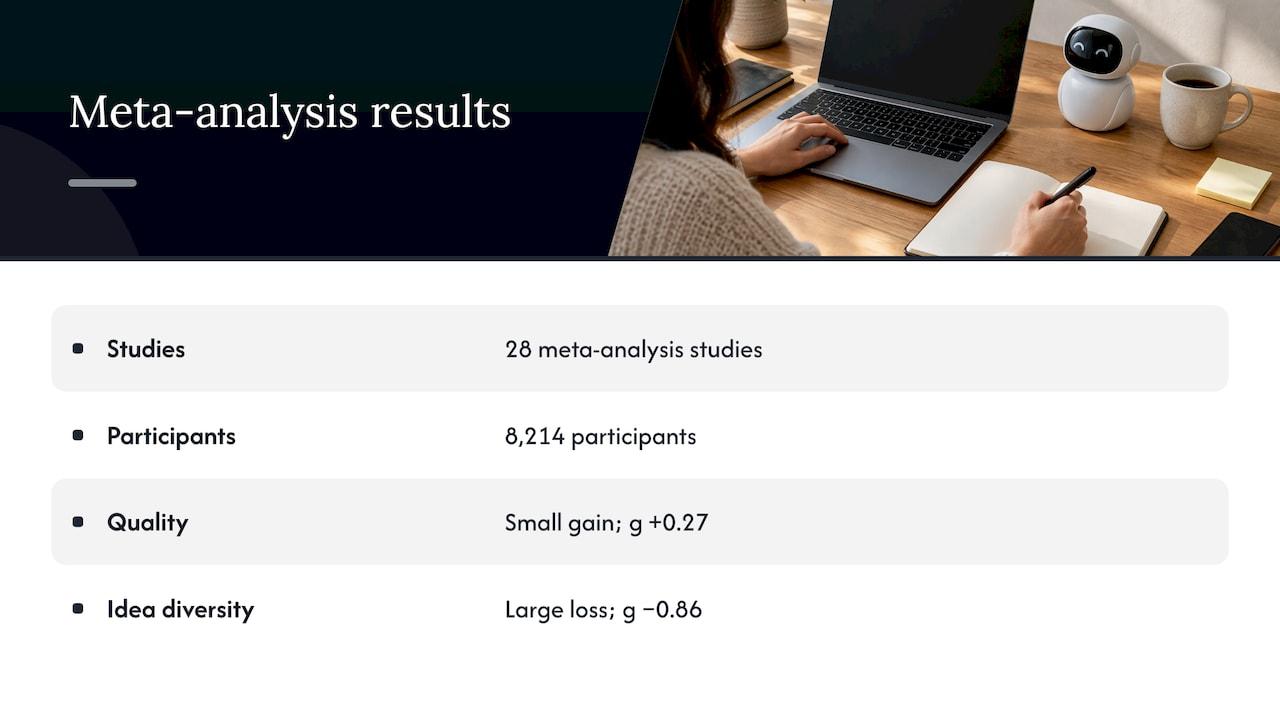
A widely cited short-story experiment by Doshi and Hauser shows the same pattern at the level of a single piece. Writers who had access to one or five AI-generated ideas produced stories rated 5.4% and 8.1% more novel than writers with no AI ideas. But the AI-assisted stories were also more similar to one another, with similarity rising by the equivalent of 10.7% of the human-only range with one idea and 8.9% with five.
The takeaway for you as a creator, marketer or student is practical. The AI boost is real for your own piece. The risk is that your piece starts to sound like everyone else's piece. Your task is to keep the first and avoid the second.
Language models predict likely wording. Likely wording is common wording. When many writers accept the same kind of suggestion, their texts converge.
The evidence goes beyond fiction. In a controlled essay-writing study, Padmakumar and He found that writing with InstructGPT significantly increased similarity across authors and reduced lexical and content diversity, though the base GPT-3 condition did not show the same statistically significant drop. A 2025 study of 118 participants from India and the United States found that AI autocomplete suggestions shifted Indian participants' writing toward Western styles and diminished cultural nuance. If your brand, publication or personal voice has a distinct cultural texture, default suggestions quietly sand it down.
For marketers and SEO professionals, this is a commercial problem as well as a creative one. Pages that read like every other AI-assisted page give a reader no reason to stay. We cover the business side of that in our piece on why originality matters for marketers.
The most actionable research distinction is between co-creating with AI and merely editing a ready-made AI draft. In a 2024 Scientific Reports study, McGuire, De Cremer and Van de Cruys found that people who wrote poetry themselves were judged more creative than people who edited an AI-generated poem. The deficit did not appear in their co-creator condition, and co-creators' creative self-efficacy (their belief in their own creative ability) did not differ significantly from the human-only group.
A second study points the same way. The Ai.llude project, a 2024 study of 27 AI-assisted writing sessions, found that deliberately imperfect intermediate suggestions significantly motivated and increased rewriting, which the authors link to reflection and ownership of creative expression. A fluent, polished AI paragraph invites you to accept it. A rough one invites you to make it yours.
So the rule is simple: never start from a finished AI draft and polish it. Start from your own premise, use AI for options, and do the writing and restructuring yourself.
Here is a routine that applies the research. It works for blog posts, newsletters, essays, scripts and marketing copy.
For concrete editing habits that go with step 5, see our eight tips for humanizing AI-generated text and our explanation of why AI writing needs editing.
If you are a student or teach writing, the Oregon State University evidence is worth knowing. A 2025 white paper by Bushnell and Harrison studied 31 students in two online introductory creative-writing courses. It found that ChatGPT without instructor support did not change overall expert-rated creativity from baseline, while instructor guidance raised scores, mainly for students who started with low scores.
The lesson applies to anyone working alone, too: give yourself the guidance a teacher would. Define what AI may do in your process (brainstorming, outlining, a tightening pass) and what it may not do (write the core argument or the opening scene). A written rule of three lines is enough.
Professional writers report the same split. In a 2022 study, 13 published writers who used the Wordcraft assistant found it useful for brainstorming, story details, world-building and research, but struggled to preserve their voice and the story's context. Use the tool where it is strong, and keep the voice work for yourself.
"More creative" is hard to judge by feel, so borrow a framework. A 2024 study proposing the Torrance Test of Creative Writing adapted four dimensions, fluency, flexibility, originality and elaboration, into 14 yes/no assessments for short fiction. You can use the same four lenses on your own draft:
| Dimension | Question to ask your draft |
|---|---|
| Fluency | Did I generate enough ideas before choosing, or did I take the first one? |
| Flexibility | Do the ideas come from different angles, or are they variations of one? |
| Originality | Would a reader find this angle, image or example elsewhere? |
| Elaboration | Are the details specific enough that only I could have written them? |
The same study found evaluators agreed only moderately on individual measures (Fleiss' kappa 0.41) but more strongly on aggregated scores (Pearson correlation 0.69). Practically, that means one reader's opinion is noisy. Ask two or three people to rate a draft and average the result.
Voice is what survives when the tool is switched off. Define yours before you prompt: three adjectives, two phrases you would never use, one recurring habit such as short closing sentences or a dry aside. Paste that description into every prompt and compare outputs against it.
Teams that publish at volume face a harder version of this problem, because consistency across many pages matters as much as quality. If you are comparing AI content writing tools for blogs and SEO, judge each by how much control it gives you over voice and structure, not only by how fast it produces drafts. Our guides on writing for your audience and content creation best practices for humanized SEO show how to carry a voice through a whole content program.
Inclusion belongs here too. The cultural-homogenization study above shows default suggestions can flatten how people actually write and speak. Our notes on inclusive language when humanizing AI drafts explain how to keep drafts respectful and specific to the audience you serve.
Creativity gains mean little if the work cannot be trusted or submitted. The University of Illinois Writers Workshop recommends using generative AI sparingly for assistive tasks such as suggesting structure or polishing small text segments, keeping your own judgment, revising or rejecting output, verifying facts, protecting confidential information, and tracking and disclosing use as appropriate. It also warns about fabricated information, bias, homogenized prose and privacy.
If you write for a course, check the assignment's AI policy first. The CUNY teaching guide advises instructors to state permitted AI uses and disclosure expectations clearly and to make writing processes visible through outlines, reflections, tracked changes or version histories. Keeping those artifacts is good practice for you as well: they show how your ideas developed. For journalists and agencies, the equivalent is your newsroom's or client's disclosure policy. Duplication is the other practical risk, and our guide to avoiding content duplication walks through it.
If you want a structured way to generate ideas before any drafting, our research-backed brainstorming exercises fit a 45-minute session.
We built Semihuman on a simple observation: the creative gain from AI comes from the thinking around the draft, not from the draft itself. The research bears this out. Ideas help the individual, and unedited output makes writers sound alike.
That is why we focus on the stage after generation. Our platform detects AI-generated text, humanizes it, restructures it for natural readability and integrates keywords for SEO, so the text you start editing already reads like a person wrote it. It keeps the meaning intact while changing the patterns that make machine text feel uniform.
For solo creators, that means more time for the part only you can do: the angle, the example, the opinion. For teams, it means a consistent standard across many pieces, through the web interface or through our API in the editorial workflow you already run. We see automation and creativity as partners, and we explore that balance in our article on balancing automation and creativity.
Use AI to widen your options, write the heart of the piece yourself, and let a humanizing pass remove the sameness. And look ahead: our view of where content writing is heading is that voice will be the differentiator.
Tilen
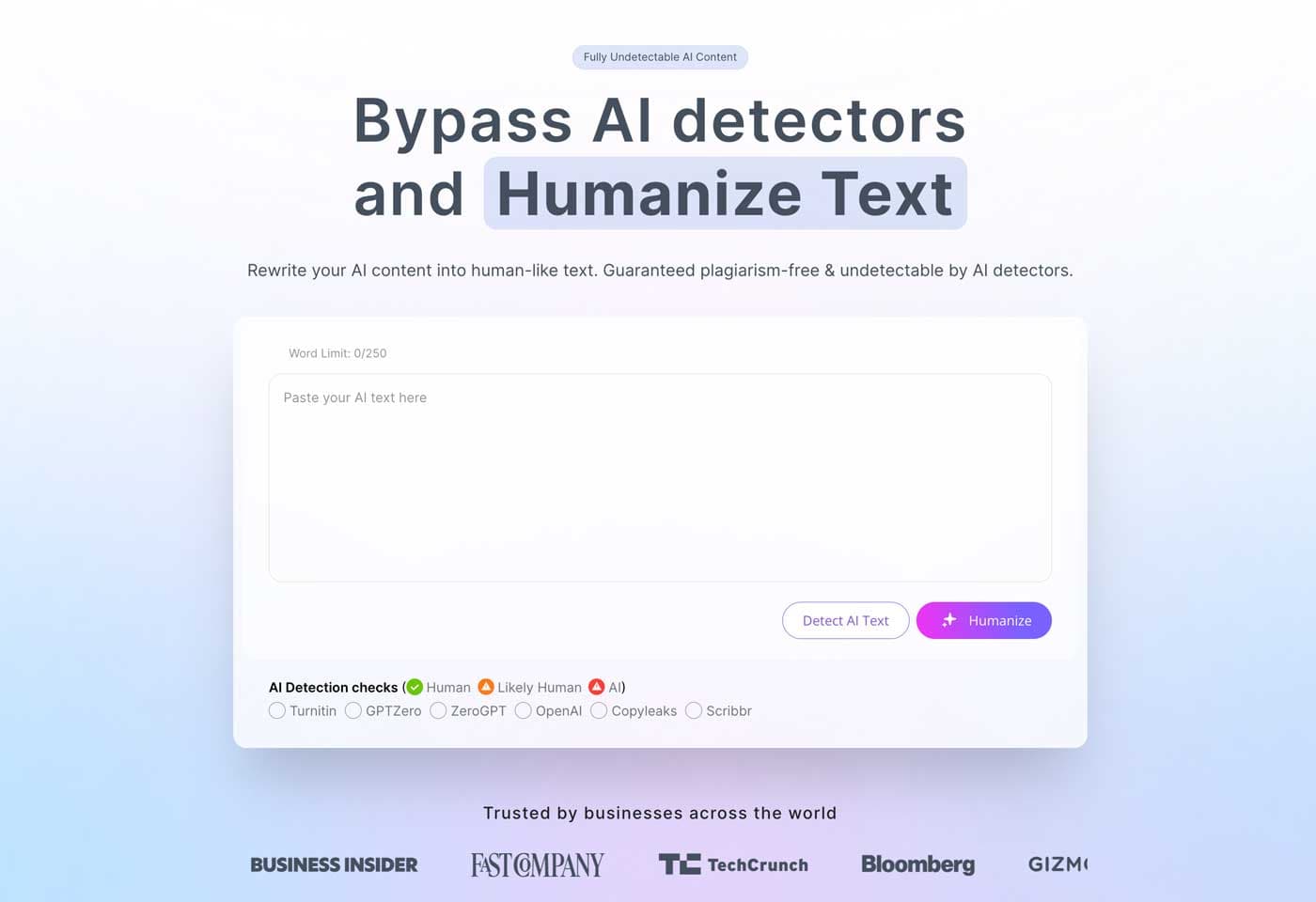
If you already draft with AI, Semihuman handles the step between a generated draft and a publishable one: it restructures the text, integrates your target keywords and produces writing that reads as authentically human. Individuals can start on the Free, Basic and Pro plans, and teams that want to build it into their own tools can look at the Developer, Business and Enterprise API plans.
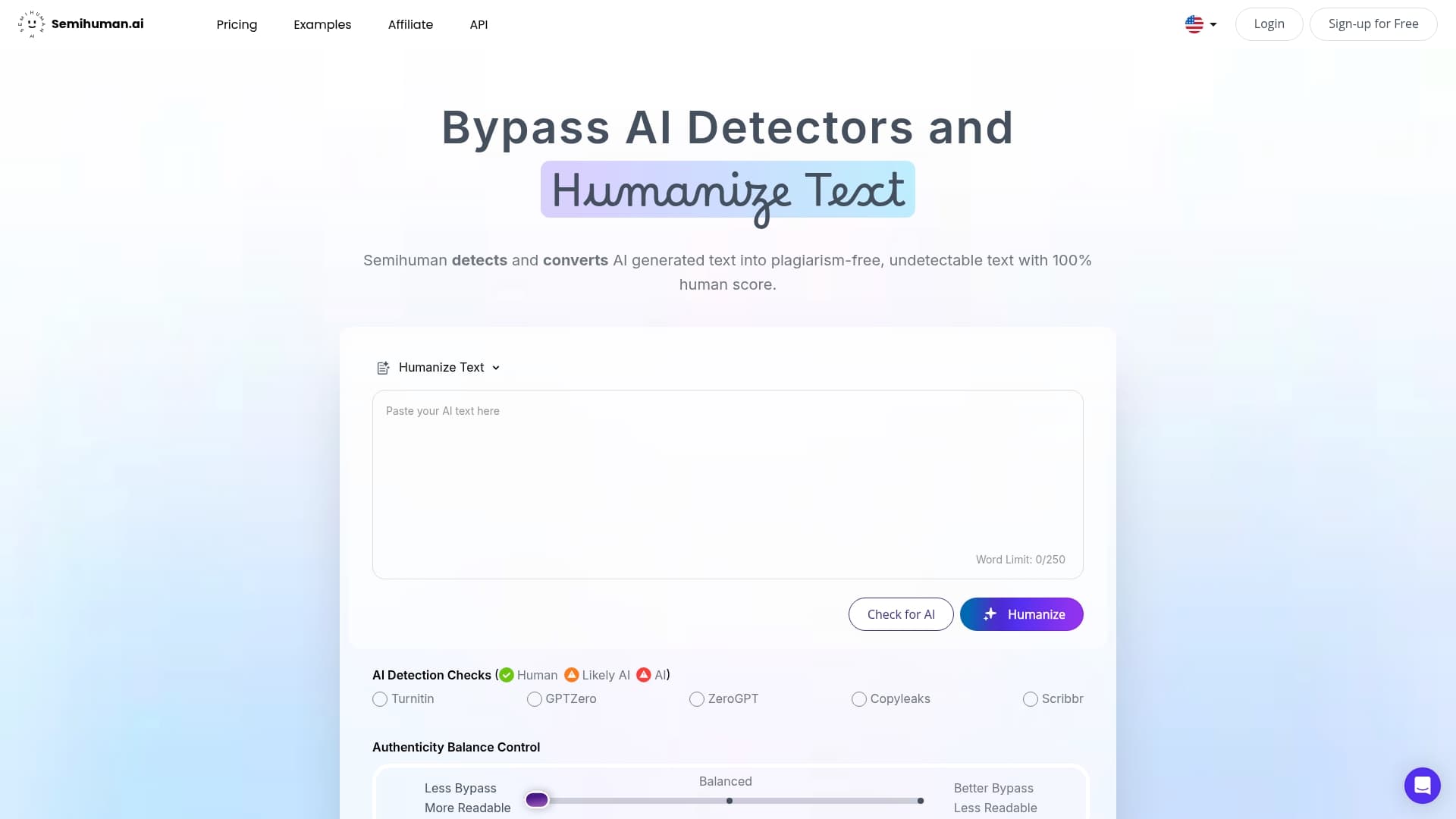
Bring your own premise and your own edits. Semihuman takes care of the rhythm and structure.
For the individual writer, modestly yes. The 2025 meta-analysis found a small improvement in creative-task performance when people worked with generative AI. The same analysis found less diverse ideas across writers, so the benefit depends on how much of your own thinking and rewriting you add.
Start from your own premise, then ask for several directions or specific prompts rather than complete paragraphs. Pick and combine the options, then write the key passages yourself. Rough suggestions encourage rewriting, which the Ai.llude study linked to stronger ownership of the final text.
Define your voice before prompting, replace the most predictable suggestion with a detail from your own experience, and restructure sentences instead of swapping words. A humanizing pass with Semihuman helps remove the uniform rhythm of generated text, and your own examples make the piece distinctive.
Follow the rules of your school, publication or client. University writing guidance recommends tracking your AI use and being prepared to disclose it, and instructors are advised to state permitted uses clearly. When in doubt, ask the person who will evaluate the work.
Only within the course's AI policy. Where AI is permitted, the research suggests guided, assistive use works best, such as brainstorming or tightening small segments, while you keep your outline, notes and drafts as a record of your own process.



Start
Humanizing
for Free!
Humanize