
Loading...

TL;DR:
- AI detection in universities analyzes student writing to identify AI assistance using various technical methods. While useful, these tools have limitations, including false positives and lack of transparency, which can harm students unfairly. Combining detection with process-based assessments and transparent policies offers a fairer approach to academic integrity.
AI detection in universities is the process of analyzing student text submissions using statistical and linguistic methods to determine whether AI tools contributed to the writing. Tools like Turnitin, GPTZero, and Copyleaks now sit at the center of academic integrity enforcement on campuses worldwide. They measure specific writing patterns, called perplexity and burstiness, that separate human prose from AI-generated text. Understanding how ai detection works in universities gives both students and educators the knowledge to navigate these systems fairly and responsibly.
Universities rely on a short list of detection platforms, each using a different technical approach. Turnitin, GPTZero, and Copyleaks are the three most widely deployed. Their accuracy varies from 33% to 81% depending on the method and context. That range is wide enough to matter. A tool that is wrong one in five times creates real consequences for real students.
Here is how the three leading platforms differ in approach:
| Tool | Primary Method | Key Strength | Reported Accuracy |
|---|---|---|---|
| Turnitin | Statistical language model comparison | Low false-positive rate at document level (under 1%) | High at document level |
| GPTZero | Perplexity and burstiness scoring | Fast, real-time feedback | Moderate, context-dependent |
| Copyleaks | Hybrid linguistic and semantic analysis | Transparent, evidence-based reporting | Varies by content type |
Detection methods fall into three broad categories:
Educators receive reports that flag suspicious passages, assign probability scores, and in some platforms highlight specific sentences. The report is a starting point for judgment, not a final verdict.
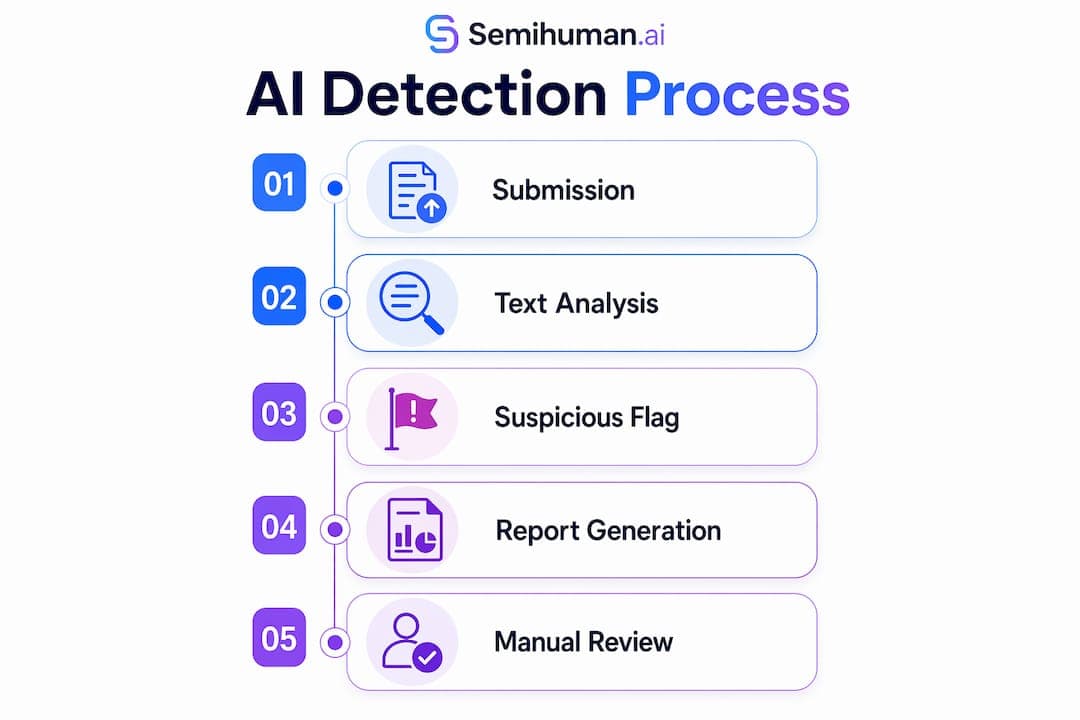
The two core metrics in AI detection are perplexity and burstiness. Perplexity measures how surprising or unpredictable a piece of text is. Human writers make unexpected word choices, take tangents, and vary their rhythm. AI models favor the statistically likely next word, producing text that scores low on perplexity. Classification models achieve reliability scores around 0.70 when separating human from AI-assisted prose using these metrics. That is solid but not perfect.

Burstiness measures sentence length variation. Human writing tends to mix short punchy sentences with longer, more complex ones. AI writing is more uniform. A paragraph where every sentence runs 18–22 words is a red flag.
Beyond those two core metrics, detectors and instructors look for these specific signals:
Pro Tip: If you use AI tools to assist your writing, read your draft aloud before submitting. Sentences that feel mechanical or overly smooth are the same ones detectors flag. Fix those passages in your own voice.
Instructors also perform manual checks. They look at whether the writing voice matches previous submissions from the same student. A sudden shift in vocabulary or argument sophistication is a signal no algorithm needs to catch.
AI detection tools are not reliable enough to serve as sole proof of misconduct. False positives and "black box" opacity remain the two biggest problems in academic integrity enforcement. A false positive means a student who wrote every word themselves gets flagged as an AI user. That is a serious harm.
The core challenges include:
"Lack of explainability remains a central tension in university academic integrity enforcement." — International Journal of Machine Learning and Cybernetics
The ethical stakes are high. Accusing a student of academic dishonesty based on a probabilistic score without transparent reasoning is not a defensible institutional practice. Educators need tools that explain their findings, not just flag them.
The key trend in 2026 is moving away from treating AI detection as a binary disciplinary tool. The shift is toward contextual, process-based approaches that support academic integrity rather than just punish violations. Text analysis alone cannot tell the full story of how a student produced a piece of writing.
Universities are adding these process layers to their detection workflows:
Pro Tip: Keep a writing process log for major assignments. Save drafts, note your research sources, and record the time you spent writing. This documentation is your best defense if a detection tool flags your work incorrectly.
Copyleaks offers transparent reporting on flagged content, giving educators evidence-based explanations rather than bare scores. That transparency is what makes a detection report usable in an academic integrity conversation.
| Assessment Layer | What It Measures | Reliability |
|---|---|---|
| Text-based AI detection | Linguistic patterns, perplexity, burstiness | Moderate (33%–81% accuracy) |
| Keystroke tracking | Typing behavior, revision patterns | High (very hard to fake) |
| Writing history comparison | Voice and style consistency | High with sufficient prior work |
| Oral defense | Comprehension of submitted content | Very high |
AI detection technology in schools is reshaping how institutions make high-stakes decisions. Some admissions offers have been rescinded due to essay voice mismatches flagged by detection tools. Conditional offers and waitlist demotions linked to AI detection are more widespread than outright retractions. That is a significant consequence for a probabilistic system.
For students, the practical effects include:
For educators, the challenge is balancing detection with trust. An instructor who treats every flagged submission as proof of cheating will damage student relationships and make errors. The better approach is to use detection reports as a prompt for conversation, not a verdict. Learning to spot AI-generated essay signs manually gives instructors a second layer of judgment that no tool can replace.
Universities that communicate clear AI use policies see better outcomes than those that rely on detection alone. When students know exactly what is permitted, they make better choices. When educators know the limits of their tools, they make fairer decisions.
AI detection in universities works best as one layer of a broader academic integrity system, not as a standalone verdict.
| Point | Details |
|---|---|
| Core detection metrics | Perplexity and burstiness are the primary signals tools use to separate AI from human writing. |
| Tool accuracy varies widely | Detection accuracy ranges from 33% to 81%, so no single tool result should be treated as conclusive. |
| Process data is more reliable | Keystroke tracking and writing history comparison are harder to fake than text analysis alone. |
| False positives are a real risk | Non-native speakers and formal writers face higher false-positive rates, creating fairness concerns. |
| Transparency matters | Tools like Copyleaks that provide evidence-based reports give educators defensible grounds for decisions. |
I have spent years watching institutions reach for technology to solve what is fundamentally a human problem. AI detection tools are useful. They catch patterns that human readers miss, and they scale in ways that individual instructors cannot. But the universities that rely on them as the final word are making a mistake they will eventually have to answer for.
The false-positive problem is not a minor technical footnote. It is a structural flaw that will harm students who did nothing wrong. A non-native English speaker who writes carefully and formally should not face an academic misconduct hearing because a probabilistic model found their prose too predictable. That is not integrity enforcement. That is a system error with consequences.
What actually works is the combination: a detection flag triggers a conversation, not a punishment. The instructor looks at the student's writing history, asks them to explain their argument, and checks whether the voice in the submission matches the voice in the room. That process is slower. It requires judgment. It cannot be automated. That is exactly why it works.
The future of AI in academic evaluations is not more powerful detectors. It is better-designed assignments, clearer policies, and educators who know how to use detection reports as one input among many. The tools will keep improving. The judgment has to improve alongside them. Students who understand this system are better positioned to navigate it honestly and to advocate for themselves when the system gets it wrong.
— Tilen
Understanding how detection tools analyze text is the first step toward writing authentically in an AI-assisted world. Semihuman is built for exactly this intersection.
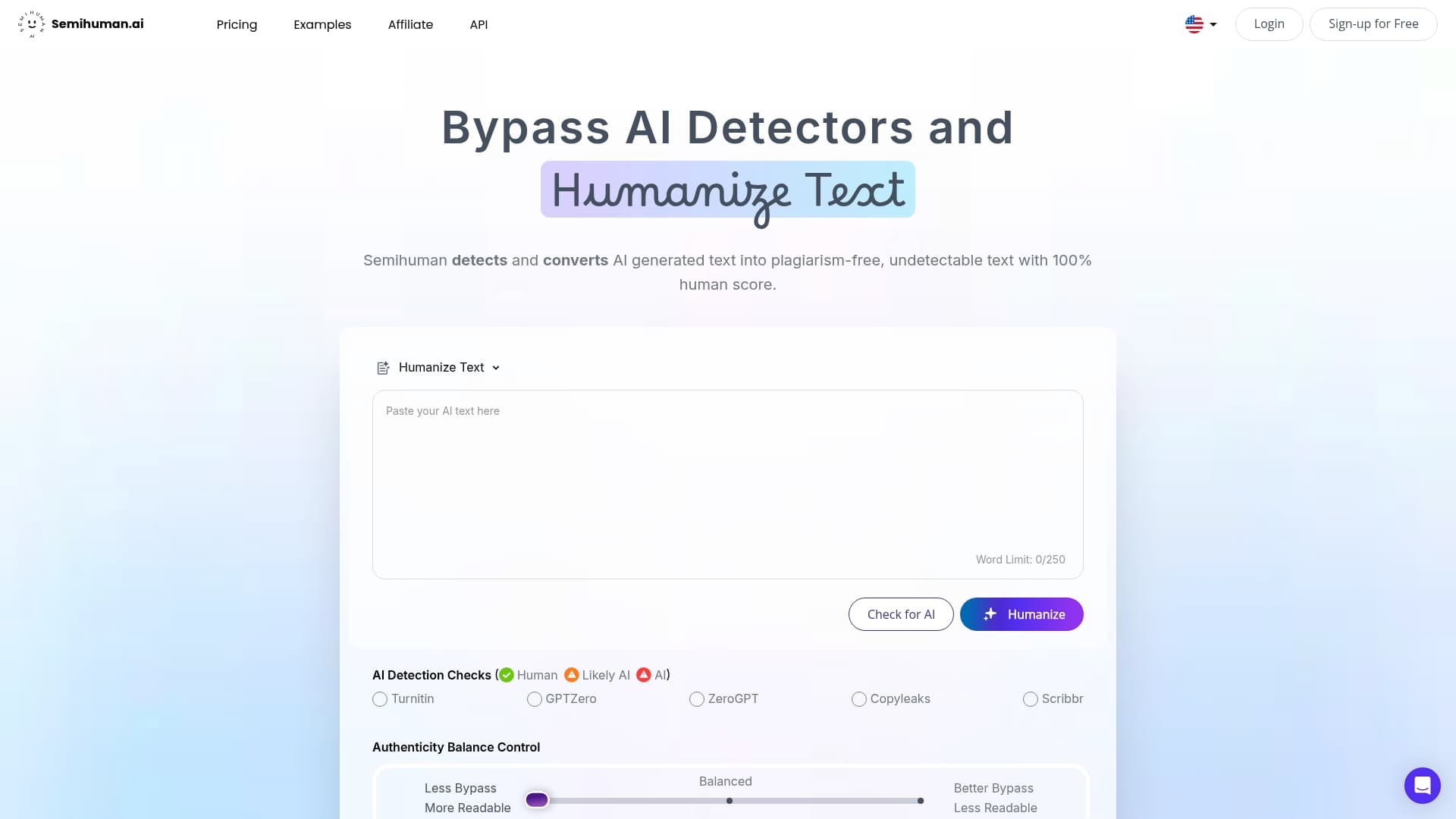
Semihuman's AI text humanizer restructures AI-generated drafts so they read with the natural variation and unpredictability that detection tools look for in human writing. For students who use AI tools as a starting point and want their final submission to reflect their own voice, this is a practical workflow. Semihuman also offers an AI-powered text generator that builds content with authenticity built in from the start. Explore Semihuman's tools to write with confidence and clarity.
Turnitin compares submissions against statistical language models to identify text that is too predictable. Its false-positive rate is under 1% at the document level but rises to around 4% at the sentence level.
Perplexity measures how unpredictable a piece of text is. AI-generated writing scores low on perplexity because language models favor statistically likely word choices, while human writing is more varied and surprising.
Yes. Students who write in formal, structured English, particularly non-native speakers, face higher false-positive rates because their writing patterns can resemble AI output.
Keystroke tracking and oral follow-up are the most reliable methods. Behavioral metrics like typing patterns are practically impossible to fake, making them a stronger indicator than text analysis alone.
Disclosure is the safest approach. Universities with clear AI use policies report better academic integrity outcomes than those relying on detection alone, and transparency protects students from misconduct accusations.



Start
Humanizing
for Free!
Humanize