
Loading...
You engage readers by giving them a reason to keep going at every step: a first sentence that raises a question, a voice that sounds like a person talking to them, a structure they can scan, and a steady supply of small payoffs. Nothing here depends on genre. The same principles work for a blog post, a newsletter, a short story or a report.
This guide covers the techniques in the order a reader meets them: the opening, the voice, the middle, the layout and the conversation after the last line.
Every technique below depends on one decision: who exactly are you writing for? The Federal Plain Language Guidelines put it plainly: the first rule is to write for your audience, using language they know and are comfortable with and accounting for what they already know.
Before drafting, answer three questions in a sentence each:
An expert reader tolerates jargon and wants depth. A beginner wants one clear path. A reader on a phone wants the answer quickly. Pick one and write for that person. An article that tries to serve everyone usually engages nobody.
Most people do not read web pages line by line. In Nielsen Norman Group's research, 79 percent of test users always scanned any new page and only 16 percent read word by word. The same research found that concise, scannable writing improved measured usability by 47 to 58 percent, and that promotional "marketese" made pages harder to use and was disliked.
Two practical consequences follow:
The techniques below are all ways of meeting a scanning reader halfway, then rewarding them when they slow down.
The first sentence has one job: get the second sentence read. HubSpot's guide to addictive articles quotes Eddie Shleyner on the idea that the first sentence is the most important in an article. It should be brief, spoken in tone or intriguing, and it should raise a question or spark curiosity.
Raise a question only the article answers. Editor Nathan Connolly suggests that a story's opening should work like a question that can only be answered by reading on. This works for nonfiction too. "Why do the best-written emails get the fewest replies?" is a question a reader wants resolved.
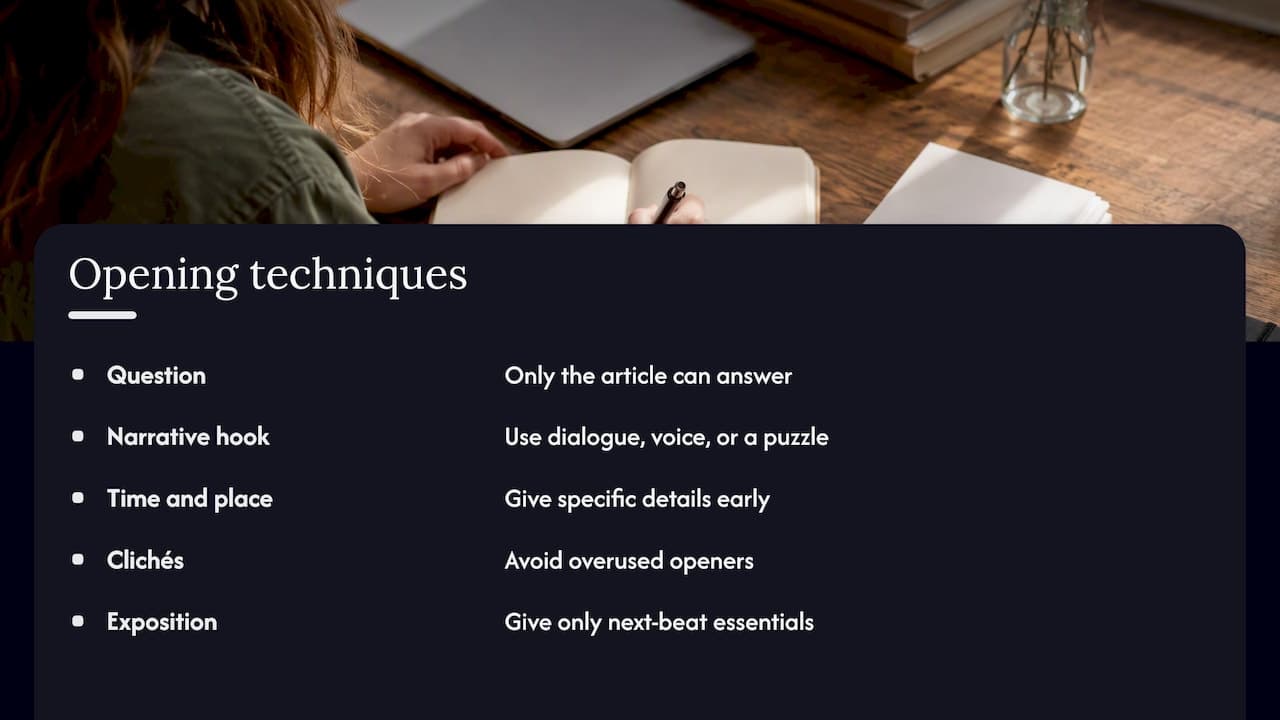
Use a narrative hook. BBC Bitesize lists an unusual narrative voice, dialogue or a puzzle as ways to capture attention at the start of a story. A line of dialogue in the middle of an argument pulls a reader in faster than a paragraph of scene-setting.
Ground the reader in time and place. Author Tom Bromley says that giving specific details of time and location early stops the reader from feeling like they are "floating." "Tuesday, 6:40 a.m., and the printer is still jammed" beats "Offices can be stressful."
Skip the clichés. The USC Writing Center warns against overused openers such as dictionary definitions, and suggests asking friends or scanning headlines to see what people already think about your topic, so you do not open with what everyone else opens with.
Keep exposition on a need-to-know basis. Writer's Digest contributor Jacqueline Faber cautions against bulky, cumbersome exposition at the start. Give readers only what they need to understand the next beat. Background can wait.
Before: "Content marketing has become an increasingly important part of modern business strategy."
After: "Our best-performing post last year was a 300-word correction to one of our own articles."
The second raises a question (why did a correction win?), contains a concrete detail and sounds like a person. If you cannot write a line like that honestly, you are probably not yet clear on your point.
Voice is the difference between text a reader endures and text a reader hears. Shleyner argues that people have a basic need for connection, and that a conversational, personal, second-person style makes readers feel a piece was written just for them.
In practice:
If you want a fuller walkthrough of the style, our guide to what conversational copywriting is covers it in detail. A marketing agency's piece on the cost of AI-designed marketing materials makes a related point about a personal, reader-focused voice building connection with an audience.
Mary Gormandy White notes that loaded rather than neutral words can provoke a stronger reaction and make readers want to continue. Use that carefully. "Disaster" and "brilliant" are powerful because you save them. A feed full of superlatives teaches readers to ignore all of them.
In stories, readers keep reading because they care what happens. In articles, they keep reading because they want the answer. Both rest on the same mechanics.
Faber stresses that opening scenes should show stakes, what a character stands to lose, so the reader invests early. In nonfiction, the stake is the cost of not knowing: the budget wasted, the application rejected, the audience lost. State it once, early, in specific terms.
Imperial College London's guide to engaging through writing advises building suspense by slowly withholding and releasing information, which keeps the reader searching for answers. In an article, this can be as simple as saying "there are three mistakes, and the third one surprised us" and then delivering.
HubSpot's term for this is short seeds of curiosity: a line at the end of a section that makes the next one feel necessary. A good test is to read only your section-ending sentences. Do they make you want to continue?
One article on storytelling and SEO discusses how questions, stakes and carefully revealed information carry readers further down a page, which also supports the time-on-page signals content teams watch.
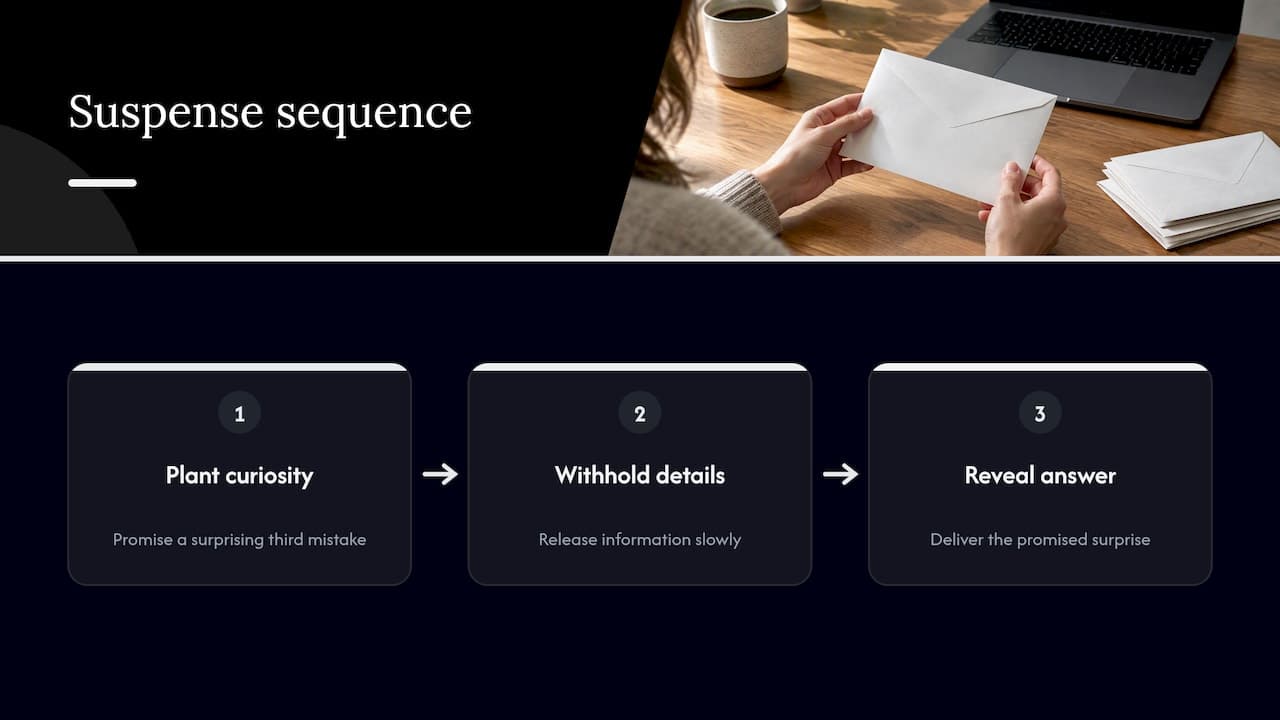
Faber describes good storytelling as a kind of seduction: balance curiosity and mystery without overwhelming the reader, and make sure they feel steady progress. Withholding too much feels like a trick. Every teaser needs a payoff within a reasonable distance.
Nancy Kress describes the implicit promise: the opening sets expectations that the rest of the piece must fulfill. A headline that promises "12 techniques" must deliver twelve. A tragic opening cannot turn into a joke collection. Broken promises cost you more trust than a weak opening ever will.
Engagement is partly design. Imperial College London recommends the inverted pyramid for informative writing, putting the most crucial information first. It also notes that subheadings break up text, add visual interest and help readers find what they need.
Nielsen Norman Group's list of scannable elements lines up with that: meaningful subheadings rather than clever ones, bulleted lists and one idea per paragraph.
A checklist you can apply to any draft:
| Element | What to do | Why it helps |
|---|---|---|
| First paragraph | State the answer or the promise | Scanners get value immediately |
| Subheadings | Say what the section contains | Readers navigate and return |
| Paragraphs | One idea, two to four sentences | Easier on small screens |
| Lists | Use for steps, criteria, options | Breaks dense text |
| Visuals | Add where they explain something | Gives the eye a rest |
| Section endings | Hint at what comes next | Pulls readers down the page |
Visuals deserve their own attention. Our posts on how visuals in blog posts boost engagement and SEO and visual storytelling trends for 2026 go deeper on that.
Journalist Spiegel, writing for the International Journalists' Network, argues that online readers want immediate engagement and have little tolerance for needless background, so in a long article every sentence must move the story forward. Cut the sentence that exists only to show you did the research. Keep the one that changes what the reader understands.
Structures like problem-agitate-solve, before-after-bridge and story-lesson-action give your draft a skeleton. They help most when you are stuck, and hurt when the reader can see the scaffolding. Our overview of copywriting formulas that boost engagement and authenticity explains when each fits. Use them to organize your thoughts, then rewrite until the seams disappear.
Readers share what makes them look useful or smart. That usually means original data, a clear point of view or a framework they can reuse. Generic summaries of what everyone already says are the fastest way to lose a reader who has seen the same advice three times that day.
Two habits help:
For more on this, read why content originality matters for marketers and how to create shareable blog content that gets passed along.
Engagement does not end when the article does. The International Journalists' Network notes that creators can invite participation through live events, in-story polls or social media threads, and that treating journalism as a conversation builds relationships and an engaged community.
Simple ways to start:
First drafts are for you. Engagement is created in revision. Work through this pass list:
If you draft with an AI assistant, the biggest engagement risk is sameness: even rhythm, safe phrasing, no particular point of view. Whatever tool you use, the fix is the same editing pass above, plus your own examples and opinions. Reading examples of humanized text can show what that difference looks like on the page, and our examples of humanized content for creators show it in finished pieces.
The principles hold across formats, but the weighting changes.
| Format | Lead with | Lean on |
|---|---|---|
| Blog post | The answer or a sharp question | Subheadings, specifics, internal links |
| Newsletter | A personal, concrete first line | Voice, one clear call to reply |
| Short story | A character wanting something specific | Stakes, suspense, vivid detail |
| Report or white paper | Key finding | Inverted pyramid, scannable summaries |
| Social post | A tension or a question | Brevity, invitation to respond |
One reader on a writing forum summed up the story case well: start with the main character wanting something specific and already moving toward it, and let that desire connect to the plot. That is the same engine as a good article: someone wants something, and something is in the way.
Most advice on engagement is about tricks. In our work, we keep seeing that it is about trust: readers stay when a text sounds like a person who knows what they are talking about and respects their time.
That is why we built Semihuman around the editing step many drafts skip. Machine-assisted drafts tend to be competent and flat. Our tool is designed to restructure text so it reads more naturally, keep the meaning intact and work in the keywords you care about, so the writer can spend their effort on the parts only a human can supply: the example, the opinion, the question that makes a reader reply.
We think the future of content is not human or machine but a good draft plus a careful human edit. Use the tools to move faster, then make it yours.
Tilen
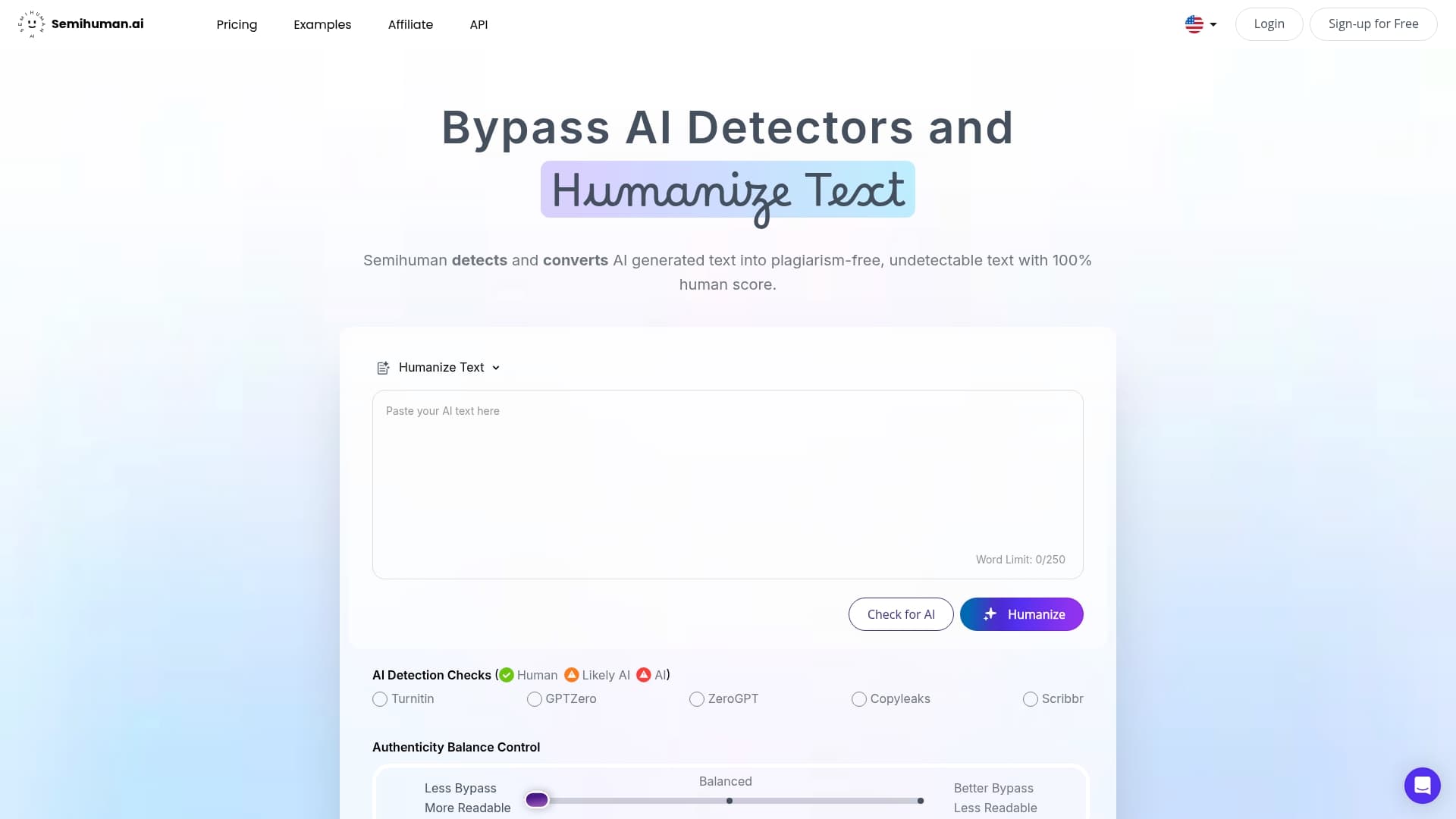
If you produce content at volume, the hardest part of engagement is keeping every draft sounding natural and distinct. Semihuman is built to help with that: it rewrites AI-assisted text so it reads more naturally, restructures it for readability and supports keyword integration, in a web app or through an API for your own workflow.
You can start by exploring the Free, Basic and Pro plans, or look at the Developer, Business and Enterprise options if you want to connect it to your publishing stack. For more guides, browse the Semihuman blog, and see our tips on authentic digital marketing content.
The most reliable ones are a hook in the first sentence, a conversational voice, stakes or a question the reader wants resolved, concrete detail, and a structure that can be scanned. Storytelling and emotional connection add depth. Pick two or three that fit your format rather than stacking them all.
The opening is usually the highest-leverage place to work, because a reader who leaves in the first sentence never sees the rest. Write a first line that is short, specific and raises a question, then deliver on it in the next paragraph.
Give them a small reward at regular intervals: a new fact, a turn in the argument, an example. Use subheadings and short paragraphs so they can see progress, and end sections with a line that points to what comes next. Cut anything that does not move the piece forward.
Ask one specific question at the end and make replying easy. Polls, discussion threads and live sessions all work, as does answering early comments quickly. Readers respond when they see that someone is listening.



Start
Humanizing
for Free!
Humanize