
Loading...

Make these six quick edits to move any AI draft from mechanical to human in your first pass. Research confirms that a significant portion of AI citations come from the early part of an article (https://digitalbridge.ie/blog/humanize-ai-content-that-ranks), so front-loading your best edits isn't optional — it's the whole game.
Your 6-item humanization checklist:
Tools like Semihuman.ai and Microsoft 365 Copilot can flag some of these patterns automatically, but specificity injection always requires a human call.
Pro Tip: When a deadline is tight, do a focused 15-minute specificity pass: find three generic claims and replace each with a named fact, a real number, or a concrete example. That single pass moves the needle more than any synonym swap.
Specificity injection — replacing vague claims with named sources, real numbers, and first-hand observations — is the single highest-impact edit for both ranking and detector robustness.
| Point | Details |
|---|---|
| Front-load the first 30% | Place your core claim and named sources in the opening section where citation engines weight signals most heavily. |
| Specificity beats synonyms | Replace three generic claims with named facts per section; this shifts both detector metrics and reader trust. |
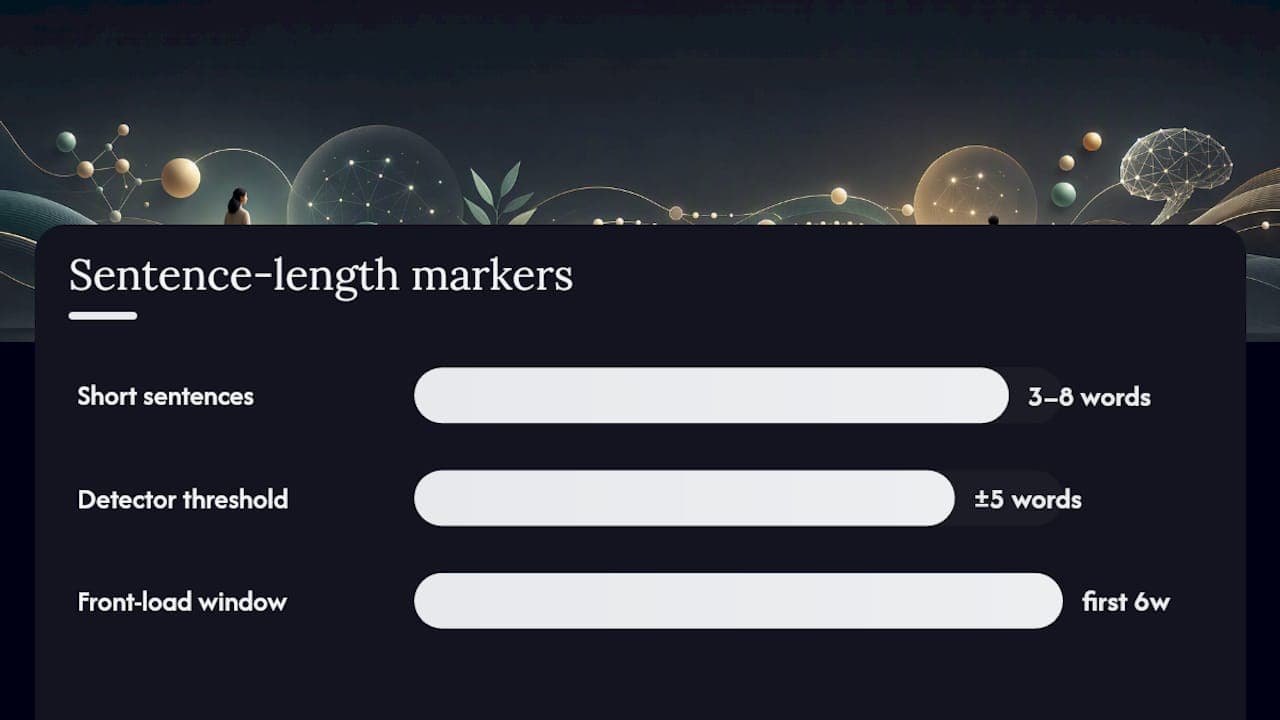
| Burstiness is structural | Mix sentences of 3–8 words with sentences over 35 words; uniform length is the clearest AI tell. |
| Detectors are diagnostic only | A low detector score doesn't guarantee ranking; E-E-A-T and information gain are the signals that matter. |
| Semihuman handles restructuring | Use Semihuman.ai for the keyword integration and restructuring pass after manual specificity edits are complete. |
AI text has a fingerprint. Once you know it, you can't unsee it.
One-line fix for each:
That's where both detectors and AI citation engines weight their signals most heavily.
Pro Tip: Run a connector audit before anything else. Search the document for "Furthermore" and "Additionally" — if either appears more than twice per 500 words, you have a fast, high-impact fix right there.
Order matters. Editors who jump straight to grammar lose the structural gains that make everything else easier.
Time budgets per pass: structure (5 minutes), specificity (15 minutes), sentence-level (10 minutes), tone (5 minutes), format (5 minutes), QA (10 minutes). A 1,000-word article should clear all six gates in under an hour.
Pro Tip: When a deadline forces triage, spend your time on passes 1 and 2. Structure and specificity produce the biggest ranking and detector gains. Grammar polish is the last thing to cut, not the first.
Burstiness is the technical term for what human writers do naturally: mix very short sentences (3–8 words) with longer, more complex ones. AI models don't. They cluster near a comfortable middle length, and detectors read that clustering as a statistical signature.
Before/after examples:
Before: "Content marketing is a strategic approach that focuses on creating and distributing valuable content to attract and retain a clearly defined audience."
After: "Content marketing is about earning attention, not buying it. You create something worth reading. The audience finds you."
Before: "Furthermore, it is important to note that keyword placement should be natural and should not disrupt the reading experience of the user."
After: "Keyword placement should feel invisible. If a reader notices it, move it."
Before: "The platform offers a range of features that make it suitable for a variety of use cases across different industries and team sizes."
After: "The platform covers most use cases. Where it struggles is niche enterprise workflows that need deep CRM integration — worth knowing before you commit."
Structural restructuring — splitting long clauses and merging short robotic sentences into variable, complex constructions — shifts detector metrics more reliably than synonym swapping. The statistical signature changes because the sentence-length distribution changes, not because the words changed.
Editor checklist for sentence-level work:
Start by naming who you're writing for, because audience-specific vocabulary choices change both perceived expertise and keyword handling.
Audience hallmarks and vocabulary choices:
Word swap examples (formal → plain):
| Audience | Tone | Keyword handling |
|---|---|---|
| Marketer | Benefit-led, punchy, first-person | Keep exact-match terms in H2 and first paragraph |
| Student | Hedged, cited, formal but clear | Vary phrasing; exact-match in intro only |
| Developer | Direct, precise, no adjectives | Use exact technical terms; skip SEO variants |
Synonym swapping alone doesn't solve tone problems. A text that replaces every "utilize" with "use" but keeps the same passive, hedging sentence structure still reads as AI-generated. Specificity and narrative voice are the real levers — persuasive copy techniques reinforce this point.
Answer-first placement is the structural move that matters most. A 40–60 word summary under the H1 satisfies AI Overviews and increases early citation probability. Put the core claim in sentence one, not after a paragraph of context.
Pro Tip: Use exact phrases for anchorable answers — a sentence that directly answers a likely search query, formatted as a standalone sentence or short paragraph. That's the unit AI Overviews pull from.
Tools have specific roles. Using them out of order wastes time and produces worse results.
Usage sequence:
Tool categories and their limits:
Semihuman's API fits teams running bulk edits or integrating humanization into a CMS pipeline. Multilingual workflows benefit from the same API approach, keeping authenticity consistent across language versions. For complementary rewriting patterns and tool-usage examples, this external guide covers practical approaches worth bookmarking.
Pro Tip: Never run a humanizer on a raw AI draft. Edit for structure and specificity first, then use Semihuman.ai as the final restructuring pass. Humanizers applied to unedited drafts tend to preserve the underlying sentence patterns and just change the surface vocabulary.
Yes — and it catches problems that detectors miss entirely. Stilted rhythm, repeated sentence openings, and hedging phrases that look fine on screen become obvious the moment you hear them.
QA checklist before publishing:
Time budgets: read-aloud (8 minutes per 1,000 words), specificity (5 minutes), burstiness (3 minutes), formatting (3 minutes), links (2 minutes).
Failure modes to fix immediately: every paragraph ends with a verdict sentence; three consecutive paragraphs open with "The"; no sentence under 12 words in an entire section.
Pro Tip: Record yourself reading one paragraph on your phone and play it back. Your eye skips over problems your ear catches immediately — especially repeated sentence openings and hedging phrases that cluster in AI drafts.
Editors must verify originality and follow any institutional disclosure requirements before publishing AI-assisted content.
Excessive rewriting aimed at avoiding detection can introduce inaccuracies by drifting from original source meanings. It is important to verify facts after each major edit.
Google doesn't penalize appropriate AI use — it penalizes low-value content. The ethical obligation and the SEO obligation are the same: produce something accurate, specific, and genuinely useful.
Every workflow I've worked through with Semihuman.ai confirms the same pattern: the tool handles the statistical restructuring reliably, but the edits that actually move a piece from forgettable to worth reading are the ones a human makes. The specificity injection, the honest tradeoff, the one sentence that admits something the AI would never admit — those are the signals that build trust with readers and with search engines. No tool generates those. You do.
If you're running this workflow at volume — multiple drafts a week, a CMS pipeline, or multilingual content — doing every pass manually doesn't scale. Semihuman's SEO text generator handles the restructuring and keyword integration passes described above, and the API lets development teams plug humanization directly into their publishing pipeline. The result is content that clears detector thresholds and reads naturally, without the synonym-swapping shortcuts that produce new tells.
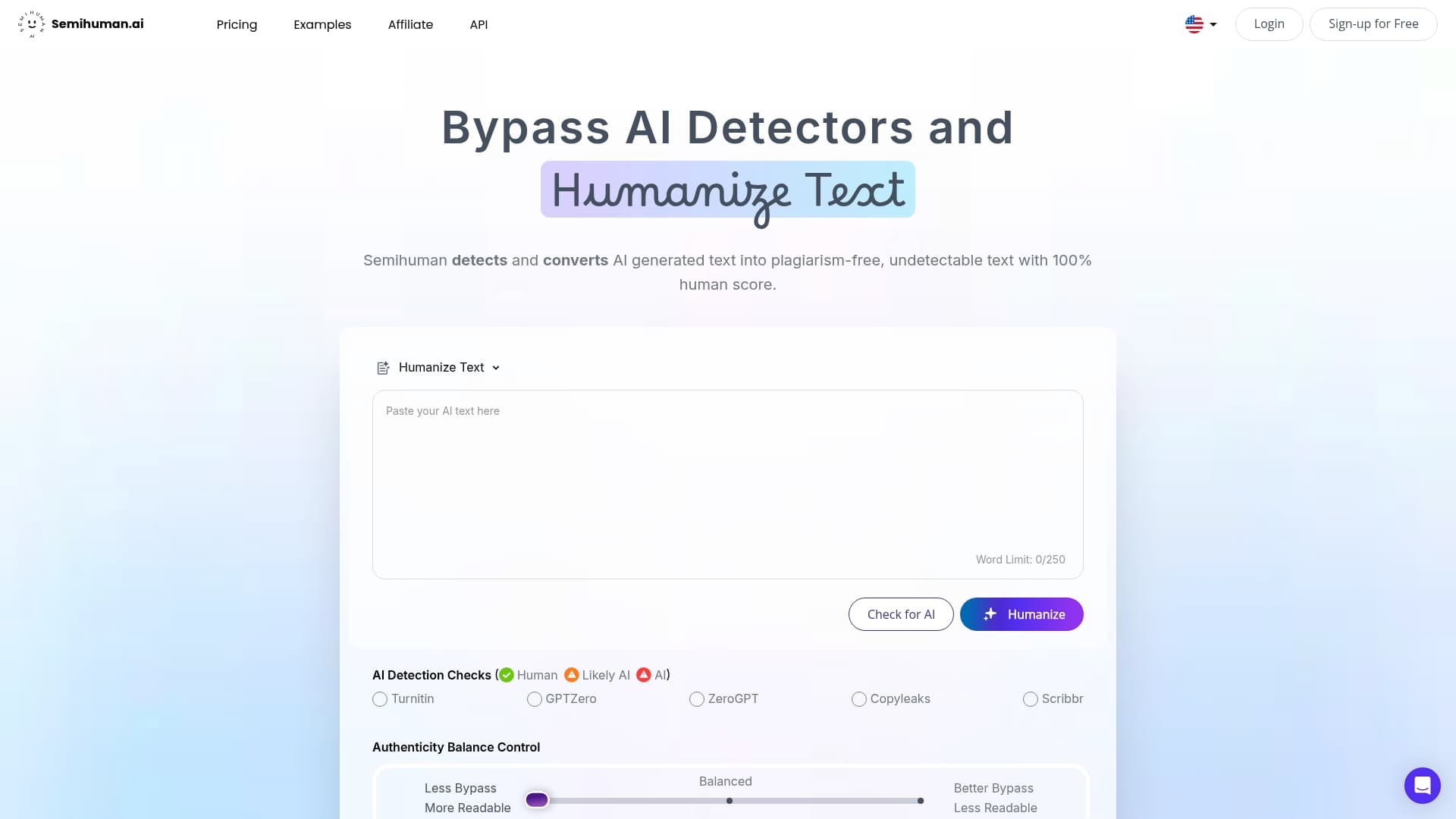
Start with one draft: paste it into Semihuman.ai, run the restructuring pass, then apply your specificity edits on top. That sequence — tool first for structure, human second for substance — is faster than either approach alone. Try it at Semihuman.



Start
Humanizing
for Free!
Humanize