
Loading...

Prioritize intent-matching content, targeted keyword research, and fixing major technical blockers: those three moves produce the largest, fastest organic gains. Technical and indexing fixes can show results within weeks, while content and backlink work typically takes months to mature. Track progress with Google Search Console and Google Analytics 4 so you know what is actually moving the needle.
TL;DR:
- Prioritize quick technical fixes like resolving indexing errors and improving page speed to see results within weeks before focusing on long-term content development.
- Refreshing pages on the second search results page with title updates and internal links can move them onto page one within two to six weeks, maximizing existing assets.
- Target high-impression pages with low click-through rates for title and meta description improvements, as these changes typically generate faster traffic gains.
- Align content format with search intent, creating explainer, comparison, or product pages accordingly to improve rankings and user engagement.
- Consistently measure impact by monitoring Google Search Console impressions and position, making incremental adjustments based on effort versus impact.
Not every SEO task deserves the same amount of your time. Some fixes take an hour and move rankings within weeks; others take months and might not pay off for a year. Sorting tasks by effort and impact keeps you from burning a quarter on a technical rebuild when a few title tag edits would have gotten you most of the way there.
Start with pages that already rank on page two of search results. These are the closest to a payoff: Google already considers them relevant, they just need a push. Refreshing the title, adding current information, and linking to them from stronger pages on your site often moves them onto page one within a few weeks.
The pattern across all five: cheap edits to existing assets beat new content when you need traction fast. New content takes months to earn trust and backlinks, but a page that already has some authority just needs a better signal to climb.
Pro Tip: Sort your Search Console Performance report by impressions, not clicks. Pages with high impressions and low click-through rates are your fastest wins because Google already shows them, searchers just aren't clicking.
Once the quick wins are moving, shift attention to the medium-effort work: new content for keyword gaps, structured data rollouts, and backlink outreach. These take longer to pay off but build the foundation that quick wins alone cannot replace. Google's Search Essentials guidance is blunt about this: there are no durable shortcuts, and sustained visibility comes from technically sound, people-first content built over time.
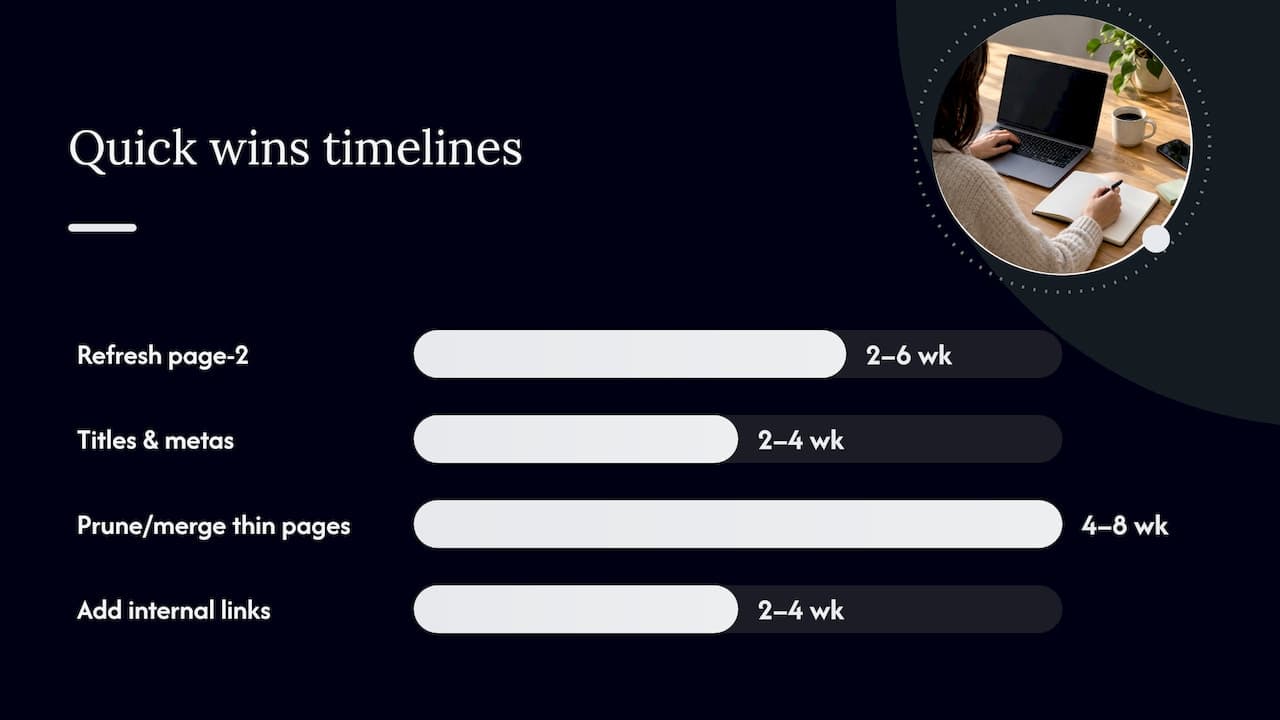
Picking topics by guesswork is the most common reason content fails to rank. A repeatable process beats intuition: start with seed topics that describe your business in plain language, then expand outward using competitor gap analysis to find long-tail queries you are missing entirely.
Competitor gap analysis means comparing the keywords a competing page ranks for against your own page on the same topic. The queries they rank for that you don't are your opportunity list, often filled with long-tail variations that are easier to rank for and still carry commercial or informational intent.
Once you have a list of candidate keywords, map each one to the intent behind it before you decide on a format:
Getting the format wrong is a common reason good content underperforms: a beautifully written guide will not outrank a comparison table if the searcher wanted a comparison table.
Group related keywords into topic clusters built around one pillar page and several supporting pages that each target a narrower query. The pillar page targets the broad term, the supporting pages target specific long-tail variations, and internal links tie them together so authority flows between them. This structure also helps Google understand which pages on your site are the authoritative source for a topic.
In practice, the workflow looks like this: identify three to five pillar topics central to your business, list ten to twenty supporting queries for each using seed-and-gap research, then decide which existing pages can be expanded versus which need new pages entirely. Write a brief for each piece that specifies the target query, the intent, the format, and which existing pages it should link to and receive links from.
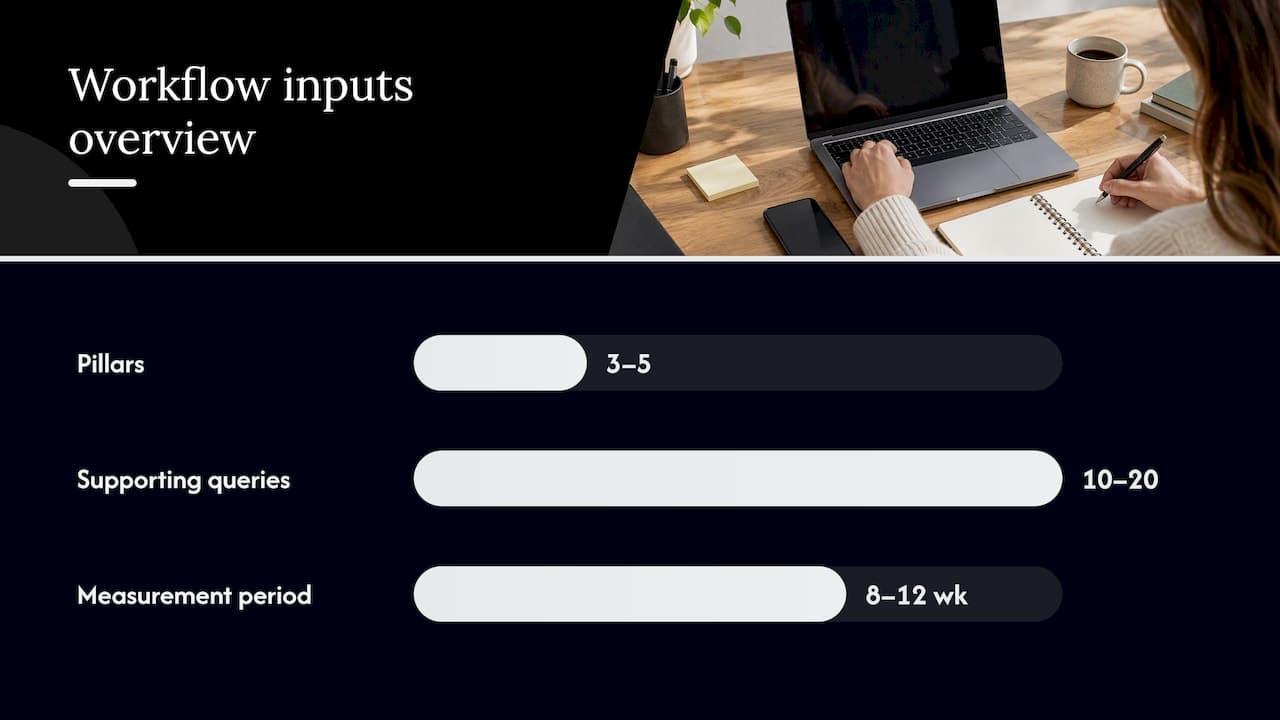
Measuring success for keyword-targeted content means watching more than rankings. Track impressions and average position in Search Console for the target query over eight to twelve weeks, then check whether click-through rate improves once the page starts appearing in results. A page that ranks but gets no clicks usually has a title or meta description problem, not a content problem. Organic traffic itself is best understood as a long-term asset: it is unpaid, compounding, and requires sustained investment rather than a one-time push to keep growing.
Good on-page SEO is really about respecting how people actually read. Most visitors skim before they commit, and search engines increasingly extract direct answers from pages to construct featured snippets and AI-generated summaries. A page structured for skimming tends to perform well in both contexts.
Titles and meta descriptions are your pitch in the search results. A title that matches the searcher's intent and states a clear value proposition earns more clicks than one that is technically accurate but vague. "SEO Tips" tells a searcher nothing; "12 SEO Fixes That Took Our Page 2 Posts to Page 1" tells them exactly what they'll get.
That last point matters more than it used to. When a page's H2 sections answer their own question in the first sentence, they become easier for AI systems to lift as standalone answers, and easier for a human skimmer to decide whether to keep reading. A section that buries its point in the third paragraph loses both audiences.
Credibility signals matter here too. Google's own guidance on Search Essentials repeatedly emphasizes people-first content, and that extends to visible signals of expertise: an author byline with relevant background, clear sourcing for any claim involving data, and transparency about when content was published or updated. A page that cites where its numbers come from is doing double duty, building reader trust and giving search engines a reason to treat it as a reliable source.
Internal links deserve the same intentionality as the writing itself. Place them where they genuinely extend the reader's next question, not stuffed into a sidebar list. A well-placed internal link from a high-traffic page to a newer page passes both authority and qualified visitors, which is often more valuable than an external backlink from an unrelated site. If you are refining drafts for readability and want to see how editing for authenticity affects both tone and search performance, practical content curation techniques offer a useful complementary approach.
Pro Tip: Write your H2 sections so each one could stand alone if someone only read that section. If a section depends on context from three paragraphs earlier, split it or rewrite the opening.
No amount of great content outranks a page Google cannot crawl or a page that loads so slowly visitors leave before it finishes. Technical SEO is unglamorous but it is the floor everything else stands on.
Core Web Vitals are the specific page-experience metrics Google recommends monitoring: Largest Contentful Paint (LCP) within 2.5 seconds, Interaction to Next Paint (INP) under 200 milliseconds, and Cumulative Layout Shift (CLS) under 0.1. Each has practical remedies:
Beyond page speed, crawlability and indexing deserve a regular audit. Confirm your XML sitemap is current and submitted in Search Console, check that robots.txt is not accidentally blocking pages you want indexed, and use canonical tags to tell Google which version of a page is the one to rank when you have duplicates, such as parameter-based URLs from filters or tracking tags. Parameter URLs left unmanaged can split ranking signals across multiple versions of what is really one page.
For monitoring, three tools cover most of what you need: the Core Web Vitals report inside Search Console shows real-user performance data across your site, PageSpeed Insights gives a page-by-page lab and field data breakdown, and Lighthouse (built into Chrome DevTools) helps you debug specific rendering issues during development. Run a technical audit quarterly at minimum, and immediately after any major site redesign or platform migration, since those are when crawl errors and broken canonicals are most likely to slip through.
Backlinks remain one of the clearest trust signals search engines use, but the tactics that earn them responsibly look nothing like the mass-email link spam of a decade ago. The goal is relevance and genuine value exchange, not volume.
That last point is worth dwelling on. Backlink value is not just about a domain's raw authority score. A page that already links to resources similar to yours, serving an audience that actually cares about your topic, is a stronger prospect than a generic high-authority site that has no topical connection, because that audience is more likely to click through and convert.
Some tactics are explicit violations of Google's spam policies and carry real ranking risk: buying or selling links that pass ranking signals without disclosure, participating in large-scale link exchange schemes, and generating content at scale purely to manipulate rankings are all flagged behaviors that can trigger manual penalties. If an outreach tactic requires hiding what you're doing from Google, it is a sign to skip it. For readers who want a broader set of distribution and outreach tactics alongside backlink strategy, this guide to sustainable organic traffic growth walks through complementary workflows.
Publishing a strong piece of content is only half the job. Traffic and links rarely arrive just because a page exists; they come from putting that content in front of people who will share it, link to it, or search for your brand later because they remember it.
Track which channels actually feed organic growth rather than assuming they all do. A referral spike from a newsletter mention often leads to a backlink a few weeks later, which can lead to branded searches a few months after that. Watching that chain in your analytics tells you which distribution channels are worth repeating and which are just noise.
SEO work is wasted if you cannot tell which changes actually moved traffic. Two metrics in Search Console matter most: impressions, which tell you whether Google is showing your page at all, and average position, which tells you how competitively it is ranking once shown. In GA4, watch engaged sessions and conversion events tied to organic traffic specifically, not blended totals that mix in paid and social.
This before-and-after approach works for structured data too: roll out JSON-LD to a subset of pages, wait several weeks, then compare click-through rate on those pages against a similar set that hasn't changed yet.
Structured data, written in JSON-LD, tells search engines explicitly what a page is about: an article, a how-to, a set of frequently asked questions. Google's structured data documentation recommends implementing it and testing on a subset of pages before a full rollout, since the eligibility for rich results and the resulting click-through impact can vary by content type.
| Schema type | Best used for | Typical rich result |
|---|---|---|
| Article | Blog posts, news content | Enhanced search listing with publish date |
| FAQPage | Pages answering multiple distinct questions | Expandable FAQ snippet in results |
| HowTo | Step-by-step instructional content | Numbered steps shown directly in results |
Documented case studies show structured data can meaningfully lift click-through rates when rich results appear: Rotten Tomatoes saw a significant CTR increase and Food Network experienced a notable rise in visits after implementing structured data on pages where they implemented structured markup correctly.
After implementing markup, validate it with Validator and confirm Google has detected it using the URL Inspection tool in Search Console. For AI-generated answers specifically, the same answer-first writing habit from the on-page section applies: open each section with a direct, self-contained answer so it can be extracted cleanly, and avoid burying the key fact in a long introductory paragraph. Avoid marking up content that is not visible to users, since that violates structured data policy and can disqualify a page from rich results entirely.
The honest answer depends on three things: how much time you have, how technical the gaps in your site are, and how fast you need results. A solo site owner with a few hours a week can realistically handle keyword research, content refreshes, and basic on-page fixes. What usually exceeds a DIY budget is large-scale technical SEO work, like fixing crawl architecture on a site with tens of thousands of pages, and backlink outreach at volume, which requires either significant time or a specialist relationship to do without cutting corners into spam territory. If your bottleneck is writing enough quality content fast enough, that's a narrower problem with narrower fixes available.
— Tilen
If your bottleneck is producing enough well-written content without sounding like it came off an assembly line, that's the specific problem we built Semihuman to solve. We take AI-assisted drafts and rework them into natural, readable text, restructuring sentences and integrating target keywords so the result reads like it was written by a person who understands the topic, not generated to fill a quota.
This fits naturally into the content refresh and cluster-building work described above: once you have a brief and a draft, running it through our tool can save the editing hours that usually eat up a content calendar. Compare Free, Basic, and Pro plans to find the right fit, or check Developer, Business, and Enterprise API access if you want to connect it directly to your existing workflow.
Focus first on matching content to what searchers actually want, fix any technical blockers that keep Google from crawling or indexing your pages, and build backlinks from topically relevant sites. Refreshing pages that already rank near page one tends to produce the fastest visible gains, while new content and backlinks typically take months to mature.
An increase in organic traffic means more visitors are arriving at your site through unpaid search results rather than ads or social referrals. It generally signals that your pages are ranking higher or appearing for more relevant queries, and because it is unpaid and compounding, it tends to be more cost-effective over time than paid traffic.
Yes, search engine optimization is specifically the practice of improving how a site ranks in unpaid search results, which is what organic traffic refers to. SEO work, from keyword targeting to technical fixes to backlinks, is the primary lever for growing that unpaid traffic over time.
The fastest realistic wins come from refreshing pages already ranking on page two of search results and fixing critical errors flagged in Search Console, since both can show movement within weeks. Larger gains from new content or backlink outreach take longer, typically months, to fully pay off.
Updating existing pages with current information, improved internal links, and clearer answers to the target query can help them regain or improve rankings, particularly for pages that have slipped over time. This is part of the broader principle in Google's Search Essentials guidance that sustained, people-first upkeep matters more than one-time publishing.




Start
Humanizing
for Free!
Humanize