
Loading...

Managing your online reputation means knowing what people find when they search for you, watching what is said about you, answering criticism calmly and publishing accurate, credible content so the true picture is what shows up first. Start with a search audit of your name or brand, set up a monitoring routine, and treat the work as a continuous loop, not a one-time cleanup. This guide walks through each step in order.
Online reputation management (ORM) is a multi-channel effort to monitor and manage the activity that shapes how current and prospective customers see you, especially what appears in top search results, as Search Engine Journal explains. In practice it covers reviews, social conversations, news coverage, forum threads and your own website and profiles. If you want a second walkthrough aimed at small teams, this step-by-step reputation guide covers the basics in a brand marketing context.
It applies to people as well as companies. A freelancer, a journalist, a student applying for jobs and a 50-person agency all face the same question: when someone types my name, what do they learn?
The numbers from the U.S. market are blunt. Semrush reports that almost 60% of U.S. consumers would avoid a brand that appears untrustworthy, 59% research online before buying, and 97% consult product reviews. These are U.S. figures, not global estimates, but they show how much of a buying decision happens before anyone talks to you.
There is also a loyalty effect. The same Search Engine Journal piece notes that responding to complaints can increase customer loyalty, so a public problem handled well can work in your favor.
The first step is a search audit. Nextdoor's small business guide suggests searching your business name in quotation marks, including aliases, nicknames, former businesses and social profiles, then inspecting at least four pages of results and repeating the search on other search engines and relevant social platforms.
Go beyond the name alone. Buyers type modifiers, so check these too:
Search in a private or logged-out window so personalization does not skew what you see. Then write it down. A simple spreadsheet works: the query, the top ten results, whether each is owned by you, earned, or controlled by someone else, and whether the tone is positive, neutral or negative.
If something already looks wrong, Search Engine Land recommends checking Google Autocomplete, the top 20 results, the image carousel, related searches and People Also Ask boxes. Damaging content often hides in these corners, not in the blue links.
For review sites, record average rating, review volume, response rate and time to first reply, and note recurring positive and negative themes. ICUC Social's checklist uses exactly these measures. The themes matter more than any single review: three people complaining about the same shipping delay is a business problem, not just a reputation problem.
Monitoring means tracking what customers say across review sites, social media and search results. Xero's small business guide boils it down to three habits: free Google Alerts, a weekly check of review sites such as Google Maps and Yelp plus industry-specific platforms, and a monthly search of your business name to see page one.
That is a sound minimum. Know its limits, though. Formative Digital warns that Google Alerts can miss social posts, private groups and review pages behind logins or JavaScript, so it recommends manually searching platform-native results weekly. Semrush's advice is to set alerts for your brand name and common misspellings, then add a monitoring tool that gathers mentions from news sites, blogs and discussion groups.
If you are in a crisis or a contested market, move the checks to daily until things calm down.
It helps to list every place your reputation lives: search, social, reviews, news, forums, AI-generated summaries and your own properties. ICUC Social suggests separating what you control (your site, your profiles) from what you do not (press, third-party reviews). That split tells you where to publish and where you can only respond.
How you reply is visible to everyone who reads the thread, so every reply is a piece of public evidence about you. The U.K. Federation of Small Businesses, in its guidance on untrue allegations, advises you to stay calm and factual, avoid public arguments, invite private discussion, clarify misunderstandings and report content that breaches platform guidelines. It also suggests deciding in advance who speaks for you, which channels you will answer on, and keeping templates ready.
These are three different things. The Society of Authors advises correcting demonstrably false factual claims politely, not challenging mere opinions, and not engaging with trolls, since engagement can raise their visibility. A one-star review that says "too expensive for me" is an opinion. A review that says you never delivered an order you delivered is a factual claim you can answer. A stream of abusive comments is something to report and ignore.

Before you reach for any removal tool, remember the order of operations. According to Google's legal help page on defamation, the most effective way to get content removed is to contact the person who posted it. If the site owner takes it down, it disappears from the web, not just from Google. If Google removes only the search result, the page still exists and can be reached through other search engines or direct links.
The practical sequence looks like this:
On that last point, NewReputation's help center says content removed from Google's index can reappear after the next crawl if the source page still exists, and that pushing unwanted results down with better content can take 4 to 12 months depending on the authority of what you are competing with. Plan for months, not days.
A hijacked account is one of the fastest ways to damage a reputation. The U.K. National Cyber Security Centre advises turning on two-step verification, reviewing privacy settings, limiting unnecessary personal details and checking what your contacts say about you online. Experian adds unique strong passwords, a password manager and multifactor authentication to reduce account takeover and impersonation risk. It also suggests searching your name, variants, email addresses and phone numbers, and securing a personal domain and consistent social profiles to reduce mistaken identity.
Claim the profiles that matter, keep your name, messaging and visual identity consistent across them, and publish authoritative content. Status Labs recommends expert content, case studies, white papers, podcasts, contributed articles and genuine earned media, so accurate information is available to search engines and AI systems alike. A good place to begin is an About page on your own site that states what you want people to know.
People often confuse the two. SEO tries to rank your website for the keywords customers search, while ORM makes sure everything that ranks for your name builds trust, as Local Impact frames it. Reputation Resolutions describes SEO as a core technical ingredient of ORM with a narrower goal: controlling a whole results page for a small set of identity queries, such as your name, your brand and your executives, so accurate results fill the visible positions.
The overlap is content. Pages you publish and optimize can occupy the top positions for your name. That is why content quality sits at the center of reputation work, and why our own writing on building authority through content and content authenticity for marketers belongs next to any ORM plan.
Pick a few numbers and track them on the same day each month:
| Metric | What it tells you | Where to find it |
|---|---|---|
| Average rating per platform | Overall sentiment trend | Each review site |
| Review volume | Whether feedback is growing | Each review site |
| Response rate and time to first reply | How reliably you engage | Review dashboards |
| Page-one results you own | Control of your name searches | Your monthly audit |
| Negative results on page one | Progress on cleanup | Your monthly audit |
If you also publish content to shape those results, a guide to choosing metrics for content programs can help you decide which visibility numbers to add. Our article on content metrics for marketers goes deeper on that side.
We build Semihuman because reputation is mostly made of words, and more of those words now start life as AI drafts. Your About page, your review replies, your contributed articles and your press statements are the material people and search systems use to judge you.
Our view is that the drafts are not the problem. Text that reads as generic, repetitive and machine-patterned is. It weakens the authority you are trying to build, and it can trigger the AI detectors that students, editors and clients increasingly run.
That is why our tool is designed to detect AI-generated text and restructure it so it reads as naturally human-authored, while keeping the meaning intact and working in your keywords. Used well, that means faster publishing without a voice that sounds like everyone else's. For teams that publish at volume, we also offer an API so the same step can sit inside an existing workflow.
Reputation work rewards consistency. A steady stream of credible, human-sounding content is the cheapest long-term protection we know of.
Tilen
If your reputation plan involves regular publishing, such as profile copy, case studies, articles or replies drafted with AI, Semihuman is designed to turn those drafts into natural, human-sounding text. It also restructures for readability and integrates keywords for SEO. You can start on the Free, Basic and Pro plans, or look at the Developer, Business and Enterprise options if you want to connect it to your own systems through the API.

For background on why this matters for search, read how AI affects search rankings and what Google's helpful content update means for authenticity.
Days 1 to 14: audit. Run every name and brand search, record the top results, log review ratings and response times, and secure your accounts with two-step verification.
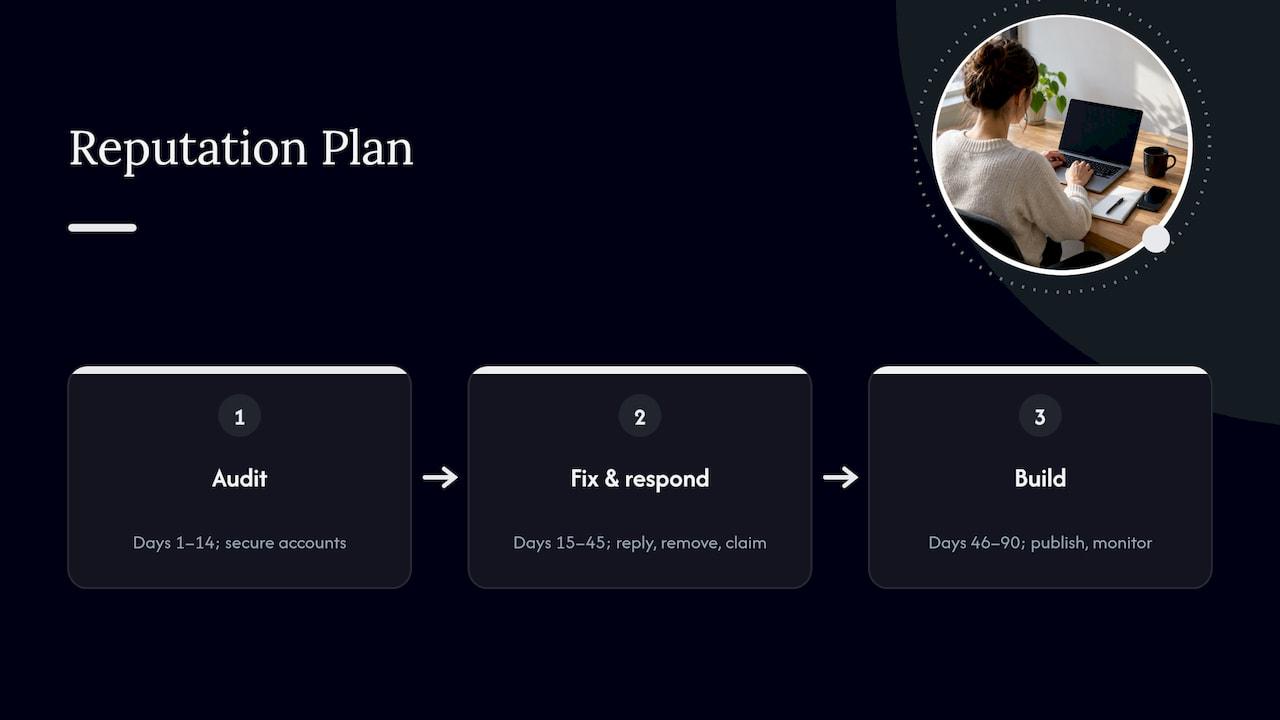
Days 15 to 45: fix and respond. Reply to open reviews, request removal of inaccurate content from its source, and claim missing profiles with consistent names and images.
Days 46 to 90: build. Publish an About page, a few substantial pieces of expert content and, where you can, earned coverage. Set your weekly monitoring routine and repeat the full audit at the end of the quarter, then every quarter after.
Search your name or brand in quotation marks, along with aliases and variations, and review several pages of results. Then add modifiers like "reviews" and "complaints" and check review sites and social platforms. Record everything so you can measure change later.
Secure your accounts with unique passwords and two-step verification, tighten privacy settings and limit unnecessary personal details. Claim your key profiles, keep your identity consistent, and publish accurate content that you control.
Audit what appears for your name, then contact the person or site that posted the problem content first, since that is what actually removes it. For anything that stays, publish stronger, accurate content over several months so it outranks the problem result.
No, though they overlap. SEO ranks your website for the keywords customers search, while reputation management focuses on what appears when someone searches for you by name. Good content serves both goals.




Start
Humanizing
for Free!
Humanize