
Loading...

An effective introduction grabs attention with a focused hook, gives just enough context for the thesis to make sense, and closes with a clear, contestable thesis, often with a brief roadmap, as this writing handout advises. A practical split gives the hook one to three sentences, as Grammarly's guide recommends, then adds enough context to prepare for the thesis. Many writers draft that thesis only after the body is finished, so the claim actually matches what the essay proves.
TL;DR:
- A roadmap previews how the body supports the thesis; shorter essays can omit it, but the thesis itself should make a specific, defensible claim.
- Match context to the assignment: lab reports need procedural framing, literary analysis needs its text and question, and personal essays may need only a scene.
- For research papers, use a sourced statistic only when it directly supports the claim; narrative essays often benefit from a brief, concrete scene.
- For a master's essay, establish the research field, situate it in existing literature, identify a specific gap, and explain why the study matters.
Before worrying about word choice, check that the paragraph is doing its job. An introduction engages attention, orients the reader in the topic, presents an argument, and maps how the essay will unfold.
The trap most students fall into is giving too much background. An introduction only needs the context that makes the thesis intelligible, nothing more. Save the rest for body paragraphs, where it belongs.
What counts as "enough" context also shifts with the assignment. A lab report needs a sentence of procedural framing; a literary analysis needs a line about the text and a narrow interpretive question; a personal essay might need almost no background at all, just a scene that sets up the reflection to come.
Every strong introduction is built from the same handful of parts, even when the prose style changes from essay to essay.
The thesis usually sits at the very end of the introduction because everything before it should be building toward that one sentence. A roadmap is not the same thing as a thesis: the thesis makes the claim, the roadmap tells the reader how the body will support it, and shorter essays often skip the roadmap entirely.
The parts need to flow into each other without seams. A hook about a surprising fact might move into one sentence of context explaining why that fact matters, then land on a thesis that answers the question the fact raised. If a transition feels forced, the fix is usually to cut a sentence of context rather than add a bridging phrase.
Grammarly's guide to essay hooks groups effective openers into a short list of reliable types, each suited to a different essay and audience. Keep the hook concise so the thesis still feels necessary once it arrives.
Whichever type you choose, the hook has to point toward the thesis. A striking opening that leads nowhere reads as decoration, not argument.
This sequence works for many essay types, from short assignments to longer research papers.
Pro Tip: If the introduction feels flat, scan your body paragraphs for the strongest sentence you already wrote and build the hook around it instead of inventing a new one.
This order feels backward to students used to writing in a straight line, but it solves the most common introduction problem: a thesis that no longer matches the essay underneath it.
Run a finished introduction through this checklist before submitting:
Before: "Throughout history, technology has changed the way people live. From the wheel to the smartphone, every invention has had an impact on society. This essay will discuss how social media affects teenagers." After: "A teenager reaches for her phone before breakfast, not because she wants to, but because the app is built to pull her back. Social media's design, not teenagers' willpower, drives compulsive use among adolescents."
The edit cuts the broad historical sweep, replaces a thesis announcement with an actual claim, and gives the opening sentence a concrete scene instead of a generality. As the Humanities LibreTexts guide to essay introductions notes, many writers only reach a strong opening by drafting the introduction after the body is done.
Most weak introductions share the same handful of problems, all fixable in one editing pass.
The same four parts, hook, context, motive, thesis, show up differently depending on what the essay is trying to do.
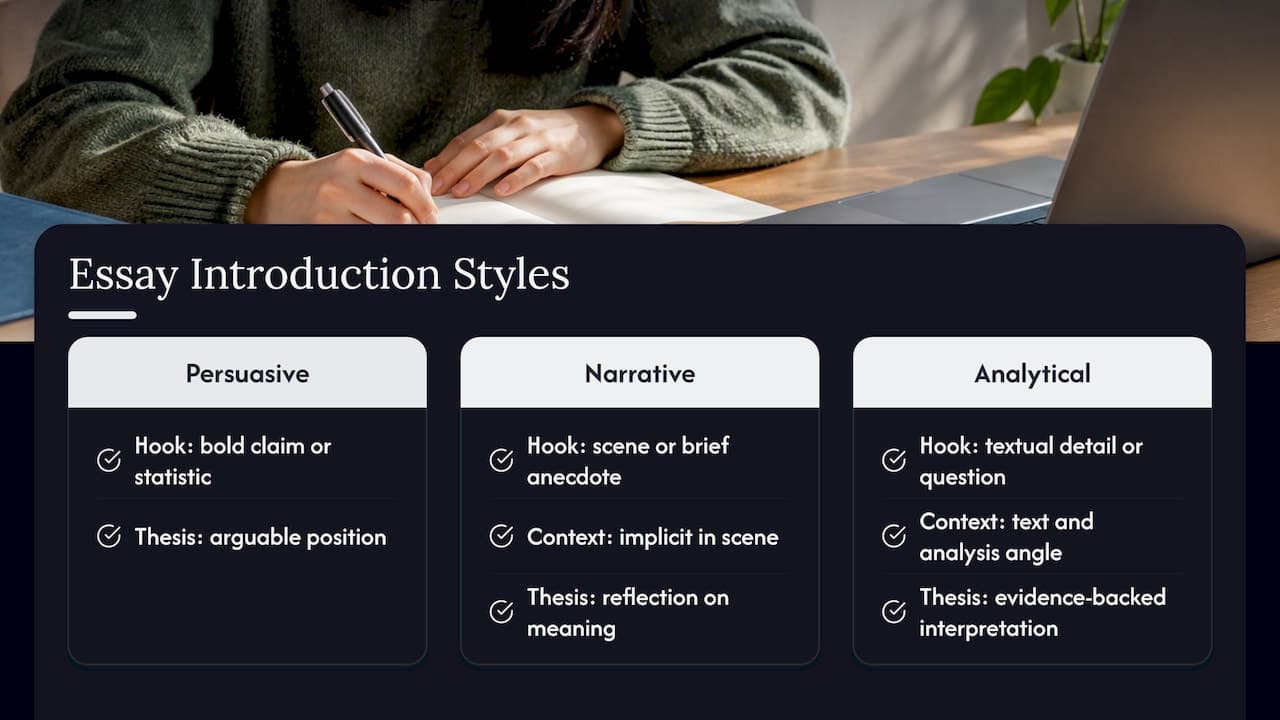
A persuasive essay benefits from a bold claim or a pointed statistic as the hook, since the goal is to establish stakes immediately. The thesis should read like a position someone could reasonably argue against, not a neutral observation.
A narrative essay usually opens with a scene or a brief anecdote rather than an abstract claim. Context here is often implicit, built into the scene itself, and the "thesis" may be a reflective statement about meaning rather than a formal argument.
An analytical essay, including literary analysis, tends to open with a specific textual detail or a narrow interpretive question. Context should name the text and the particular angle of analysis, and the thesis should state an interpretation that the body will support with evidence, not a plot summary.
Across all three, the test stays the same: does the opening match the kind of claim the body is built to prove? A scene-based hook followed by a formal, academic thesis statement will feel mismatched no matter how well each part is written on its own.
Student writers submitting essays online, and anyone posting written work to a blog or portfolio, sometimes need an introduction to work for search visibility as well as for a reader or grader. The fix is the same one that makes an introduction readable in the first place: specificity.
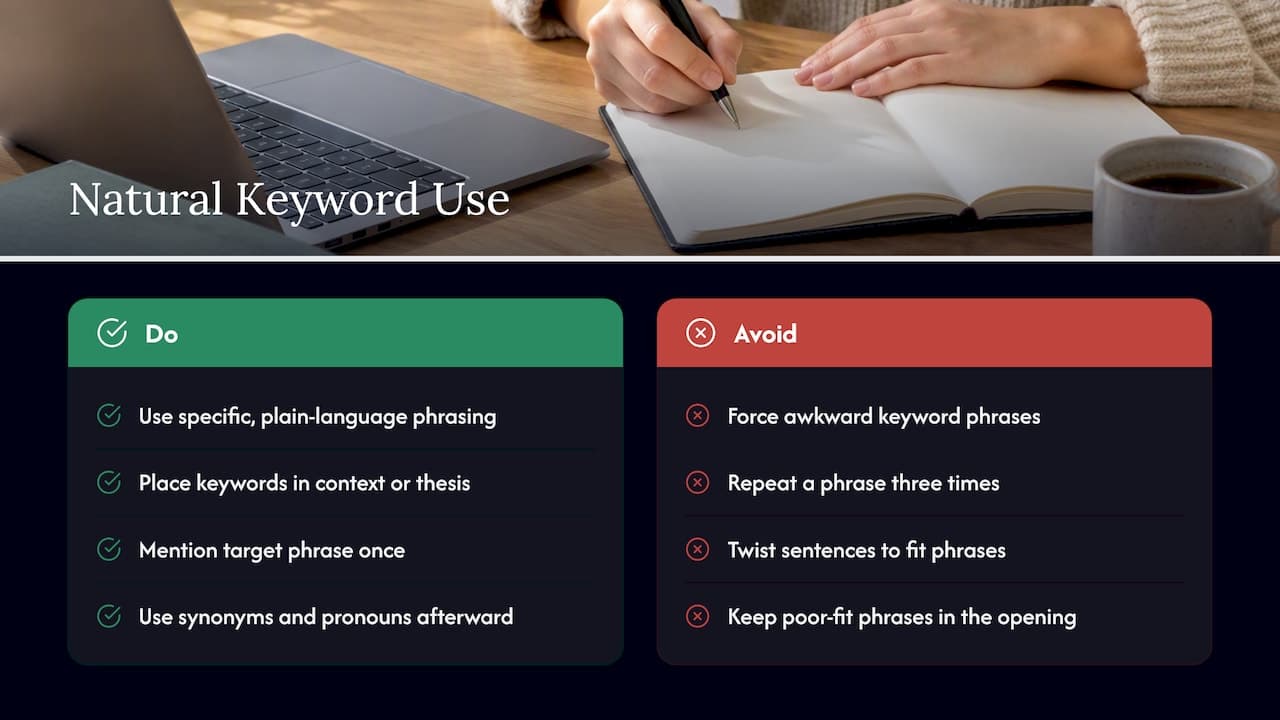
Instead of forcing a phrase like "effective essay hooks" into an awkward sentence, work the underlying idea into the context or thesis where it fits naturally, the way this guide names "hook," "context," and "thesis" as functional terms rather than keywords to repeat. A sentence that already explains a concept in plain language usually contains its own natural keyword phrasing.
Keep any target phrase to one clear mention in the opening paragraph, then rely on synonyms and pronouns afterward. Repeating the same phrase three times in one paragraph reads as stuffing to a human reader and does not help an otherwise thin introduction. If a phrase cannot fit without twisting the sentence, it belongs in a heading or a later section instead of the opening.
A first draft from an AI writing tool can be a useful starting point for structure, but it tends to produce introductions with flat rhythm: sentences of similar length, generic transitions, and a thesis that states a fact instead of making a claim. Treat that draft as raw material, not a finished paragraph.
Start by varying sentence length on purpose: follow a short, punchy hook with a longer context sentence, then close with a tight thesis. Replace generic nouns and vague transitions with specific details from your own research or experience, a particular statistic, a named source, a scene you actually observed. Read the paragraph aloud; a sentence that sounds stiff or overly formal usually needs a plainer verb or a shorter clause.
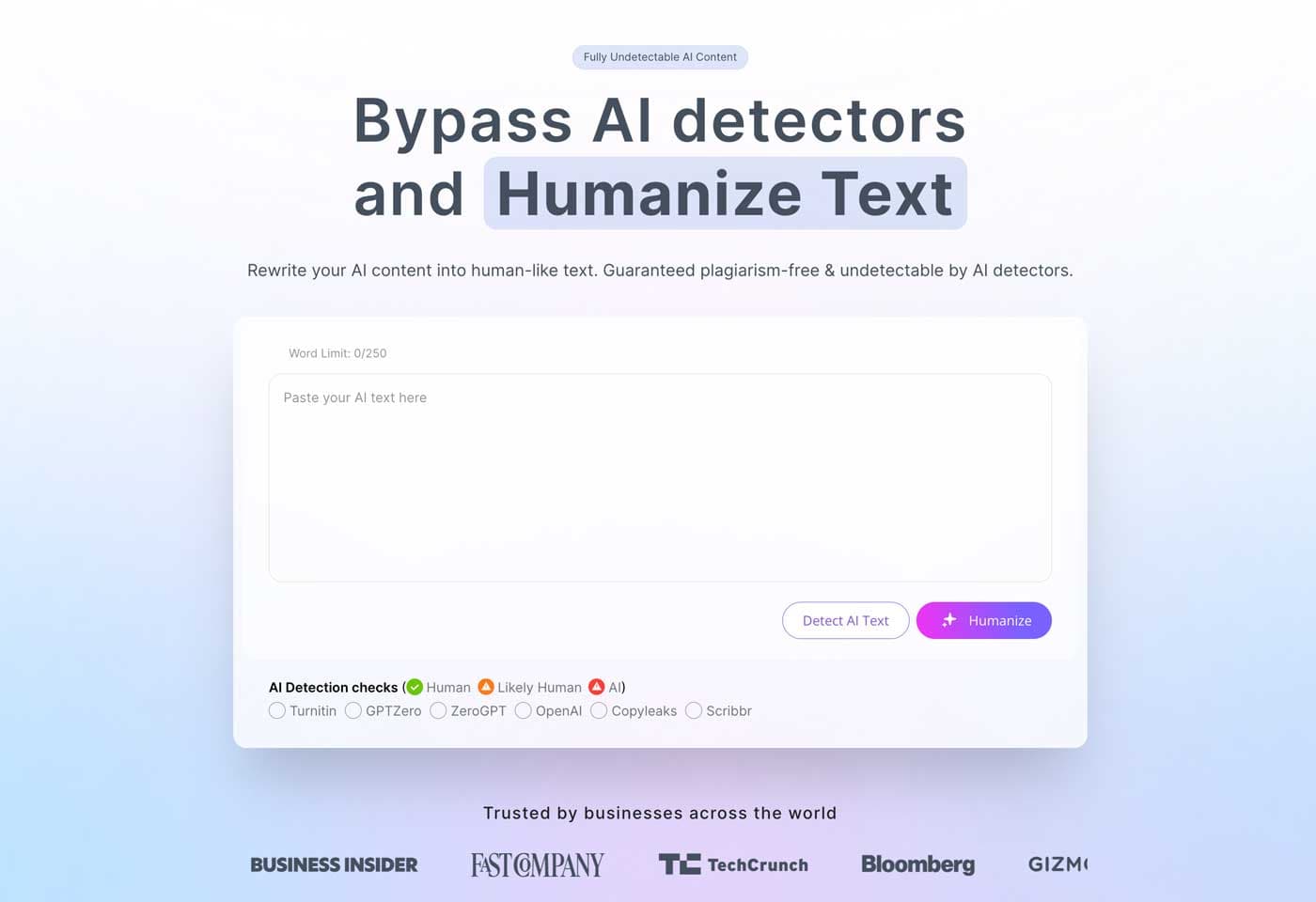
A tool built specifically to rewrite AI-flavored prose into more natural phrasing, such as Semihuman, can speed up this pass by restructuring sentences and adjusting rhythm while keeping the thesis intact, which is useful once the ideas are set and only the voice needs work.
Writing the thesis after finishing the body paragraphs fixed more mismatched introductions than any single revision trick I've tried. I also keep three hook drafts for any piece and pick the one that leads most naturally into the context, rather than the one that sounds cleverest on its own.
Peer feedback catches a gap no checklist will: whether the introduction signals what the body actually delivers. Keeping a running list of hook and thesis templates from essays that worked makes the next first draft faster.
— Tilen
Once the structure is right, the last mile is voice: sentences that feel stiff, a thesis that reads more like a summary than a claim, or an opening paragraph that drags because every sentence runs the same length. That's a gap Semihuman can help address.
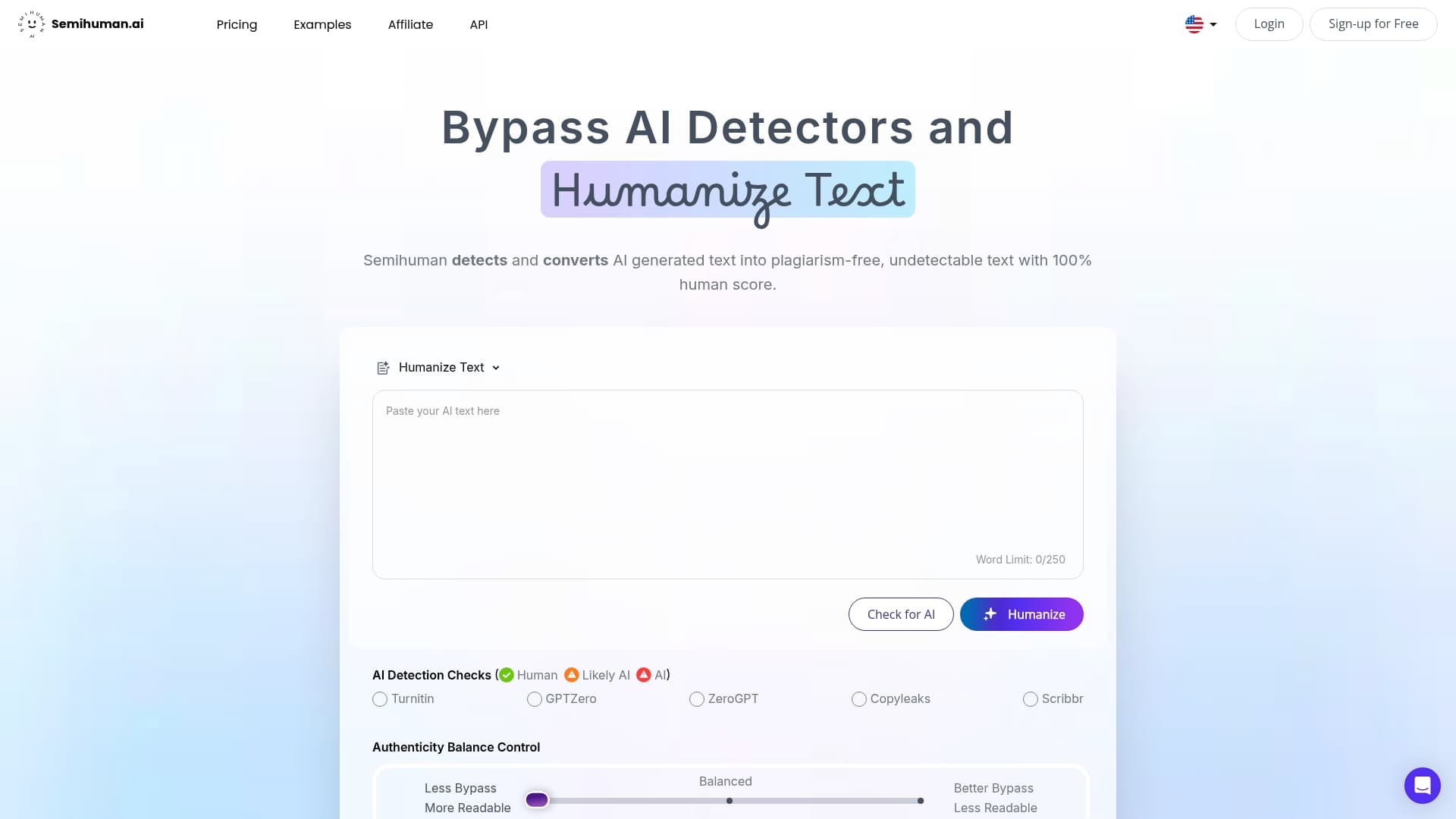
We restructure sentences to vary rhythm, smooth overly formal academic tone, and tighten long opening lines while aiming to preserve the meaning of your thesis. This step works best after you've drafted your hook, context, and thesis using the checklist above; it's a polish pass, not a substitute for building the argument. Current plan details are on our plans page, and current API access details are on our API page. Start with the free plan and run your next introduction through it before you submit.
A master's-level introduction needs to establish a research territory: show why the topic matters, situate it in existing literature, name a specific gap, and state the study's significance, as outlined in MIT's guide to thesis outlines. Keep the hook minimal and let the literature context and gap statement carry most of the paragraph's weight.
Start with a hook that earns attention in one to three sentences, a question, a fact, a short anecdote, or a bold claim, chosen to fit your essay type. Follow it with just enough context for your thesis to make sense, then end the paragraph with the thesis itself.
Reliable openers include a rhetorical question, a statistic or fact, a brief anecdote, a vivid description, and a short quote, each suited to different essay types as described in Grammarly's guide to essay hooks. A bold claim can also work well for persuasive essays when the thesis can back it up.
Many experienced writers draft the introduction after finishing the body paragraphs, since that order lets the thesis match what the essay actually proves. Drafting first is fine for getting started, but plan to revisit the opening once the argument is complete.
The most common mistake is a broad "funnel" opening or a dictionary definition that delays the actual argument, a pattern Harvard's writing center specifically advises against. A close second is a thesis announcement like "In this essay I will discuss," which states an intention instead of making a claim.
These sources go deeper into the specific techniques covered above and are worth reading directly for additional examples and nuance.



Start
Humanizing
for Free!
Humanize