
Loading...

Phrase rewriting for authenticity means restating an idea in your own voice while preserving its original meaning and crediting the source. Done right, it sharpens clarity, reflects your voice, and keeps you on the right side of academic and professional integrity standards.
Start here, right now:
Authentic phrase rewriting requires a look-away draft, a meaning check, and a citation — in that order, every time.
| Point | Details |
|---|---|
| Look-away draft first | Write the idea from memory before touching any tool; this prevents patchwriting. |
| Meaning check is non-negotiable | Verify hedges, numbers, and causal claims match the original before finalizing. |
| Citation always required | Paraphrasing does not remove attribution obligations in academic or professional work. |
| Detector scores are a byproduct | False-positive rates on authentic writing reached a very high level in Stanford-led research; write for clarity, not detector output. |
| Semihuman for structural lift | Use Semihuman's AI text paraphraser after your look-away draft for sentence-level variety and tone control. |
Authentic rewriting is not synonym swapping. Replacing "significant" with "considerable" while keeping the same sentence structure is called patchwriting, and universities treat it as plagiarism. The goal is to absorb the idea, then express it the way you would explain it to a colleague.
Three terms get confused here. Rephrasing tweaks wording at the surface level. Paraphrasing restructures the sentence and shifts the word class while keeping the meaning intact. Rewriting goes further, sometimes reorganizing the logic of a passage. All three still require a citation when the underlying idea belongs to someone else.
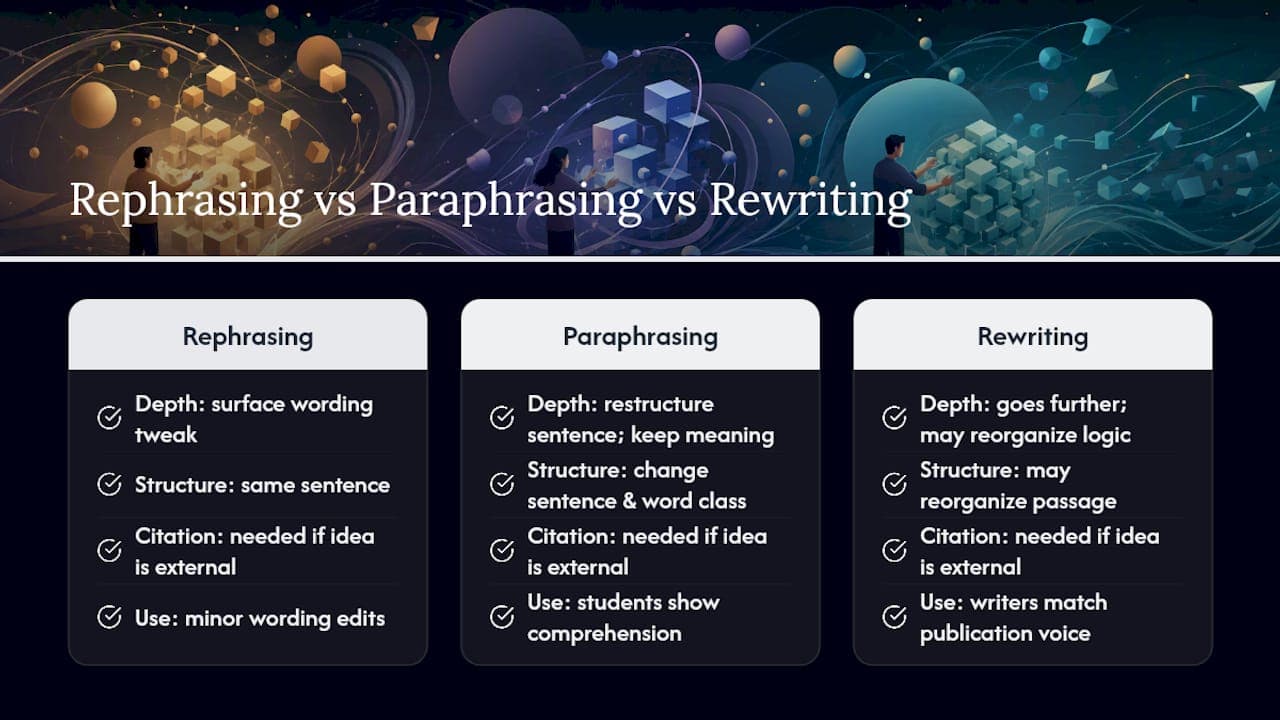
The use cases split cleanly by audience. Students paraphrase source material to show comprehension without quoting verbatim. Professional writers rewrite client briefs or research summaries to match a publication's voice. Marketers adapt technical copy for different channels without losing the original claim's accuracy.
Academic library guidance backs a workflow that consistently produces authentic rewrites. Follow these steps:
Pro Tip: The look-away draft is the single most effective technique for avoiding patchwriting. Writing from memory forces genuine interpretation rather than surface editing. Compare your draft to the original only after you've written it.
Grammarly's paraphrasing guide adds a useful structural move: shift word class. Turn a noun phrase into a verb clause, or a passive construction into an active one. That alone changes the sentence architecture enough to make the rewrite genuinely yours.
Students face the highest stakes. A paraphrase that stays too close to the source text risks a plagiarism flag even when the intent was honest. A student writing a literature review on climate policy, for example, needs to absorb a researcher's finding and express it in their own analytical voice, not echo the abstract.
Content marketers deal with a different pressure: adapting the same core message across a blog post, a LinkedIn update, and an email without the repetition reading as copy-paste. Authentic rewriting preserves the claim while shifting the sentence shape and tone for each format. Content originality matters for marketers precisely because audiences notice when a brand sounds like it's reading from a script.

Technical writers often work with source material they didn't produce: engineering specs, legal summaries, clinical data. Their job is to translate precision into clarity without softening a hard fact.
Non-native English writers benefit most from the look-away method. Writing from memory in your own voice produces more natural phrasing than editing someone else's sentence word by word. The role of AI in content strategy increasingly includes supporting this kind of stylistic lift without replacing the writer's judgment.
Not every AI rewriting tool is built for authenticity. Before you pick one, check for these features:
Privacy matters too. If you're rewriting a client proposal or unpublished research, check whether the tool stores your input. Read the data-handling policy before you paste anything sensitive.
One practical rule: use AI suggestions as a second opinion, not a final draft. Run the tool after your look-away draft, accept the structural changes that improve clarity, and then do a manual meaning check. AI writing always needs human editing before it's ready to publish or submit.
| Original phrase | Rewritten phrase | Why it works |
|---|---|---|
| "The results indicate a significant improvement in patient outcomes." | "Patients showed measurable improvement, according to the study results." | Shifts from passive to active; preserves hedging ("according to") and the factual scope. |
| "Numerous studies have demonstrated the efficacy of this approach." | "Research consistently supports this method's effectiveness." | Removes vague quantifier; keeps the claim's strength without overstating it. |
| "The algorithm was unable to process inputs exceeding the defined threshold." | "Inputs above the set threshold caused the algorithm to fail." | Converts passive construction to active; preserves the causal relationship and the technical fact. |
| "Smith (2021) argues that early intervention reduces long-term costs." | "Early intervention tends to lower long-term costs, Smith (2021) contends." | Moves the citation to the end; shifts verb from "argues" to "contends" for variety; keeps the hedge. |
What changed in each case: sentence structure, voice (passive to active), and word class. What stayed the same: the core claim, the numbers, and the hedging language.
Pro Tip: After every rewrite, read only your version and ask: "Does this make the same claim, with the same confidence level, as the original?" If the answer is no, you've changed the meaning, not just the words.
The most common failure modes:
On AI detectors: they are less reliable than most people assume. Stanford-led research found an average false-positive rate of 61.22% on authentic TOEFL essays, meaning detectors flagged genuine human writing as AI-generated at a striking rate. The arXiv paper behind that research showed that a vocabulary-enrichment intervention dropped misclassification from 61.22% to 11.77%, not by gaming the detector, but by increasing lexical richness.
The practical implication: optimizing your rewrite for a detector score is the wrong goal. A detector penalizes linguistic patterns, not authenticity. Write for clarity and voice. The detector score follows. For a deeper look at why AI content gets flagged, the triggers are often structural, not semantic.
A reliable human-plus-AI loop looks like this:
Disclosure depends on context. For academic submissions, follow your institution's policy. Many universities now require a statement when AI tools assisted with drafting or editing. For client work, disclose if the client's contract or brief requires it. For web content, there's no universal rule, but transparency builds trust. When in doubt, follow your instructor's or employer's guidelines. The MIT Academic Integrity Handbook is a useful reference for academic contexts.
Semihuman is built for exactly the workflow described above. Its core features align with the checklist in this article:
The best way to test it: do your look-away draft first, then run Semihuman's AI text paraphraser on your draft for stylistic lift. Compare the two versions. Accept the structural improvements, keep your phrasing where it's stronger, and run the meaning check before you finalize. That loop keeps you in control of the content while the tool handles the heavy lifting on sentence variety.
The instinct to optimize for detector output is understandable, but it points in the wrong direction.
Detector tools measure statistical patterns in text. They don't measure whether an idea is genuinely yours or whether you understood what you read. A rewrite that scores well on a detector but drops a crucial qualifier or rounds a reported figure is worse than useless. It's a meaning error dressed up as clean prose.
The look-away method works because it forces comprehension. You can't write an idea from memory unless you actually understood it. That's the test worth passing. Detector scores are a byproduct of good writing, not the target. Write for your reader, check your meaning, cite your sources, and the scores tend to take care of themselves.
Rewriting for authenticity takes real effort. Semihuman shortens the loop without skipping the steps that matter. Paste your look-away draft into the AI text paraphraser, set your tone, and get structural alternatives in seconds. The output is designed to preserve your meaning and register, not flatten them. You still run the meaning check and add the citation. Semihuman handles the sentence-level variation so you can focus on accuracy and voice.
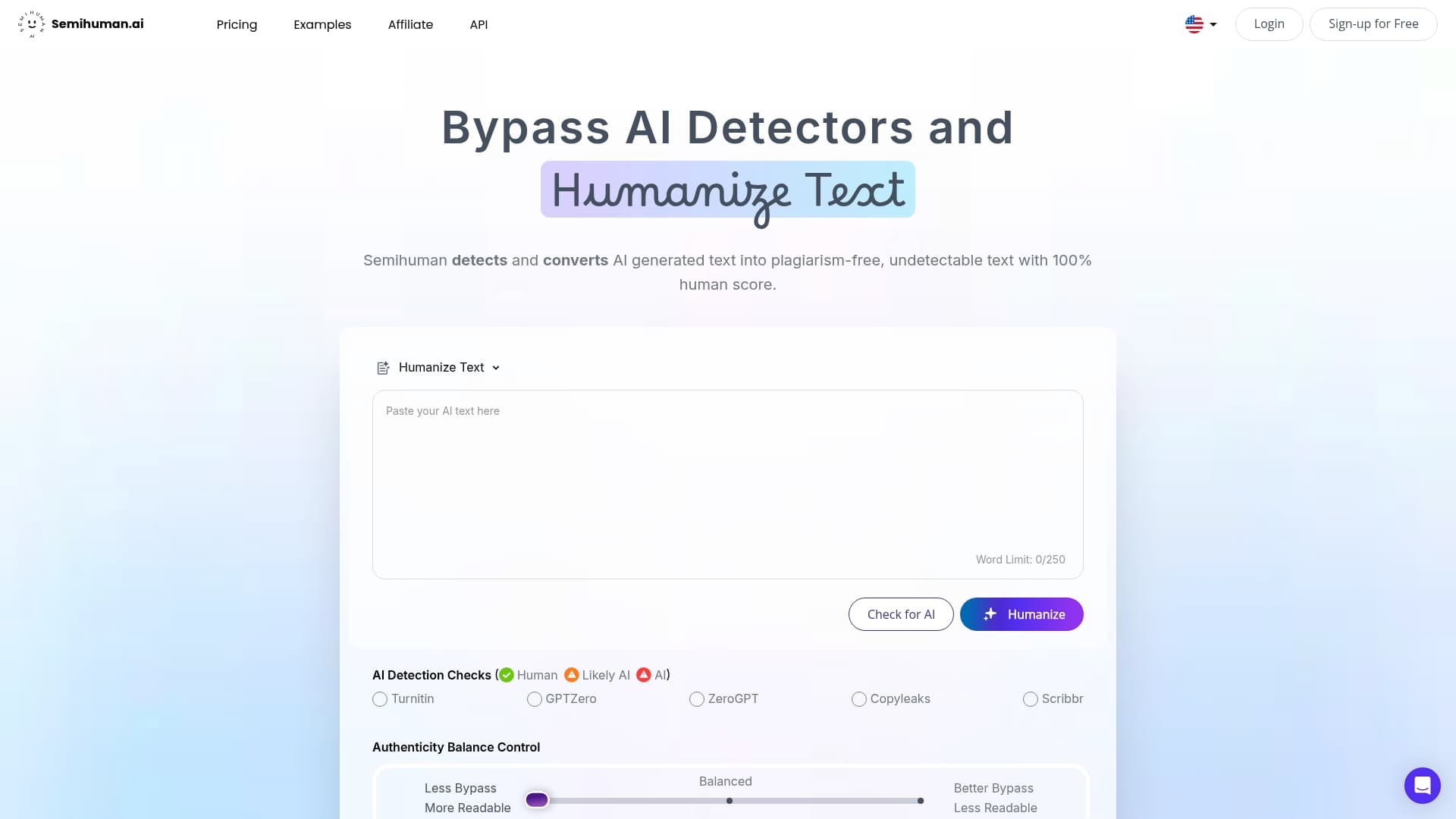
For writers who also need their content to hold up against AI detection tools, Semihuman's detector-resilient rewriting applies the same lexical-richness principles the Stanford research identified. Your input stays private. Try the paraphraser on a single paragraph today and compare it to your look-away draft.
The guidance in this article draws on a short set of primary sources worth bookmarking. APA Style's paraphrasing page is the clearest single reference on when and how to cite a paraphrase. The SNHU Library FAQ on paraphrasing walks through the stepwise workflow that underpins the how-to section above. For the detector-bias evidence, the Stanford HAI summary and the full arXiv paper give the complete picture on false-positive rates and the vocabulary-enrichment intervention. Grammarly's paraphrasing guide rounds out the practical technique advice, particularly on changing sentence structure and verifying meaning.



Start
Humanizing
for Free!
Humanize