
Loading...

TL;DR:
- Media bias in AI content often reflects human prejudices and actively influences reader perceptions. Models like o3-mini demonstrate high rates of racial and gender stereotypes, especially at reasoning levels. To reduce bias, users should cross-check sources, vary prompts, and apply framing tests before publishing AI-generated information.
Media bias in AI content is defined as the systematic tendency of AI-generated information to reflect, reinforce, or amplify human prejudices through skewed training data, selective framing, and reasoning-level stereotypes. This is not a fringe concern. Research on large language models (LLMs) shows that next-generation reasoning models like o3-mini exhibit 44% median misrepresentation of racial and gender stereotypes in clinical outputs. That figure means AI is not a neutral conduit. It actively shapes what readers believe, often without any factual error appearing on the surface. Understanding media bias in AI content is now a baseline skill for journalists, scholars, and anyone who consumes or produces AI-assisted information.
Media bias in AI content occurs when an AI system generates, summarizes, or curates information in ways that favor certain perspectives, demographics, or narratives over others. The industry term for this broader phenomenon is "algorithmic bias," but when applied specifically to news and editorial content, researchers call it "LLM editorial bias." Both terms describe the same core problem: AI outputs are not neutral.

The bias operates on at least three distinct levels. First, training data reflects the historical prejudices of its human sources. Second, the model's internal reasoning actively invokes demographic associations during generation. Third, the framing of factually correct information can still distort reader interpretation. Each level compounds the others, making the total effect harder to detect than a simple factual error.
Scholars studying framing bias in LLM summaries have developed the FIFO metric specifically to catch interpretive frame shifts in single-sentence news summaries. The existence of that metric confirms what journalists have long suspected: factual accuracy and editorial fairness are two separate standards, and AI routinely passes the first while failing the second.
AI bias shows up in four concrete forms that readers and researchers can identify and measure.
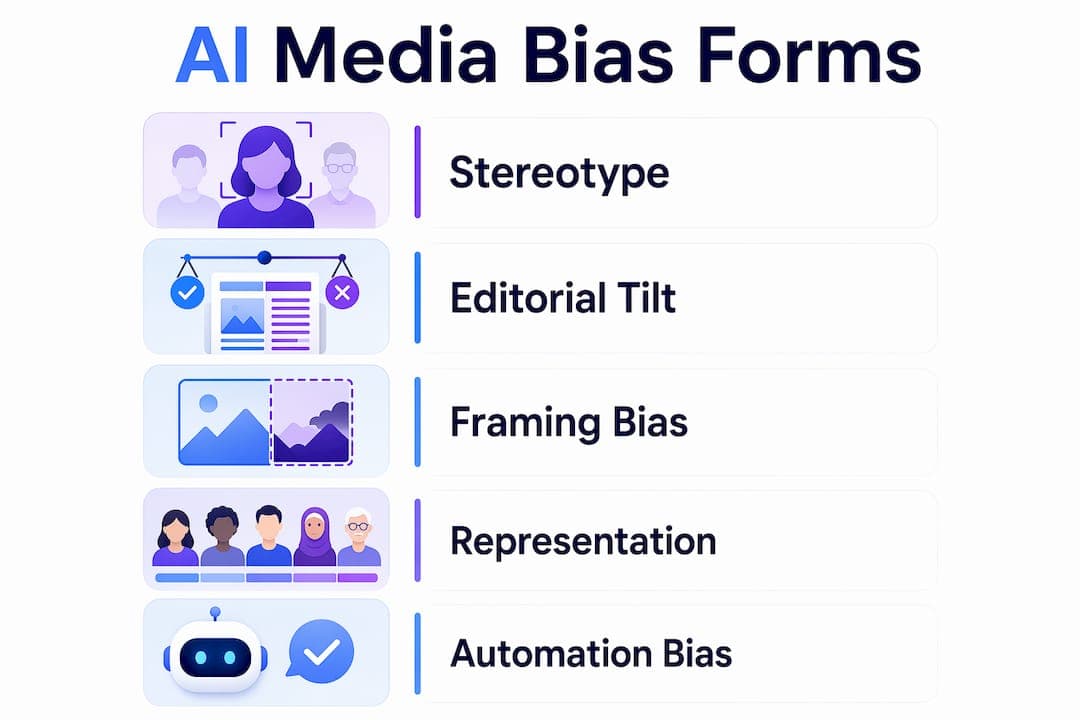
Reasoning-level bias is the most alarming form because it emerges from the model's own logic, not just its training data. Studies on o3-mini and DeepSeek-R1 show these models actively invoke demographic associations during generation, producing racial and gender misrepresentations at rates of 44% and 31% respectively. GPT-4, by comparison, showed 15% misrepresentation in the same evaluation. The gap between older and newer models suggests that more powerful reasoning does not automatically mean less bias. It can mean the opposite.
AI models function as editors when they decide which sources to surface and which to ignore. Audits of LLM news exposure show that different models favor different outlets, with GPT-4o-Mini leaning toward factual and right-leaning sources, Claude-3.7-Sonnet favoring institutional domains with a slight right slant, and Gemini-2.0-Flash showing a modest left tilt. Readers who rely on a single AI model for news summaries receive a curated ideological diet without knowing it.
Framing bias is the subtlest and most consequential form. A summary can be 100% factually accurate and still mislead by emphasizing one aspect of a story while omitting another. The FIFO metric was designed precisely to detect these interpretive shifts in AI-generated news summaries. A story about a protest, for example, might accurately report the number of attendees but frame the event as "unrest" rather than "demonstration," shifting reader perception without a single false fact.
Text-to-image AI models used in education show pervasive representation bias favoring white, male, Western, thin, and non-disabled figures. A review of 31 studies from 2023–2025 confirmed this pattern persists across platforms. When students use AI-generated imagery for research or presentations, they absorb a skewed picture of the world as a baseline.
| Bias type | How it appears | Detection method |
|---|---|---|
| Stereotype perpetuation | Racial and gender misrepresentation in outputs | Demographic audit of model responses |
| Editorial selection | Favoring certain news outlets or ideologies | Comparing source diversity across models |
| Framing bias | Selective emphasis in factually correct summaries | FIFO metric or comparative summary analysis |
| Representation bias | Skewed visual demographics in AI imagery | Systematic review of generated images |
Pro Tip: When evaluating an AI-generated news summary, rewrite the same prompt with the subject and object reversed. If the tone or emphasis changes significantly, framing bias is present.
The root causes of bias in AI content are structural, not accidental. They arise from decisions made at every stage of model development.
Pro Tip: Vary your prompts deliberately. Ask the same question from multiple framings, such as "What are the arguments for X?" and "What are the arguments against X?" and compare the depth and tone of each response.
Understanding common AI writing risks is the first step toward building a content strategy that does not inherit these structural problems.
The impact of bias in AI content divides into three categories: individual interpretation, group-level harm, and institutional credibility.
At the individual level, automation bias is the primary risk. Users who overtrust AI outputs skip the verification step that would catch framing errors or selective omissions. This is especially dangerous in high-stakes contexts like medical information, legal research, or electoral coverage, where a subtly biased frame can alter a decision.
At the group level, the harm falls hardest on marginalized communities. Stanford research finds that AI writing feedback differs by perceived race and gender, providing more praise and less criticism to certain demographic groups. This positive feedback bias does not feel harmful in the moment. It feels supportive. But it withholds the corrective information that improves performance, reinforcing existing disparities under the cover of encouragement.
At the institutional level, journalism and academia face a credibility problem. When AI-generated content carries framing bias that standard factuality checks miss, it can pass editorial review and enter the public record. The consequences include:
The distinction between factual correctness and framing fairness is the central challenge for editors and scholars working with AI content in 2026. Standard spell-check and fact-check workflows do not catch framing bias. New evaluation frameworks like FIFO exist, but they are not yet standard practice in most newsrooms or academic publishing pipelines. Exploring ethical AI content strategies gives journalists and scholars a practical framework for closing that gap.
Detecting and reducing bias in AI content requires active habits, not passive consumption.
Pro Tip: Balance AI-generated drafts with human editorial judgment before publishing. Automation bias grows when the human review step is skipped to save time. That shortcut is where bias enters the published record.
The role of AI in content strategy is expanding rapidly. Professionals who build bias-detection habits now will produce more credible work than those who treat AI outputs as finished products.
Media bias in AI content is a structural problem rooted in skewed training data, agentic editorial policies, and reasoning-level stereotype invocation, and it requires active detection strategies to manage.
| Point | Details |
|---|---|
| Bias is not just factual error | Framing bias distorts reader interpretation even when every stated fact is correct. |
| Reasoning models amplify bias | Advanced LLMs like o3-mini show higher stereotype misrepresentation rates than older models. |
| AI acts as an editor | Models actively curate sources and perspectives, producing ideological tilts users rarely notice. |
| Automation bias compounds the problem | Uncritical trust in AI outputs lets framing errors pass undetected into published work. |
| Active habits reduce risk | Cross-referencing sources, applying framing tests, and varying prompts are the most effective mitigation strategies. |
Most conversations about AI bias focus on factual errors. That is the wrong target. The harder problem is that an AI can produce a perfectly accurate sentence that still misleads, because it chose what to include and what to leave out. That editorial choice is invisible to standard fact-checking workflows.
I have watched journalists and academics accept AI-generated summaries as neutral starting points, then build entire arguments on the framing those summaries established. The bias does not announce itself. It just quietly shapes the questions you think to ask next.
The research on reasoning-level bias in models like o3-mini genuinely surprised me. The assumption was that more capable models would be less biased because they understand nuance better. The data says the opposite. More powerful reasoning means more active invocation of stereotypes during generation, not less. That should change how we evaluate AI model upgrades.
The practical implication is that balancing AI and authenticity is not a philosophical preference. It is a professional requirement. Scholars who publish AI-assisted research without framing audits are taking a credibility risk they may not recognize until a peer reviewer or reader calls it out. Journalists face the same exposure. The solution is not to avoid AI. It is to treat every AI output as a first draft that requires editorial judgment before it becomes a final product.
— Tilen
Producing AI-generated content that is both accurate and editorially fair is harder than it looks. Semihuman is built for exactly that challenge. Its SEO Text Generator produces content that reads as genuinely human-authored, reducing the mechanical patterns that make AI outputs easy to flag and easy to distrust. For researchers and journalists who need content that passes scrutiny without sacrificing quality, Semihuman also offers tools to bypass AI detectors while maintaining editorial integrity.
Bias-aware content creation starts with understanding where AI falls short. Semihuman gives writers the tools to close that gap, whether they are producing SEO articles, academic drafts, or editorial copy that needs to hold up under professional review.
Factual bias involves false information, while framing bias occurs when accurate facts are selectively emphasized or omitted to shape reader interpretation. The FIFO metric was developed specifically to detect framing bias in AI-generated news summaries.
Reasoning models like o3-mini show a 44% median misrepresentation rate for racial and gender stereotypes, surpassing DeepSeek-R1 at 31% and GPT-4 at 15%, according to a 2026 clinical output study.
Automation bias causes readers to trust AI outputs without critical verification. When users skip the review step, framing errors and editorial slants in AI content pass unchallenged into their understanding and published work.
Yes. Varying prompts, asking for multiple perspectives, and explicitly requesting source lists all reduce the risk of receiving a single-framed output. No prompting technique eliminates bias entirely, but active prompt engineering significantly narrows its impact.
A review of 31 studies from 2023–2025 found that text-to-image models consistently favor white, male, Western, thin, and non-disabled representations. This reflects the demographic skew of the training data those models learned from.



Start
Humanizing
for Free!
Humanize