
Loading...

TL;DR:
- AI-written essays sound unnatural because they predict language based on averages rather than personal experience or genuine reasoning.
- They lack specific details, argumentative friction, and the imperfections that reveal human thinking, making them appear hollow and overly polished.
AI-written essays sound unnatural because they are built on probability, not experience. A large language model predicts the most statistically likely next word, drawing from an average of everything ever written on a topic. That process produces prose that is technically correct but hollow at its core. Understanding why AI-written essays sound unnatural matters for students who want to protect their own voice and for educators who need to recognize artificial intelligence writing flaws in submitted work. The gap between AI fluency and human authenticity is structural, not cosmetic.

The root cause is mechanical. AI returns the average of all writing on a topic, which means it cannot produce content that is truly original or specific to any one person's experience. Human writing earns its authority from constraints: a student who struggled with a particular argument, a teacher who watched a class fail to grasp a concept, a writer who changed their mind halfway through a draft. AI has none of that.
Large language models also lack persistent intent. AI reconstructs its content goals every few hundred words, which is why AI essays often feel like they are circling the same point without building toward anything. A human writer carries a thesis forward through every paragraph. An AI model resets its sense of direction constantly, producing generic organizational patterns that feel repetitive and flat.
The result is what researchers call structural shallowness. AI outputs the most statistically probable word sequences, and no amount of editing or detailed prompting can fix that at the source. You can ask an AI to "write like a college junior" or "add more personality," but the underlying mechanism still favors consensus language over risk. That is why AI essay writing issues persist even when students try to customize the output.
What readers perceive as AI writing is often a sense of hollowness. The specific detail that only a person with lived experience would include is simply absent. No embarrassing example, no moment of genuine doubt, no argument the writer actually had to fight for.
The most obvious sign is polish. Human writing shows hesitation, varying sentence length, and occasionally awkward phrasing. Those imperfections signal a real person working through ideas in real time. AI prose is too smooth. Every sentence lands cleanly, every transition connects logically, and the result feels assembled rather than written.
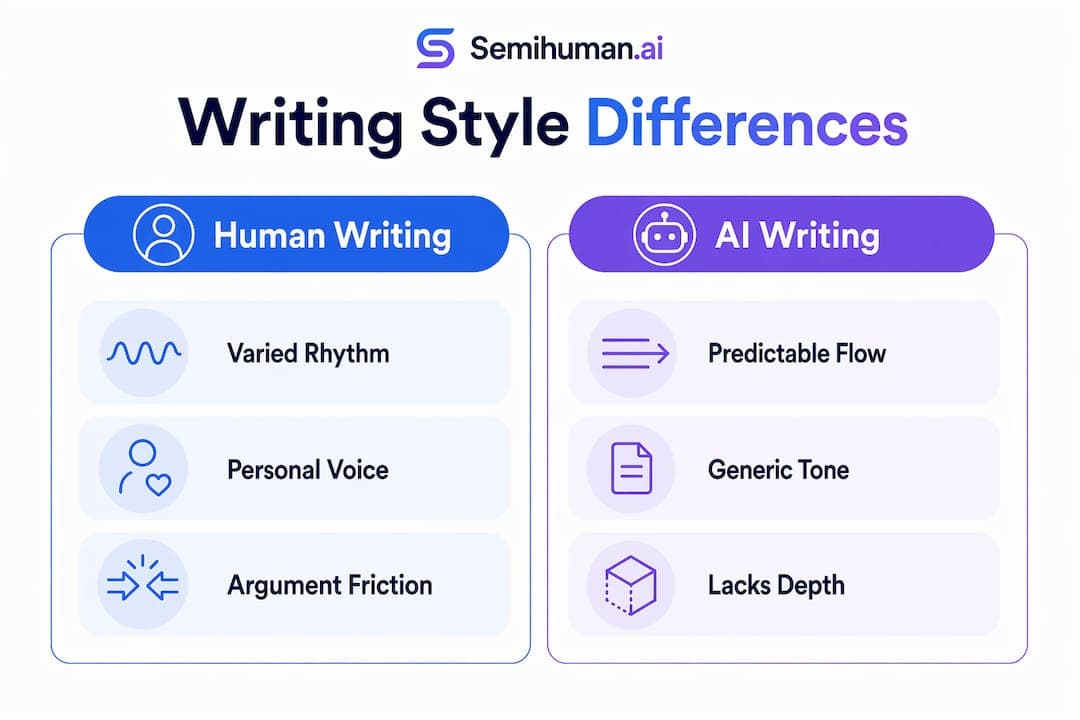
AI essays also rely on a narrow set of transitional phrases. Words like "additionally," "it is clear that," and "in light of this" appear with mechanical regularity. A human writer builds transitions from the actual logic of their argument. An AI model reaches for the most common connective tissue it has seen in training data.
The deeper problem is the absence of argumentative friction. Educators identify AI use by spotting essays that present all sides of an issue without actually committing to one. Human essays argue. They push back, concede ground reluctantly, and reveal what the writer actually believes. AI essays perform balance without taking a position.
Pro Tip: Before submitting any AI-assisted draft, read it aloud. If you never stumble, never feel surprised by a sentence, and never disagree with a claim, the essay probably lacks a human voice. Add one paragraph where you argue against your own thesis, then refute it.
Here is how the two writing styles compare across key dimensions:
| Feature | Human writing | AI-generated writing |
|---|---|---|
| Sentence rhythm | Varied, sometimes irregular | Consistently smooth |
| Transitions | Built from argument logic | Formulaic and repetitive |
| Personal stakes | Present, often explicit | Absent or generic |
| Argumentative position | Committed and defended | Balanced to the point of vagueness |
| Specific examples | Drawn from experience | Generic or hypothetical |
| Imperfections | Natural and revealing | Absent |
Detection tools are less reliable than most educators assume. A Stanford 2023 study found a 61.3% average false-positive rate when detection tools were tested on 91 student essays written by humans. That means more than half of genuine student work was flagged as AI-generated. That number should give every educator pause before acting on a detection result alone.
The tools also perform inconsistently across AI generations. Detectors work better on older models like GPT-3.5 but fail more often on newer ones like GPT-4, which produce text that is harder to distinguish from human writing. Hybrid texts, where a student uses AI for a draft and then revises heavily, complicate detection further.
The false-positive problem creates a secondary harm. Some students rewrite well-written essays to score below a 30% AI content threshold, deliberately making their prose less polished to avoid being flagged. That is a pedagogical failure. Students are optimizing for detection safety rather than for writing quality.
Experienced educators rely less on software and more on content knowledge. Educators spot AI use through missing personal details, lack of critical verification, and arguments that never take a real position. That kind of reading requires subject expertise, not an algorithm.
The fix for AI's generic sound is not a better prompt. Human writing quality comes from real thinking and lived experience, which AI cannot replicate. Students and educators need strategies that put human material back into the writing process before a draft is ever generated.
For students, the most effective approach is an interview-first method:
For educators, the goal is to teach reasoning rather than police output. Assignments that require students to cite personal experience, defend a specific claim under questioning, or revise a peer's argument are far harder to complete with AI alone. Process-based assessment, including drafts, outlines, and in-class writing, reveals the thinking behind the final product.
Pro Tip: Educators can ask students to submit a one-paragraph "thinking log" alongside any major essay. The log should explain one moment where the student changed their mind during drafting. AI cannot produce a genuine thinking log because it does not change its mind.
Tools that humanize AI-generated text can help students who use AI assistance produce writing that reads more naturally. The key is using those tools as a revision layer on top of genuine human input, not as a replacement for it. Authentic content starts with authentic thinking, and no tool changes that equation. Learning how to sound less robotic is a skill that benefits both AI-assisted and purely human writing.
AI-driven content strategies in professional contexts face the same challenge: the output is only as specific as the human input that shapes it.
AI-written essays sound unnatural because they are structurally incapable of producing the specific perspective, argumentative friction, and lived detail that define authentic human writing.
| Point | Details |
|---|---|
| Structural cause | AI predicts average language patterns, producing hollow prose regardless of prompting. |
| Detection tool limits | A Stanford study found a 61.3% false-positive rate, making software alone unreliable for enforcement. |
| Educator advantage | Experienced educators identify AI essays through missing personal stakes and absent argumentative commitment. |
| Student fix | Write personal notes and examples before using AI, then revise output to reflect your actual position. |
| Educator fix | Design assignments requiring process evidence, such as drafts and thinking logs, that AI cannot fake. |
The real damage from AI fluency is not academic dishonesty. It is the quiet erosion of student confidence. AI's polished prose makes students believe their own ideas are inadequate by comparison. A student reads their rough draft next to a clean AI version and concludes that the AI is simply better at thinking. That conclusion is wrong, and it is dangerous.
What the AI produced is not better thinking. It is more average thinking, dressed in cleaner sentences. The student's rough draft, with its hesitations and half-formed arguments, contains something the AI version never will: a real person working through a real problem. That is the raw material of intellectual growth.
Educators who respond to AI by tightening restrictions miss the deeper issue. The pedagogical failure happened before the student opened an AI tool. If students do not believe their own voice is worth developing, they will always reach for something that sounds more authoritative. The answer is not to make AI harder to access. The answer is to make students feel that their specific, imperfect, personal thinking is exactly what the assignment is asking for.
I have watched this play out repeatedly. The students who use AI most heavily are often the ones who are most anxious about being wrong. They are not lazy. They are afraid. Treating AI use as a moral failure misses that entirely. The better response is to design assignments where being wrong in an interesting way is worth more than being right in a generic one. Imperfection is not a flaw in student writing. It is the evidence that a human being was actually thinking.
— Tilen
Understanding why AI essays fall flat is the first step. Knowing what to do about it is the second.
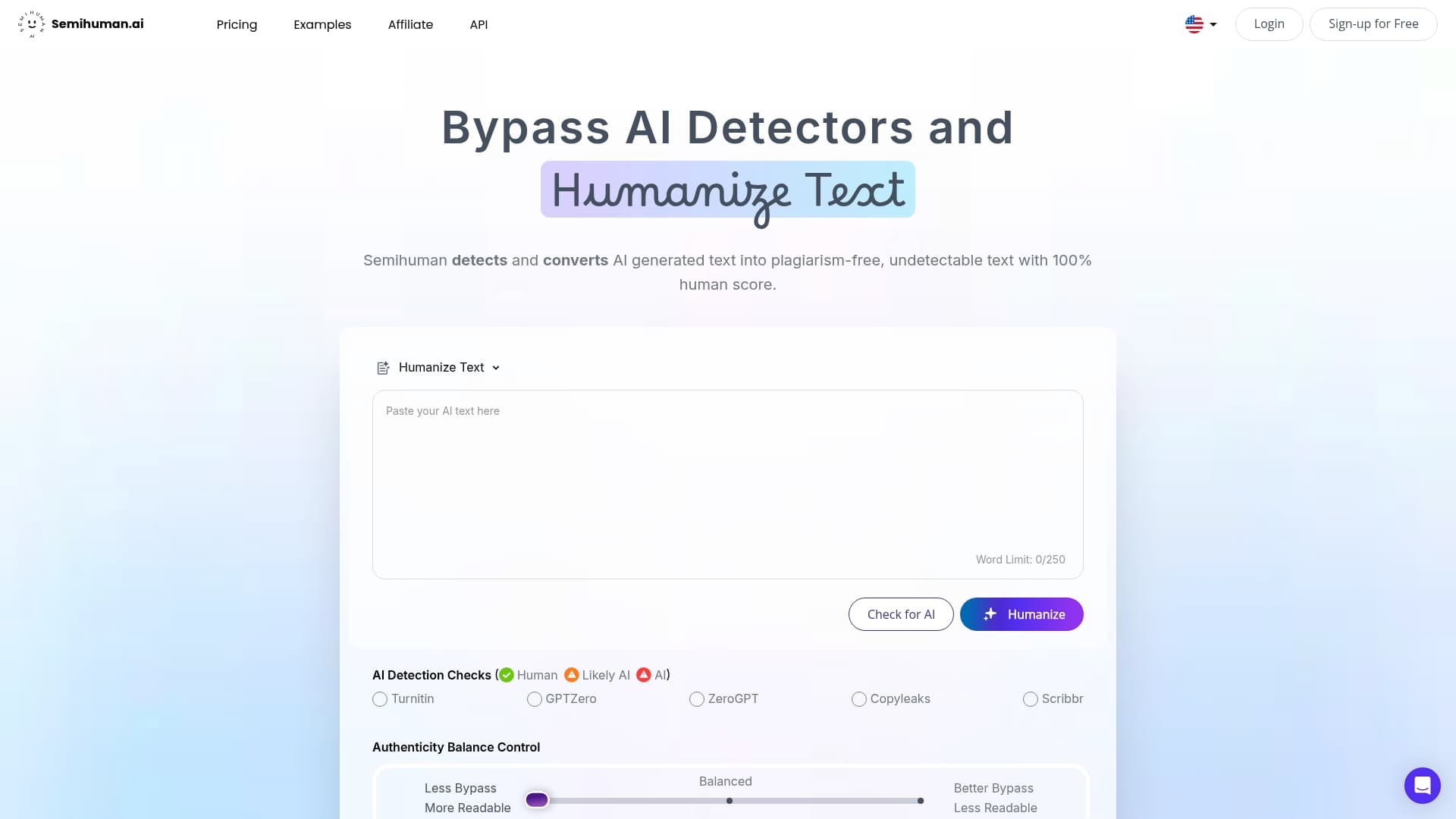
Semihuman's AI Proof Writing tool helps students and educators work with AI-generated text without losing the human voice that makes writing worth reading. The platform restructures AI output to read more naturally, flags the generic patterns that trigger detection tools, and preserves the specific details you bring to the draft. For students who use AI assistance, Semihuman adds the layer of authenticity that raw AI output cannot produce on its own. For educators evaluating submitted work, it clarifies where the human voice is present and where it is not. Explore Semihuman's SEO text generator for content that reads as genuinely authored.
AI essays sound robotic because the model predicts statistically average language rather than drawing on personal experience or genuine argument. The result is smooth but hollow prose that lacks the specific details and friction of human thinking.
Detection software alone is unreliable, with false-positive rates as high as 61.3% in controlled studies. Experienced educators are more accurate when they read for missing personal stakes, absent argumentative commitment, and lack of critical verification.
Editing helps but does not solve the core problem. The structural shallowness of AI prose comes from its probabilistic mechanism, so surface edits leave the generic foundation intact. Adding genuine human material before drafting produces better results than revising after.
Human essays include specific examples, personal stakes, and moments where the writer commits to a position and defends it. Those elements come from lived experience and real thinking, neither of which AI can replicate.
AI-written essays are effective at producing grammatically correct, well-organized text. They are ineffective at demonstrating the reasoning, personal voice, and argumentative depth that academic writing is designed to develop and assess.



Start
Humanizing
for Free!
Humanize