
Loading...

Your introduction either earns the next sentence or loses the reader forever. The most reliable approach: lead with your direct answer, then prove it. Every strong opening passes three questions readers silently ask: What is this about? Why should I care? What will I get? Miss any one of them and even a clever hook won't save your bounce rate.
The UW–Madison Writing Center frames introductions as invitations to an intellectual conversation, not throat-clearing. That framing matters: your intro is a marketing instrument for your ideas, and for AI-generated content, it's also the section detectors scrutinize hardest.
Run this before you publish anything:
Pro Tip: Do the three-second scroll test. Cover everything after the first two sentences and ask: does a stranger know what this piece is about and why they should keep reading? If not, rewrite those two sentences before touching anything else.
Introductions lose readers in the first three seconds when the opening line fails to create tension or promise value. These six hooks cover almost every format and audience:
The psychology behind all six: curiosity gap, priming, and emotional triggers. Questions create open loops. Stats prime the reader to accept your framing. Stories trigger mirror neurons. Pick the hook that fits your audience's emotional state when they land on the page.

A practical hook/context/promise structure works across formats. These templates let you swap in specifics without increasing AI-detection risk.
Blog post
Marketing email
Landing page
Social post
To humanize an AI draft, swap the generic subject for a named audience, replace vague outcomes with specific results, and cut any sentence that could apply to any topic. That specificity is what authentic blog content relies on to feel human.
Experienced writers often draft the introduction last so the opening promise matches what the body actually delivers. Apply the same logic when editing AI output.
Pro Tip: Log every change you make in a simple comment or tracked-changes note. Detectors flag text that looks uniformly polished. A few deliberate, logged edits create the micro-variation that signals human revision.
Keyword stuffing and AI detection share a root cause: both result from mechanical, pattern-driven writing. The fix for one usually fixes the other.
Do: Place the primary keyword in the first 50 words inside a natural phrase. Use one or two LSI terms (related concepts, not synonyms) in the same paragraph. Write the sentence around the keyword, not the keyword around the sentence.
Don't: Force exact-match phrases into positions where a human wouldn't use them. Don't repeat the keyword in consecutive sentences. Avoid rare or elevated synonyms inserted purely to avoid repetition — detectors recognize that pattern too.
The common AI writing risks that damage SEO and trigger detectors overlap heavily: overuse of formal connectives, uniform sentence length, and abstract nouns where concrete ones belong. Vary sentence length deliberately, and your keyword placement will feel natural as a side effect.
Pro Tip: Use user-intent phrasing rather than exact-match phrases. "How to write introductions that pass AI detection" reads more naturally than "writing compelling introductions guide 2026" and still captures the search signal.
Pro Tip: Read your intro alongside three competitors' intros. If yours sounds interchangeable with theirs, you haven't said anything specific enough to earn the click. One concrete detail or named example is usually all it takes to separate it.
Blog post
Before (AI draft): "Writing an effective introduction is a crucial skill for any content creator. There are many factors to consider when crafting an engaging opening paragraph."
After (humanized): "Your first sentence decides whether anyone reads the second. Here's the three-part structure that fixes most weak openings in under ten minutes."
What changed: Removed the generic claim and the passive list setup. Replaced with a direct consequence and a specific promise. Sentence length dropped from 18 words to 11.
Marketing email
Before: "We wanted to reach out to share some information about our new content tool that may be of interest to you."
After: "GPTZero flagged your last three posts. Semihuman's humanization pass fixes that before you hit publish."
What changed: Eliminated the throat-clearing opener. Named the specific pain point and the tool in the same sentence. Detection risk drops because the sentence structure is conversational, not templated.
Landing page headline + lead
Before: "Advanced AI Content Solutions for Modern Marketers"
After: "Your AI draft is one detector away from being flagged. Semihuman rewrites it so it reads like you wrote it."
What changed: Swapped the abstract feature label for a concrete reader fear, then answered it immediately. The content marketing mistakes that hurt SEO authenticity almost always trace back to writer-centered framing like the "before" version.
Micro-phrases for authority: "The data is clear:", "Here's what actually works:", "Most guides skip this part:"
Micro-phrases for curiosity: "The real reason [X] fails:", "What [audience] get wrong about [topic]:", "Before you [action]:"
Micro-phrases for benefit: "In [timeframe], you'll be able to:", "The result:", "Here's the short version:"
For U.S. audiences, keep tone direct and benefit-forward. Avoid formal or deferential phrasing that reads as overly polished. Pair these phrases with social sharing psychology principles to increase the chance readers pass your content along.
A micro-story is one sentence. Deeper storytelling in an introduction means using narrative structure, not just a scene. The most effective technique is the "before state / tension / after state" arc compressed into two or three sentences: show the reader where they are now, name the friction, and hint at the resolution the piece provides.
Character specificity matters more than length. "A marketer" is forgettable. "A content lead managing 12 posts a week" creates immediate recognition for the right reader. The psychology of social sharing research consistently shows that specificity, not drama, drives emotional resonance.
One structural rule: the story must connect directly to the piece's core claim. An anecdote that requires a transition sentence to link it to the topic is a story that doesn't belong in the introduction. Cut it or rewrite the opening claim so the story lands without a bridge.
The three-question test stays constant across personas. What changes is the language, the assumed knowledge level, and the specific fear or desire you name in the "why should I care" answer.
A technical audience wants the mechanism named early. A beginner audience needs the consequence named before the mechanism. A skeptical audience needs a concrete proof point in the first two sentences, not a promise. Writing for digital audiences means reading the vocabulary your persona already uses and mirroring it, not translating it into marketing language.
Practical approach: write three versions of your first sentence, each aimed at a different persona. The one that names the most specific fear or desire for your actual reader is the one to keep.
U.S. readers generally expect a direct, benefit-first opening. The BLUF pattern (bottom line up front) aligns with American communication norms: state the conclusion, then support it. Indirect or context-heavy openings that work in some European or East Asian writing traditions can read as evasive to a U.S. audience.
Within the U.S., register matters as much as culture. A B2B SaaS audience expects precision and evidence. A consumer lifestyle audience responds to relatability and voice. An academic audience expects a framed question, not a sales promise. The overcoming digital marketing challenges framework applies here: know the cultural and contextual norms of your specific reader before you pick your hook type.
For multilingual or multicultural U.S. audiences, avoid idioms that assume a shared cultural reference. Concrete, specific language travels better across backgrounds than colloquial shorthand.
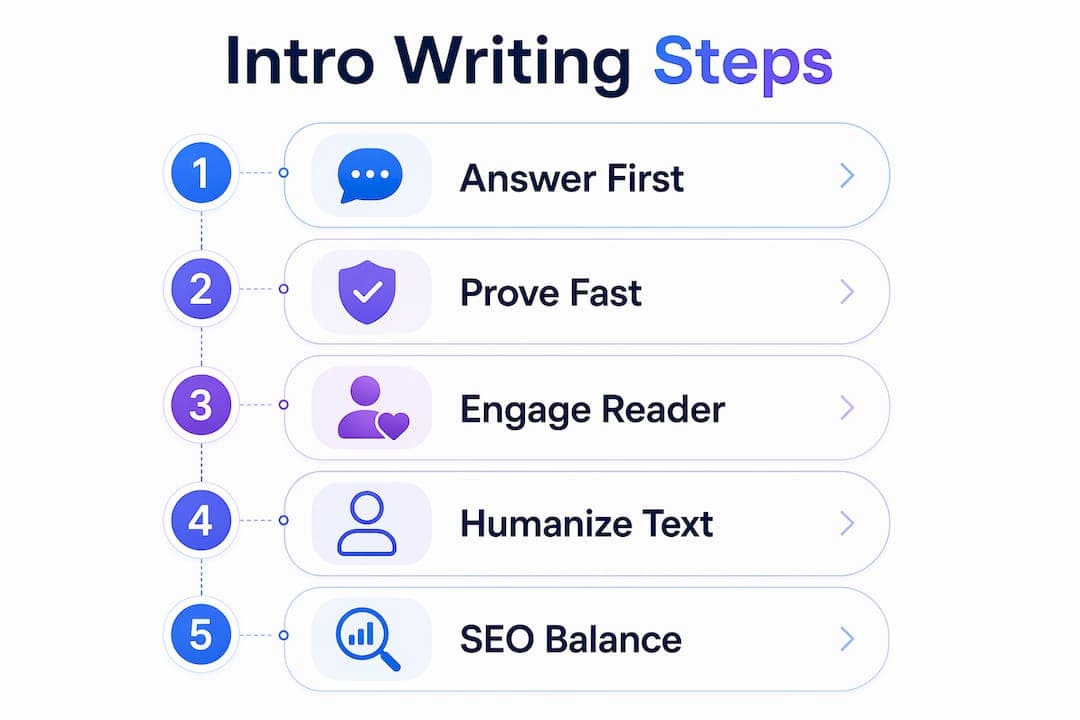
Writing compelling introductions comes down to one repeatable structure: answer first, prove it fast, and make sure every word earns its place.
| Point | Details |
|---|---|
| Three-question test | Every intro must answer: What is this about? Why should I care? What will I get? |
| BLUF structure | Lead with the direct answer or benefit in the first sentence, then support it. |
| Hook selection | Match the hook type to the audience's emotional state: question, stat, story, bold claim, promise, or snapshot. |
| Humanization workflow | Run six sequential passes: confidence, specificity, rhythm, voice, keyword smoothing, verification. |
| Semihuman for automation | Use Semihuman's text restructuring and humanization tools to apply these edits at scale and reduce AI-detection signals. |
The conventional advice is to "write a great hook." That's not wrong, but it misses the bigger problem. Most introductions that fail don't fail because the hook is weak. They fail because the hook and the body are misaligned. The intro promises one thing; the article delivers another. Readers feel that mismatch within the first scroll, and they leave.
The fix isn't a better hook. It's writing or rewriting the introduction after the body is finished, so the promise is accurate. That single habit, recommended by the UW–Madison Writing Center and the University of Waterloo alike, does more for bounce rate than any hook formula.
For AI-generated content specifically, the alignment problem is worse. AI drafts often generate an introduction that sounds plausible but doesn't reflect the actual argument the body makes. The humanization pass isn't just about removing robotic phrasing. It's about making the intro's contract with the reader honest.
Manual editing works. But when you're managing a content calendar with dozens of posts, running six sequential passes on every introduction by hand isn't realistic. That's where a tool built specifically for this problem earns its place.
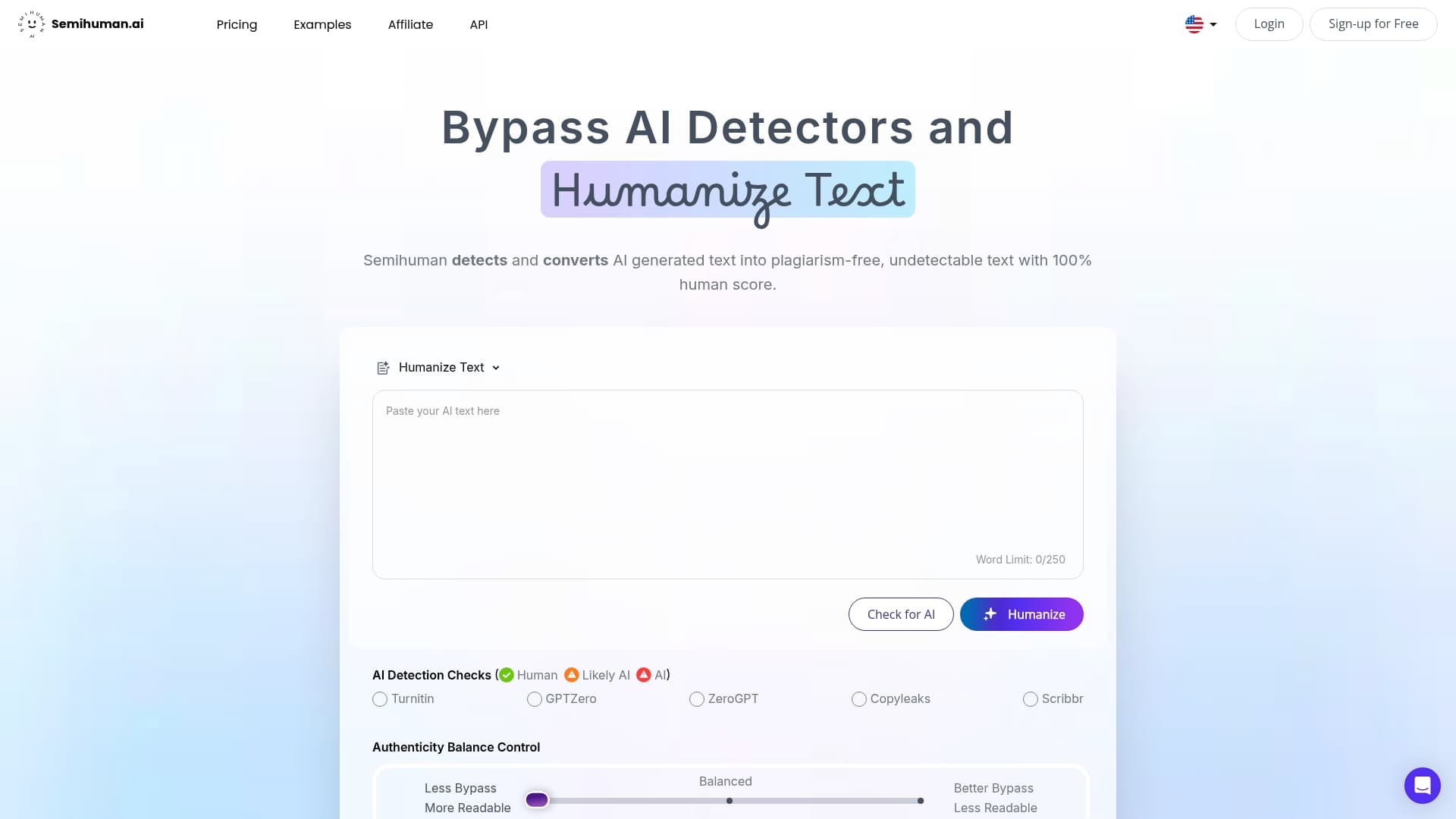
Semihuman's platform handles the mechanical parts of humanization: text restructuring, keyword integration, and detection-avoidance passes that lower the signals GPTZero, Turnitin, and Copyleaks flag. You bring the judgment; Semihuman handles the pattern-breaking. The result is an introduction that reads like a person wrote it, ranks for the right terms, and doesn't get flagged before a human ever sees it.
Use manual edits for high-stakes pieces where voice precision matters most. Use Semihuman for volume, speed, and consistency across a team. Bypass AI detectors with Semihuman's humanization workflow, or generate SEO-first content from scratch with the SEO text generator. Start with a single introduction and see the difference in under two minutes.



Start
Humanizing
for Free!
Humanize