
Loading...

To publish in an academic journal, start by naming your one-sentence central message and your target journal. Write a 1-2 sentence summary of what you found or argue, then open that journal's Instructions for Authors before you draft a single paragraph. A clear message, matched to the right venue, is what turns a pile of results into a submission-ready manuscript.
TL;DR:
- Draft Methods and Results first, then Introduction and Discussion, and leave the title and abstract until the paper’s actual contribution is clear.
- Use the reporting guideline that matches your study, such as CONSORT, STROBE, or PRISMA, and include author contributions and data availability statements.
- Reviewer completion to first decision commonly takes one to four months, while final acceptance with revisions can take six months to a year.
- After review, answer each comment separately, identify the exact change and location, and support any disagreement with evidence rather than assertion.
Every strong manuscript starts with a single sentence: what did you find, and why does it matter? If you cannot state that in plain language, you are not ready to draft, you are still analyzing.
Once that message is clear, decide what kind of article it belongs in. A novel dataset with a complete study arc fits an original article; a smaller, focused result might suit a short report; a synthesis of existing work points toward a review. Each format carries its own length and scope expectations, so check them early rather than discovering a mismatch after a first draft.
Then read the target journal's Instructions for Authors (IFAs) in full, not just the word count. According to Taylor & Francis author guidance, poor fit with a journal's stated scope is among the most common reasons editors issue a desk rejection before review even begins.
Pro Tip: Paste your one-sentence message into the journal's "aims and scope" page; if it doesn't obviously belong there, keep looking before you draft.
Editors and reviewers often decide whether to keep reading based on the title and abstract alone, so both need to state the finding, not just the topic. A title that describes what you did is weaker than one that states what you found.
Most empirical papers follow IMRaD: Introduction, Methods, Results, and Discussion. Humanities papers and reviews often use a thematic structure instead, organized around arguments or subtopics rather than a linear study arc. Either way, the ICMJE recommendations point authors toward standardized reporting guidelines from the EQUATOR Network, such as CONSORT for trials, STROBE for observational studies, and PRISMA for systematic reviews, which spell out exactly what each section needs to contain.
Beyond the main text, journals expect:
Following a recognized reporting guideline where one exists reduces the chance of a reviewer flagging missing methodological detail later.
Most early-career researchers start with the introduction and get stuck. Reversing the order fixes this.
Newcastle University's Academic Skills Kit recommends exactly this sequence, along with freewriting and short, focused writing sessions to get past blocks without overthinking sentence quality mid-draft.
Keep a reference manager (Zotero, Mendeley, or EndNote) running from the first draft, not added at the end, and use track changes consistently once co-authors are involved so edits stay traceable.
Pro Tip: Block 25-minute writing sprints with no editing allowed; save all polishing for a separate pass.
Clear prose beats impressive prose every time a reviewer is deciding whether your argument holds up. Short sentences, active voice, and concrete verbs make your claims easier to evaluate, which is exactly what you want from someone judging your work for publication.
UC Berkeley's Student Learning Center frames this as writing to express rather than to impress: concise, plain sentences reduce reviewer friction and speed up evaluation.
Peer-review timelines stretch when manuscripts need heavy line editing. Clean prose at submission is one of the few factors fully within your control, so check your journal's required style guide, EASE guidelines, AMA, or APA, and follow its house style exactly rather than defaulting to habit.
Picking a legitimate, well-matched journal matters as much as the writing itself. Check the journal's scope statement, its indexing status, and whether it belongs to COPE, OASPA, or DOAJ. Guidance on identifying predatory journals warns that promises of unusually fast publication, vague peer-review processes, and aggressive solicitation emails are common red flags worth screening for before you submit.
Once you submit, expect review to move in stages, each with its own realistic time range.
| Stage | Typical time range |
|---|---|
| Desk decision (accept for review or reject) | Days to a few weeks |
| Reviewer invitation and recruitment | A few weeks |
| Review completion to first decision | One to four months |
| Submission to final acceptance (with revisions) | Six months to a year |
A strong response letter is itemized, specific, and calm, even when a comment feels unfair.
Guidance on structuring research papers recommends this itemized approach as standard practice, since it lets editors verify every concern was addressed without re-reading the whole manuscript.
A rejection letter that explicitly invites resubmission is a real opportunity. One that does not, according to Nature's editorial guidance, generally means resubmitting the same manuscript unchanged to that journal is unlikely to succeed, so read the editor's language carefully before deciding your next step.
Academic writing is not one register. The EIT Library guide to types of academic writing groups academic prose into four functions: descriptive, analytical, persuasive, and critical, and these functions shift from section to section within a single paper. Your abstract and methods are mostly descriptive, stating what you did. Your discussion is evaluative, arguing what it means.

Discipline shapes this further. Clinical and life sciences journals expect tight adherence to IMRaD and reporting guidelines like CONSORT or STROBE, with minimal narrative flourish. Social science journals often allow more interpretive language in the discussion but still expect a clearly stated hypothesis and method. Humanities journals frequently abandon IMRaD altogether in favor of a thematic or chronological argument structure, where the "method" is closer to a stated analytical approach than a replicable protocol.
Short reports and letters compress everything: expect a combined results-and-discussion section and a hard word limit that forces you to cut context you might otherwise include. Review articles invert the usual balance, spending most of their length on synthesis rather than original data, and often require a stated search strategy if the journal treats them as systematic.
Before adapting your writing to a new target, read two or three recently published articles in that exact journal, not just the discipline generally. House conventions around tense, heading depth, and citation density vary even between journals that cover the same field.
Fit matters more than polish. An editor scanning a submission against the journal's scope statement decides quickly whether it belongs there, so your cover letter should state plainly why your paper fits that specific journal rather than restating your abstract.
A strong cover letter does three things: states your central message in one sentence, explains why it fits the journal's scope and readership, and confirms the manuscript is original and not under consideration elsewhere. Keep it short. Editors read dozens of these.
Many journals invite authors to suggest reviewers. When you do, name researchers who work directly in your subfield but have no recent collaboration or conflict with you, and explain briefly why each is qualified. This speeds up reviewer recruitment, one of the slower stages of the review timeline, and shows the editor you understand where your work sits in the field.
Beyond the cover letter, small details add up: following the IFAs exactly, including reference style and figure formatting; submitting a clean, proofread manuscript free of inconsistent terminology; and addressing likely reviewer objections preemptively in the discussion rather than waiting for them to surface in review. None of this guarantees' acceptance, but each removes a reason for an editor to set your manuscript aside.
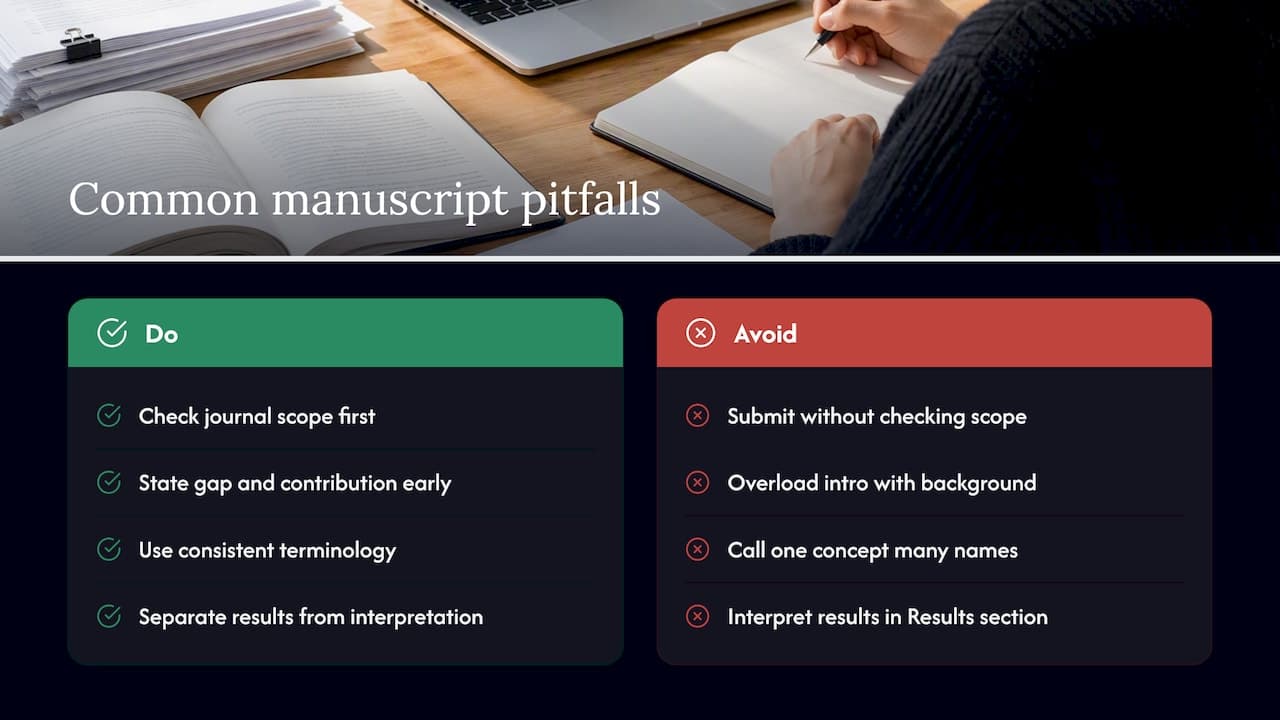
A few mistakes show up again and again in rejected or heavily revised manuscripts.
Submitting to a journal without checking its scope is the most avoidable one. A technically sound paper sent to the wrong venue gets desk-rejected regardless of quality, costing weeks before you even learn why.
Overloading the introduction with background instead of stating the gap and your contribution early is another common trap. Editors and reviewers want to know within the first paragraph what question you are answering and why it matters.
Inconsistent terminology, where the same concept is called three different things across sections, forces reviewers to work harder than necessary and signals a draft that was not read end to end before submission. Similarly, results sections that interpret findings instead of reporting them blur the line between results and discussion, which most reviewers flag immediately.
Finally, ignoring the journal's house style, whether in reference formatting, heading structure, or word limits, reads as carelessness even when the science or argument is strong. None of these pitfalls are hard to avoid; they are just easy to miss when you are close to your own draft, which is exactly why a dedicated editing pass, separate from drafting, matters so much.
Academic publishing runs on a small set of ethical standards that every journal expects you to already know.
Plagiarism includes copying your own previously published text without citation, not just copying someone else's work. Paraphrase properly and cite the original source even when the original author is you.
Authorship criteria matter more than they might seem. The ICMJE recommendations set out specific conditions for who qualifies as an author, generally requiring a substantial contribution to the work, drafting or revising it critically, final approval of the version submitted, and accountability for its accuracy. Contributors who do not meet all of these criteria belong in the acknowledgments, not the author list.
Conflicts of interest, financial or otherwise, need disclosure regardless of whether you believe they influenced your findings. Most journals require a conflict-of-interest statement as a standard part of submission, and omitting one can delay or derail review even for otherwise sound work.
Citations do two jobs: they credit prior work and they let readers verify your claims. Both fail when references are sloppy.
The most common referencing errors are citing a source for a claim it does not actually support, relying on secondary citations instead of reading the original study, and mismatched reference lists where an in-text citation has no corresponding entry or vice versa. Reference management software catches many formatting errors automatically, but it will not catch a citation attached to the wrong claim, so a manual check against your source list before submission is worth the time.
Following your journal's specified citation style exactly, whether APA, AMA, Vancouver, or a journal-specific variant, matters more than it might seem, since inconsistent formatting is one of the easier things for a reviewer or editor to notice and flag. Where a reporting guideline applies to your study type, citing it explicitly in your methods section, as the ICMJE recommendations suggest, signals to reviewers that your methodology follows an established standard rather than an ad hoc approach.
A figure or table should stand on its own. A reader skimming just your tables and figures should be able to follow your main findings without reading the full text.
Every table needs a clear, descriptive caption and consistently labeled columns, with units stated explicitly rather than assumed. The same rule applies to figures: label axes fully, keep legends readable at publication size, and avoid cramming multiple unrelated comparisons into a single panel just to save space.
Choose the right format for the data. Precise numerical comparisons across several variables usually belong in a table; trends, distributions, or relationships are usually clearer as a figure. Avoid presenting the same data in both a table and a redundant figure, since this duplicates space without adding information, and most journals will ask you to cut one.
Finally, make sure every figure and table is referenced in the text, in order, and that the numbers in your tables match the numbers you cite in your results section exactly. Mismatches here are a common and entirely avoidable source of reviewer comments.
The writers who publish consistently treat writing as a daily habit, not a deadline-driven sprint. A short, focused session most days moves a manuscript forward faster than occasional long stretches that are easy to postpone.
Set a small daily goal, even 20 minutes, and protect it the way you would a lab meeting or a class. Publishing becomes part of your research routine, not a separate burden layered on top of it.
— Tilen
Once your manuscript says what you want it to say, the last mile is making sure the prose reads naturally and holds up under the kind of automated scrutiny more departments and journals now apply to submitted text. We built our platform for exactly that stage: after your draft is substantively done, we help you tighten sentences, smooth out awkward phrasing left over from heavy editing, and check for patterns that automated detectors tend to flag.
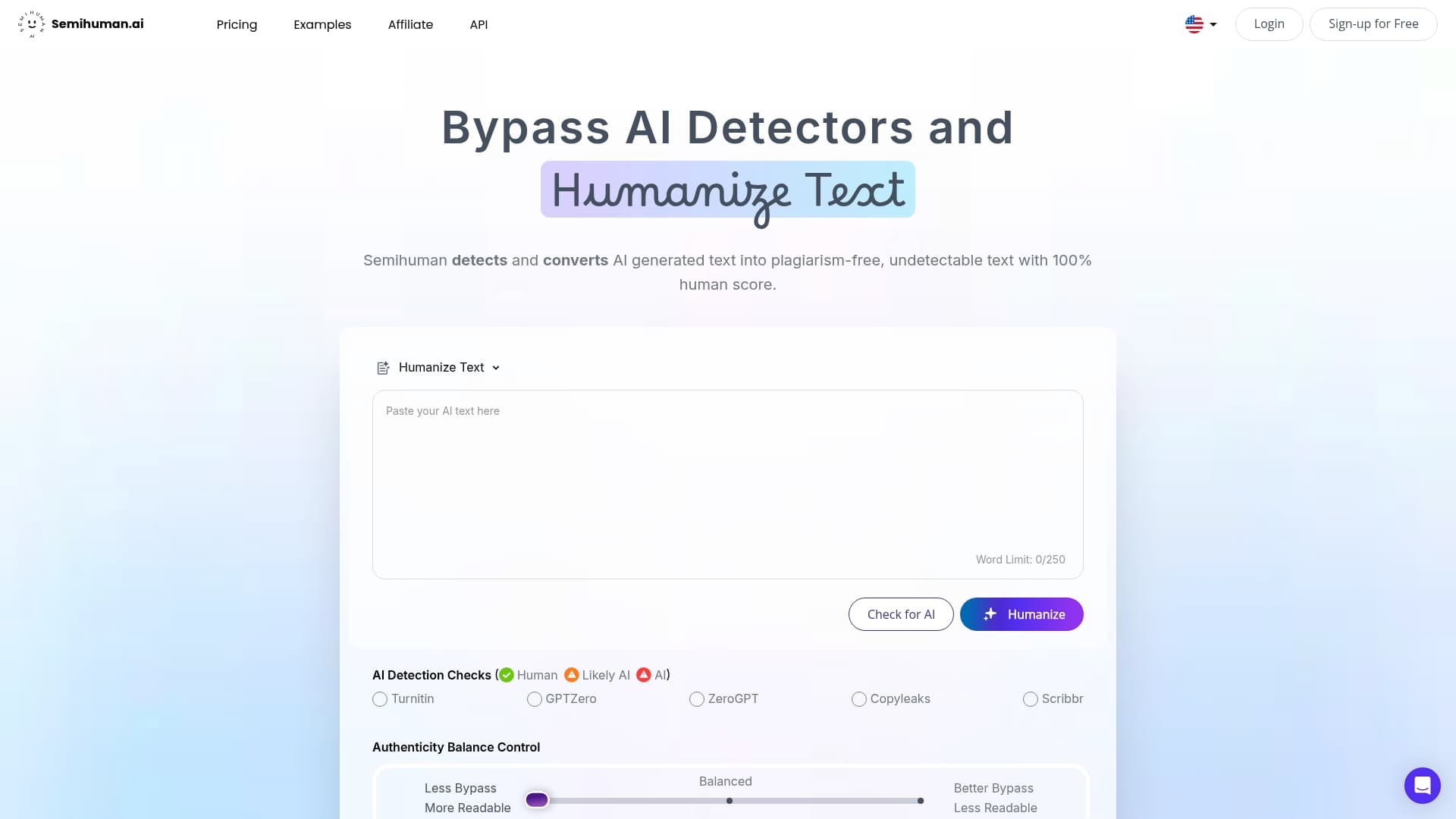
Our platform restructures text for natural readability, helps integrate keywords where discoverability matters, such as preprint servers or institutional repositories, and works whether you prefer a simple web interface or want to connect an API directly into a lab's existing writing workflow.
We never replace peer review or disciplinary editing, but we do give your prose one more honest pass before it reaches an editor's desk. If you want to try it on your next draft, our Free, Basic, and Pro plans are a straightforward place to start, and labs or research groups that want deeper integration can look at our Developer, Business, and Enterprise options.
Start by writing a one or two sentence statement of your central finding or argument, then identify a journal whose scope matches it. Read that journal's Instructions for Authors in full before drafting, since format and scope requirements vary widely between journals.
Academic writing is commonly grouped into descriptive, analytical, persuasive, and critical functions, and most papers blend all four across different sections. Your methods section is largely descriptive, while your discussion tends to be analytical and critical.
Most empirical articles follow IMRaD: Introduction, Methods, Results, and Discussion, alongside a title, abstract, keywords, and reference list. Reviews and humanities papers often use a thematic structure instead, organized around arguments rather than a linear study.
Submission to first decision commonly takes one to four months, while submission to final acceptance, including revision rounds, commonly takes six months to a year. Timelines vary by journal and field, so check a target journal's own reported statistics when available.
Reply to every comment individually, stating exactly what changed in the manuscript and where. When you disagree with a reviewer, explain your reasoning with evidence rather than simply asserting a different view.



Start
Humanizing
for Free!
Humanize