
Loading...

Writing for multiple platforms means starting with one strong idea and shaping it for each channel's audience, format and norms, instead of posting identical copy everywhere. The workable approach has five parts: choose a small number of platforms, build one core piece, adapt it for each channel, keep your voice steady, and track what happens. This guide walks through each part with concrete examples.
The case is mostly about risk and reach. A report from the Center for News, Technology & Innovation points out that platforms control both access to audience information and what content audiences see, and they can change features, ranking or allowed content unilaterally. If your whole readership lives on one feed, a single algorithm change can erase it.
Reach is the other half. Literary agent Kate McKean notes that using several platforms creates more than one way to reach readers and build a sturdier connection with them. Different genres and audiences gravitate to different places, and you learn which fit you by watching what gains traction.
There is a counterweight, and it matters. Jane Friedman's author-creator playbook advises creating where readers are, but not everywhere they are, since simultaneous blogging, podcasting, Instagram and daily TikTok is hard to sustain. She also argues that advantage compounds when you develop one format and grow its audience before adding another. That is the sensible order: depth first, breadth second.
Start with the audience, not the app. Three questions do most of the work.
BookBub also stresses that you do not need to use every platform, and that comfort and genuine interaction tend to produce more organic engagement. Launch My Book recommends focusing on one or two platforms and weighing your existing habits, current audience, brand fit and comparable authors.
If you want a deeper look at matching channels to readers, this piece on creating audience-centric content covers the thinking behind it. Our own guide to user intent in content strategy helps with the follow-up question: what is the reader on this platform actually trying to do?
If you are torn between candidates, score each from 1 to 5 on four criteria and add them up.
| Criterion | What to ask |
|---|---|
| Audience presence | Do my readers or buyers actually gather here? |
| Format fit | Can I make this format well, every week? |
| Purpose fit | Does it serve discovery, relationship or revenue, whichever I need? |
| Ownership | If the platform changes, do I keep access to these readers? |
The last row is the one people skip. An email list or a website you own scores a 5. A feed you rent scores lower, however large it is.
The efficient way to cover several channels is to avoid starting from zero on each. HubSpot's guide to multi-channel distribution describes creating a core piece, then adapting it into channel-appropriate versions: a blog post can become a LinkedIn text post or carousel, an email summary, a 60 to 90 second video, or a question posed in a community.
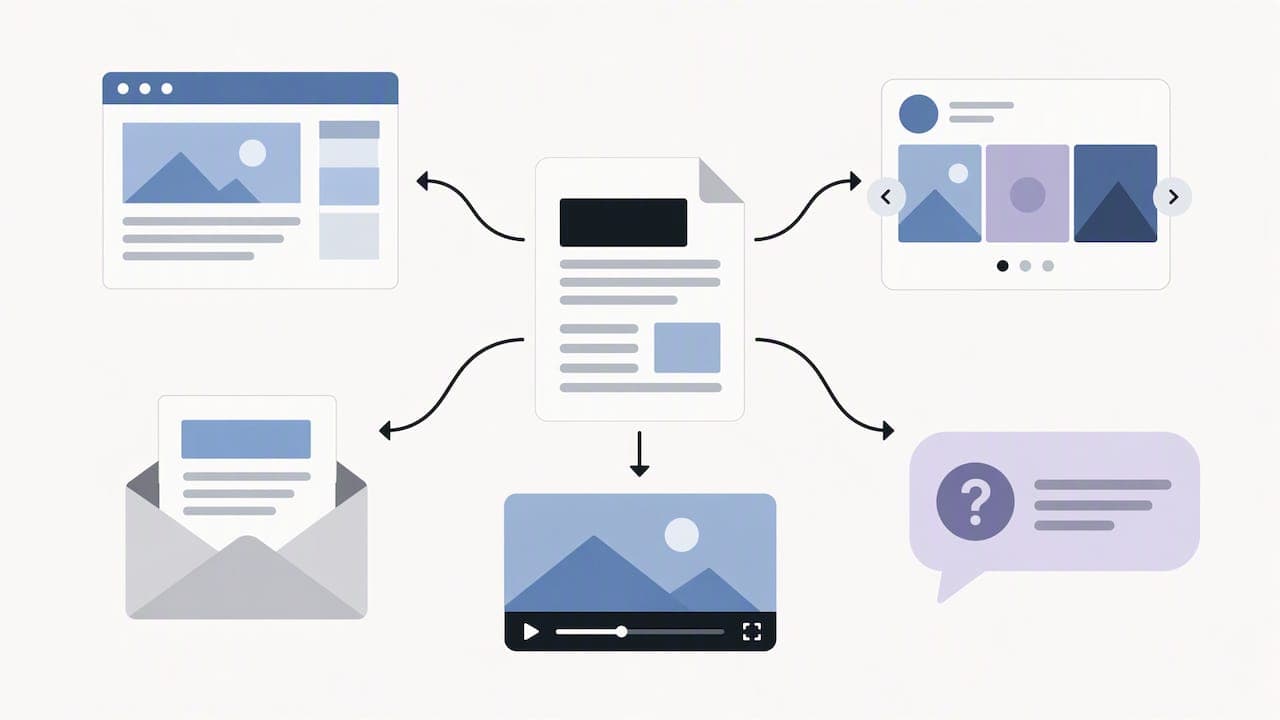
The core piece should be the version where you think hardest. It holds your argument, your best examples and your evidence. Everything else is a view onto it.
A useful habit is to pull four things out of the core piece before you adapt anything:
Those four items travel across every channel. What changes is how much of each you show, and in what order.
We cover the mechanics of reusing material without hollowing it out in our article on repurposing written content, and on content curation versus creation if part of your plan involves sharing other people's work.
HubSpot's position is that multi-channel success depends on optimizing for each channel rather than distributing identical copy. OpenStax's writing guide frames the same idea as a rhetorical decision: audience knowledge, viewpoint and cultural relationship should shape the information you include and the genre, medium, tone and language you choose. Purpose and quality stay; the packaging changes.
Datalily's guide to writing for different channels offers a practical starting point. It says to consult the publisher's style guide before drafting, and it sketches the broad registers: blogs and how-to articles can use professional prose and SEO structure, social posts must catch attention fast, LinkedIn can be conversational but educational, Instagram captions can add context, and TikTok scripts can be planned or casual.
| Channel | Opening | Length and shape | Typical job |
|---|---|---|---|
| Blog or website | Answer the query in the first paragraph | Long, with headings and structure for search | Authority, search traffic |
| A subject line and first line that earn the open | Short, one idea, one link or action | Relationship, repeat readers | |
| A specific, professional hook | Short paragraphs, a lesson learned | Professional visibility | |
| Short social posts | The point in the first line | A few sentences at most | Discovery |
| Video or audio script | Spoken, conversational hook | Written for the ear, short sentences | Reach, personality |
| Community post | A real question or problem | Brief context, then an invitation to respond | Feedback, trust |
The rows are guidelines, not laws. Read what performs in the community you are joining and match its norms. If you are writing for LinkedIn specifically, this guide to writing a LinkedIn article is a useful companion on structure.
Say your core piece is a 1,500-word article arguing that small teams should document their editorial process. Here is how the same idea might travel:
None of these is a trimmed copy. Each has its own opening, its own evidence and its own invitation. That is the difference between adapting and spraying.
Readers who meet you in two places should recognize the same person. Narrareach's guide says voice should stay stable while format changes across Substack, Medium, LinkedIn and X: keep the argument, values and position fixed, and adjust the opening, evidence, paragraph length and invitation to respond.
To make that concrete, write a short voice sheet and keep it beside your drafts:
If you publish under a brand or run a book and authority platform, the same discipline applies at larger scale; this overview of keeping an authority voice consistent shows how one expert's ideas can be carried across many touchpoints.
AI drafting adds a particular risk. Text produced quickly in bulk tends to flatten into the same rhythm and stock phrases on every channel, which is the opposite of a recognizable voice. Our article on content originality for marketers explains why this matters, and the examples of humanized content for creators show what a revised, personal version looks like next to a raw draft.
We build tools that help people turn machine-generated drafts into text that reads as written by a person, so we see the multi-platform problem from a specific angle. Most of the trouble starts when a draft is generated once and pasted into five places. The result is sameness: identical phrasing on a blog, in a newsletter and in a LinkedIn post, none of it sounding like the author.
Our view is that the efficiency gain in multi-platform work should come from the thinking, not from skipping the editing. Draft quickly if that helps, but revise each version for the channel it is going to. Restructure the opening, change the sentence rhythm, put in the detail only you would know, and check that any keywords you need for search sit naturally in the long-form version rather than being forced into every post.
We also think workflow beats rewriting from scratch. Our piece on workflow-first content restructuring argues for editing what is already good rather than starting over, and the same applies when you move from one channel to another. Keep the spine, change the skin.
— Tilen
Yes, and many writers do. The question is how to do it without hurting the original.
Just Publishing Advice recommends keeping a primary publishing home, such as a website or blog, and using other platforms as discovery channels with clearly defined purposes. The same guide warns that republishing can let a higher-authority platform outrank your original, and that canonical tags do not guarantee search engines will index your version.
That last point is consistent with how Google's guidance has moved. Search Engine Land reported that Google no longer recommends canonical tags for syndicated content, noting they did not always stop syndicated copies from outranking the original. In practice:
The rewritten-version route is also better for readers. Someone who follows you in two places does not want to read the same text twice.
Consistency is where most multi-platform plans fail. HubSpot's guide outlines a sequence: create a core asset, map audience channels, adapt the format, coordinate publishing with scheduling and automation, and track engagement, conversions and attribution. It also suggests channel-specific frequency, for example daily social, weekly email and monthly long-form, with cadence coordinated and documented.
For a solo writer, a scaled-down version might look like this:
For teams, Solvea's operations playbook suggests that every workflow stage should have one owner, one exit condition and one proof field, which prevents stale offers, broken links and muddled handoffs. Even a two-person team benefits from naming who approves what.
Keywords deserve a place in the plan too, because search-facing channels need them and social channels mostly do not. Our four-stage workflow for keyword integration shows how content teams handle this without stuffing, and our digital marketing content tips cover wider habits.
You cannot tell whether a channel earns its place without tracking. HubSpot's guidance is to follow engagement, conversions and attribution on each channel to see what works.
Keep it simple at first:
Then apply the earlier advice about revisiting platform choices. Once a quarter, look at each channel against its stated purpose. If it is not doing that job and you do not enjoy it, stop. Our guide to content metrics for marketers goes deeper into which numbers deserve attention.
If you draft with AI and then adapt for several channels, the editing step is where the time goes. Semihuman detects AI-generated patterns in text, rewrites it to read more naturally, restructures it for readability and helps integrate keywords, so each channel version starts from a cleaner draft that you then make your own. It works in the browser for individual writers, and an API is available for teams who want it inside their own publishing workflow.
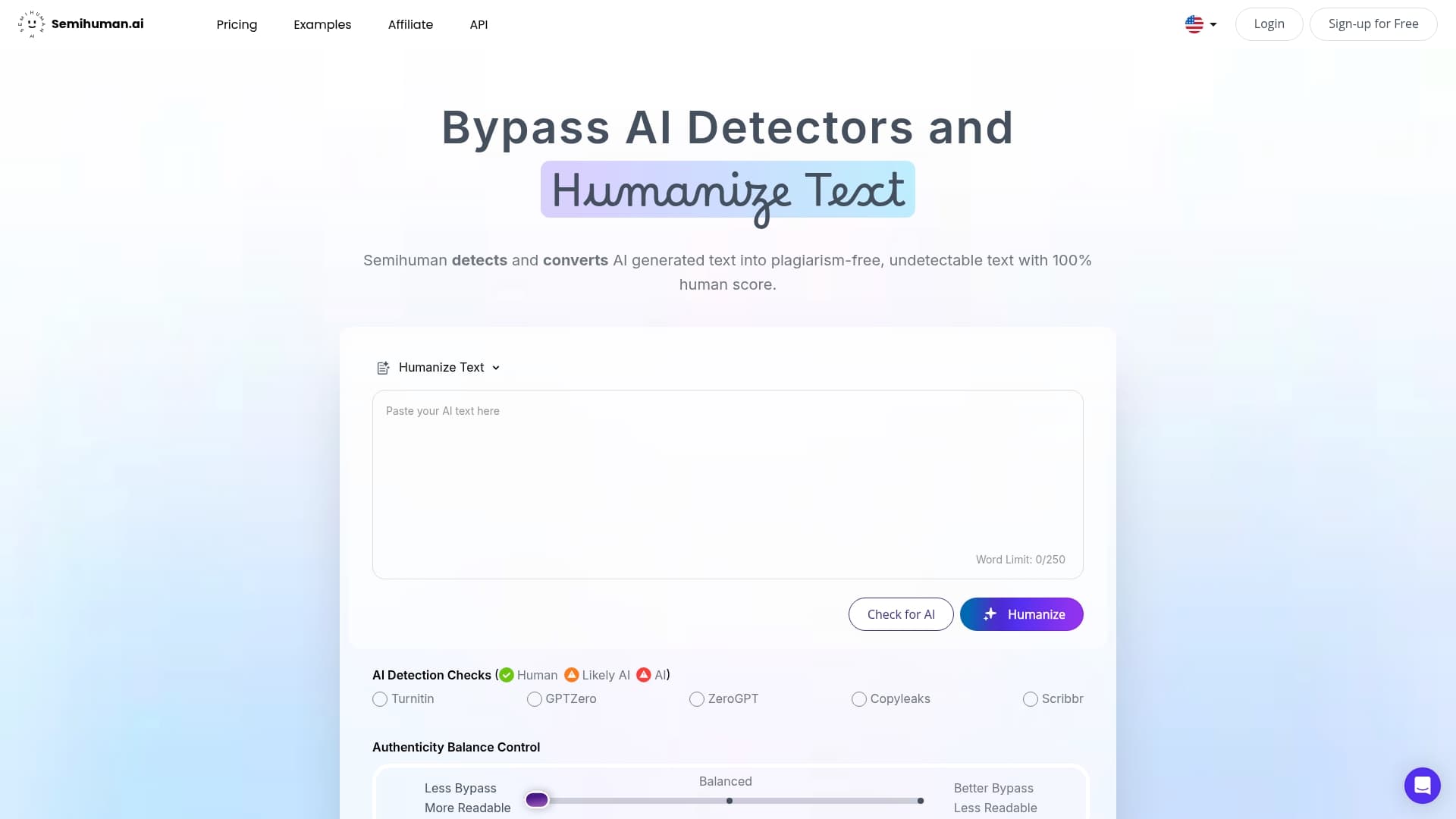
You can start with the Free, Basic and Pro plans, or look at the Developer, Business and Enterprise options if you need API access. Review the output before you publish. The final voice should still be yours, and any rules your school, publisher or employer sets on AI use still apply.
There is no single best one. It depends on where your readers are and which format you can sustain. Start with one or two platforms where comparable writers have an audience, and keep a site or email list you own as your base.
Keep the argument the same and change the opening, length, tone and call to action. Check the platform's norms and any style guide first. A blog post can lead with the answer and use headings, while a social post needs its point in the first line.
It is allowed on many platforms, but it is rarely the best choice. Identical copy can compete with your original in search, and readers who follow you in several places see repetition. Publish the full version on your own site, and adapt or summarize elsewhere with a link back.
Most writers do better with one or two to begin with. Add another only when the first is running steadily and you have the time to give the new one its own version of your work.



Start
Humanizing
for Free!
Humanize