
Loading...

Humanizing an AI draft means rewriting it so it reads like a person wrote it, not just running it through a paraphraser. Start by adding one piece of first-hand evidence and varying your sentence rhythm before you touch anything else. Tools like Semihuman.ai can scale this, but the fix begins with information density: perplexity and burstiness matter more than word substitution.
TL;DR:
- AI detectors primarily measure word predictability and sentence length variation, which can lead to high false positives on human or edited texts.
- Focus on adding concrete, unexpected details and varying sentence structure, rather than trying to fool detection algorithms with superficial tricks.
- Incorporate real evidence, specific data, or personal observations to genuinely increase perceived human authenticity.
- Prompt constraints and structural instructions yield more reliable human-like writing than post-hoc paraphrasing or synonym swaps.
- Prioritize including at least one real, replaceable data point early in the draft to improve authenticity and ranking, especially at scale.
AI detectors don't read for meaning. They measure two statistical properties: perplexity, which tracks how predictable your word choices are, and burstiness, which tracks how much your sentence lengths vary. Human writing tends to zigzag, short sentence, long sentence, a fragment, back to something dense. AI text tends to hum along at a consistent rhythm and reach for the statistically likely next word again and again. That evenness is the tell.
The problem is these are estimators, not lie detectors. A Patterns study found an exceptionally high false-positive rate on TOEFL essays written by non-native English speakers, while false positives were near-zero on writing from native eighth-graders. The models were flagging simpler, more predictable sentence structures, not machine authorship.
Detector brittleness runs deeper than one study. Interpretable-detection research shows models often learn dataset-specific quirks rather than a universal signature of machine writing, which means strong accuracy in one domain can collapse in another, according to research on explainable detection. Heavily edited human text, technical writing, and non-native English prose all get caught in the crossfire.
That single number should change how you interpret any detector score.
What this means for your editing: don't chase tricks that fool a specific algorithm. Focus on the two things detectors actually measure.
Fix the draft in this order. Each step compounds on the last, and skipping to the bottom without doing the top wastes your time.
Pro Tip: Do steps 1 through 4 in your prompt, not your editor. A model given explicit sentence-variety rules and a banned-phrase list at generation time will follow them more consistently than a human editor manually hunting for violations after the fact.
Manual editing that injects real experience and specific data produces stronger authority signals than automated paraphrasing alone, no matter how many synonyms get swapped in. You can read more on why expertise beats mechanical rewriting if you want the deeper case for prioritizing evidence over cosmetic edits.
Prompt-level constraints beat synonym-swapping because they change how a model builds the sentence, not just which words fill it in. Practitioners across content teams report that models follow structural directives at generation time far more reliably than they respond to a post-hoc paraphrase pass, which tends to preserve the same statistical fingerprints underneath new vocabulary.
Build your generation prompt with these elements:
For text that already exists, your rewrite instruction should ask for something more specific than "make this sound human." Try: "Rewrite this paragraph, cut the third sentence in half, add a concrete example after the second point, and keep the same meaning." That level of specificity forces a real structural change instead of a cosmetic one.
Run this before you publish anything, whether you wrote it or a model did.
Statistic Callout: Detector disagreement isn't a fringe problem. Even well-funded commercial tools inconsistently label mixed AI-human writing, which is exactly the kind of text most published content actually is after a real edit.
My process starts with the boring part: I read the AI draft once for facts, once for rhythm, and only then start rewriting. The first pass never touches wording. It just asks, "where does this need a real detail only I would know?"
Here's roughly how that plays out on a typical piece:
For teams scaling this across dozens of articles a week, a tool like Semihuman applies restructuring and keyword integration on top of that manual pass rather than instead of it. That's the honest way to think about it: automation extends a workflow that starts with a human decision, it doesn't replace the decision itself.
Most guidance on this subject treats humanization as a synonym-swapping exercise: run the draft through a paraphraser, hope the perplexity score drops, ship it. That approach treats detectors as the audience. They're not. Readers are the audience, and readers can tell when a sentence has been shuffled rather than rethought.
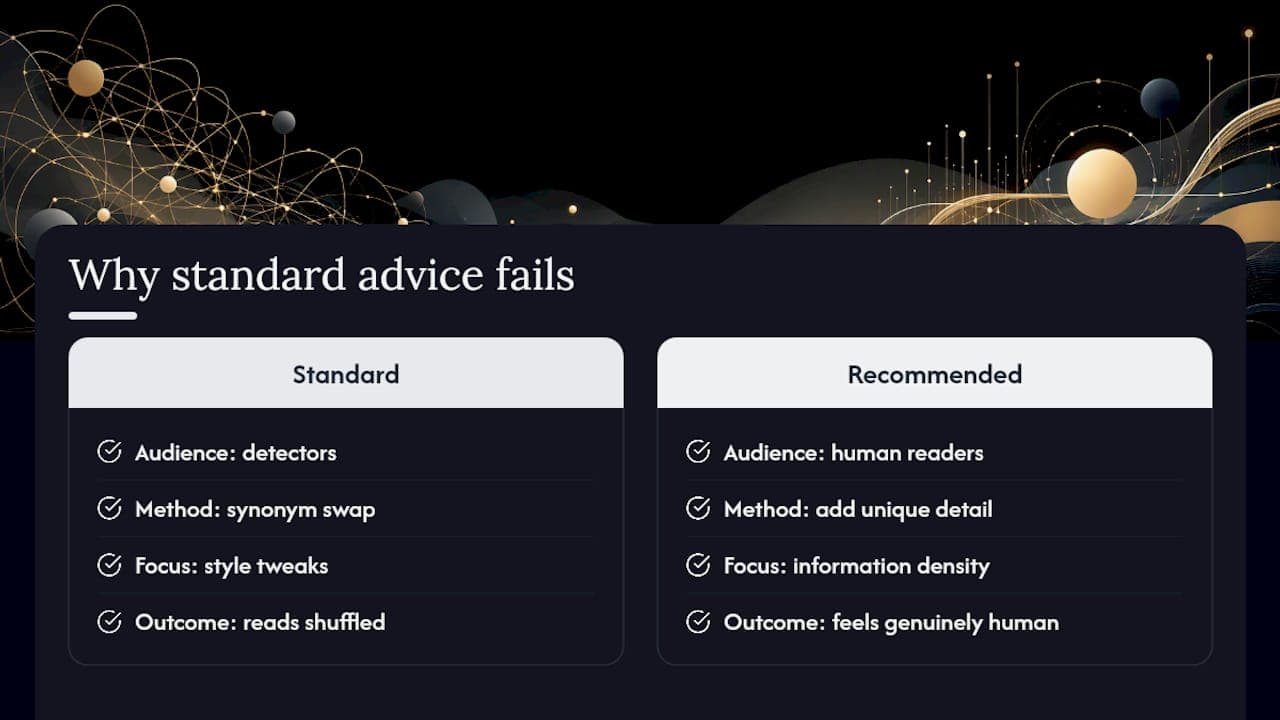
The actual leverage sits somewhere else entirely: information density. A draft that includes one fact, number, or observation nobody else has will read as more human and rank better, regardless of what any detector says about it. Sentence-length variation and contractions matter, but they're cosmetic compared to adding something the model genuinely couldn't have generated on its own.
Prioritize your prompt before your edit. Constraints baked in at generation time consistently hold up better than fixes bolted on afterward, and they save you the tedious back-and-forth of manually hunting for banned phrases in a finished draft. If you only have time for one change today, add a real detail to your intro. That single move does more than any detector-focused checklist.
— Tilen
Manual edits work, but they don't scale past a handful of articles a week, which is why many teams turn to AI content optimization to improve their SEO results efficiently. That's the gap a specialized platform fills: a tool built to restructure AI drafts, integrate keywords naturally, and reduce detection risk across tools like Turnitin, GPTZero, and Copyleaks, without you rewriting every sentence by hand.
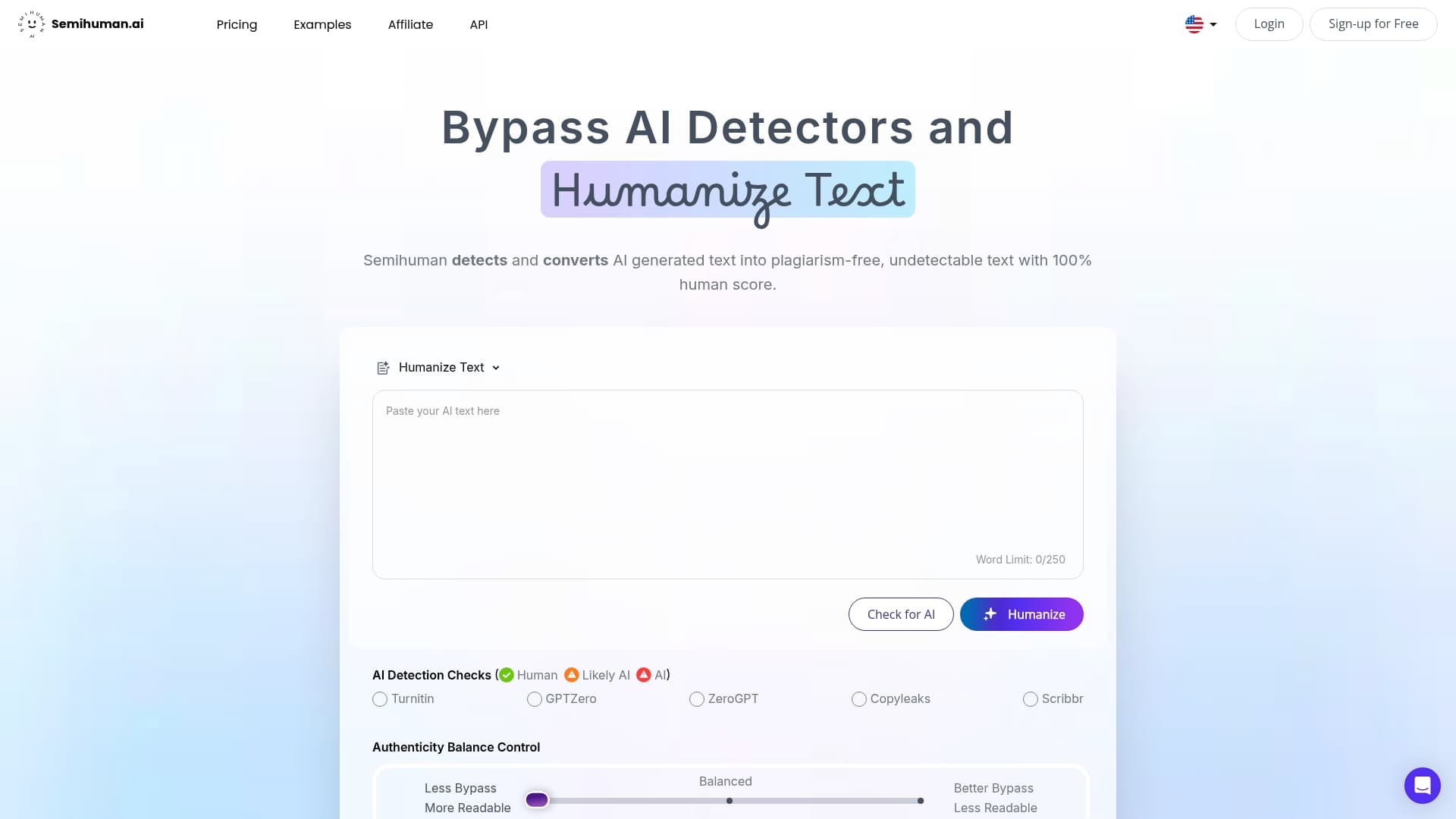
This tool works best as the second step in the workflow described above, after you've already added your one piece of first-hand evidence and set the tone. It handles the mechanical layer, sentence rhythm, phrasing variety, keyword placement, so you can spend your time on the part a machine still can't do: the actual insight. It also offers an API for teams running this process across many drafts instead of one at a time.
If you're producing content at volume, whether for client work, an agency pipeline, or coursework under a deadline, start with the SEO text generator and run your next draft through it before you publish.



Start
Humanizing
for Free!
Humanize