
Loading...

The most reliable writing routine is short and specific: a protected calendar slot at your peak hour, a tiny repeatable session goal, a clear starting trigger, a simple metric, and one accountability check. Building good writing routines does not require a complicated system. The sections below show how to pick and adjust each of these five pieces for your own schedule and energy.
TL;DR:
- Most effective routines involve short, specific sessions scheduled at peak focus hours, with clear goals and minimal friction to maintain consistency.
- Protecting the writing slot with calendar blocks, sensory triggers, and a dedicated space helps cement the habit and minimizes distractions.
- Tracking targeted metrics such as words per day or session completion, coupled with weekly reviews, supports ongoing progress without judgment of quality.
- Using concrete if-then plans and immediate rewards increases accountability and makes it easier to start and stick with writing sessions.
- Having fallback strategies like rescue sessions, accountability partners, and small adjustments ensures the routine survives inevitable life disruptions.
Start by testing, not guessing. For one week, write at a different time each day (early morning, midday, evening) and rate your focus and word output afterward. Patterns usually emerge fast: most people find one or two windows where sentences come easier and distractions fade. Graduate writing centers recommend exactly this kind of self-test, pairing peak-hour discovery with non-negotiable scheduled blocks rather than waiting for motivation to strike.
Once you know your window, decide between time-based sessions and word-count quotas. A Pomodoro-style 25-minute sprint suits drafting when you tend to overthink sentences, since the clock forces momentum. A word quota (250 to 1,000 words) suits writers who stall when a timer runs out mid-thought. Neither is universally better: pick whichever removes more friction for your current project.
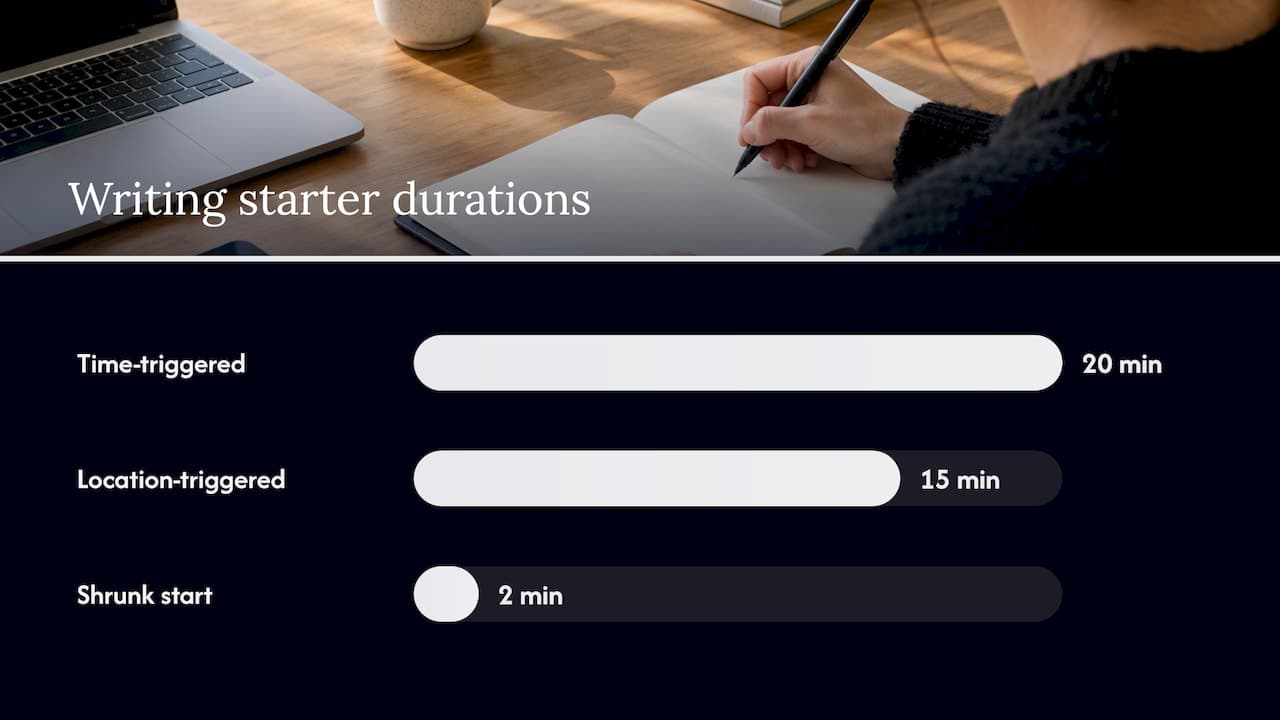
For starting points, match the target to your experience:
University writing resources echo this progression, favoring multiple short sessions over rare long ones because frequency builds the habit faster than duration does.
Protecting the block matters as much as choosing it. Put the session on your calendar with a title that says what it is, not just "writing," and set it to repeat. Turn off notifications for that window, close unrelated browser tabs, and if you share a calendar with colleagues or family, mark it busy rather than tentative. A content calendar built around protected recurring slots works the same way for writers as it does for marketing teams: the block only holds if it is treated as unmovable.
Your environment can do a lot of the psychological work for you. A dedicated surface, even a corner of a table used only for writing, signals to your brain that it is time to focus the moment you sit down. Add consistent lighting and a chair that supports decent posture, since physical discomfort is one of the fastest ways a session gets cut short.
A short checklist for the space itself:
These anchors work because they become associated with writing specifically. The same playlist every session, or the same pen, cuts the mental negotiation of "should I start now" down to almost nothing.
For travel days or tight schedules, build a portable version: the same playlist on headphones, the same notebook, and a five-minute setup you can recreate at a kitchen table or an airport gate. Test it today with a "prep-in-5" run: clear a surface, start your trigger (music, drink, or notebook), and write for five minutes without judging the output.

Pro Tip: Keep your ritual under two minutes to set up, or you will skip it on your busiest days, which are exactly when you need it most.
Not every project needs the same measurement. Match your metric to the task:
A short weekly review, 5 to 15 minutes, keeps you honest without turning into another chore. Look at three things: how many sessions you completed against plan, whether your chosen metric trended up or down, and what got in the way on missed days. Adjust one variable at a time (a different start time, a shorter target) rather than overhauling the whole routine.
Avoid two common traps. First, do not judge a draft's quality while you are still drafting it: that is a revision-stage question, and mixing the two stalls output. Second, keep drafting and revision metrics separate, since a slow revision week is not a failed writing week. A plain spreadsheet, a habit-tracking app, or even calendar tags color-coded by session type all work fine as trackers. The tool matters less than checking it weekly.
Vague intentions like "I'll write more" rarely survive a busy week. Specific if-then plans do better, because they tie a concrete cue to a concrete action, which research on implementation intentions links to meaningfully better follow-through on complex tasks.
Three ready templates:
Public commitment strengthens these further. Stating your plan to someone else, or writing it somewhere visible, adds a layer of accountability that raises the cost of skipping it.
When a plan feels too big to start, shrink it until it feels almost too easy: one sentence, one paragraph, two minutes. Momentum tends to carry you past the minimum once you have started. Pair completed sessions with a small, immediate reward, a coffee, a short walk, an episode of something, rather than a distant reward tied to finishing the whole project. Keep rewards modest: a reward so large it feels like the point can quietly turn writing into an obstacle between you and the prize.
Following through on plans depends heavily on how specific they are. Concrete if-then plans that name a time, place, and action consistently outperform general intentions to write more.
Every routine meets a bad week eventually. Illness, travel, and deadlines from other parts of life will interrupt even a well-designed schedule, so build the fallback before you need it.
Writing centers frame this well: treat the routine as a protected professional appointment rather than something that only happens if everything else goes right, and lean on accountability structures to reinforce it when willpower alone is not enough.
Pro Tip: When you are genuinely overloaded, shrink the commitment instead of abandoning it: a five-minute session preserves the habit far better than a skipped week does.
Know the difference between a routine that needs reworking and one that just needs a temporary shrink. If you have missed most sessions for two straight weeks, the schedule itself is probably wrong for your life right now, not your discipline. Adjust the time or length before you decide the whole system has failed.
Drafting without revision or reading eventually runs dry. Build a separate, scheduled slot, weekly or biweekly, for revision work distinct from drafting time, and use it deliberately:
Reading refills the well that drafting empties. Short, scheduled "reading snacks," even 10 minutes, and a running commonplace notebook of phrases or ideas worth stealing keep your input flowing alongside your output. Try reading as a writer: pause on a paragraph you admire and ask what specifically makes it work, not just whether you liked it.
Alternating drafting days with revision or reading days across the week prevents the flat, depleted feeling that comes from drafting nonstop. A repeatable weekly system that treats drafting and revision as distinct, scheduled stages tends to hold up longer than one that blurs them together.
Pick the template closest to your current schedule and adjust the numbers, not the structure.
Not every writer thrives on daily quotas. Some produce strong work in irregular bursts, writing intensively when an idea has matured rather than on a fixed daily schedule, which shows that a routine's value lies in fitting your actual working style, not in matching someone else's calendar. Adjust session length and frequency to your genre: fiction drafts often benefit from daily momentum, while essays or long-form research pieces can tolerate more irregular, burst-driven sessions. For quick productivity tactics to pair with any of these templates, small tweaks to session order or timing often matter more than adding more hours.
A sustainable routine, in my experience, looks boring on paper: the same short block, most days, with a low bar for what counts as success. The habit survived longer than any ambitious plan I tried, because a 15-minute floor is nearly impossible to skip, while a two-hour ideal gets postponed the first busy week.
Revision became the other half of that system. A repeatable pass, structure first, then sentences, then a final read for voice, kept drafts moving instead of piling up half-finished. Some of that thinking shows up in posts on the Semihuman blog, where the focus stays on keeping writing sound like a person wrote it, even after several editing passes.
— Tilen
A writing routine gets your words on the page. What happens after, revision, restructuring, making sure the final piece still sounds like you, is a separate job, and Semihuman.ai is built for that part. It detects AI-influenced patterns in a draft, restructures text for natural readability, and integrates keywords for SEO without flattening your voice, which matters most for writers who draft quickly and want a faster path to a publishable version.

The platform works through a web interface for individual writers and an API for teams who want it built into a larger content workflow. If you are polishing your own drafts, the Free, Basic, and Pro plans cover most individual needs, with pricing details available on the upgrade page itself. Either route gets you from a completed draft to a cleaner, more natural final version faster than a manual line-by-line pass.
Pick a consistent time at your peak energy hour, set a small repeatable goal like 15 minutes or 250 words, and protect that block on your calendar as a fixed appointment. Add one trigger, such as a specific drink or playlist, and one accountability check, like a weekly report to a partner, to reinforce it.
Definitions vary by source, but a practical version for building a routine covers: choosing a time and session length, designing a space with sensory triggers, setting a simple metric, using an if-then plan to start reliably, and scheduling regular revision alongside drafting. Treating these as a repeatable cycle matters more than any single step.
Susan Sontag worked in spurts rather than on a fixed daily quota, writing intensively when a project felt ready and revising extensively afterward. Her approach shows that a productive routine does not have to mean writing every day: it has to match how you actually think and work.
Stephen King writes daily starting at a fixed time, around 8 to 8:30 in the morning, and holds himself to a steady daily word quota alongside heavy daily reading. The combination of a fixed trigger, a repeatable target, and constant reading is a large part of why the routine has lasted across decades of work.




Start
Humanizing
for Free!
Humanize