
Loading...

Run this order: bake rules into the prompt first, paraphrase the paragraphs a detector flags, then run one full humanize pass across the whole document, and finish with a specificity check. Skipping straight to a paraphraser rarely moves detection scores. The prompt stage stops most "AI tells" before they exist, and tools like Semihuman.ai handle the humanize pass and final verification. Success looks like a lower detector score, tighter prose, and no lost facts.
TL;DR:
- Restructuring involves changing sentence length, varying sentence structure, and removing overused phrases to reduce AI detection scores more effectively than simple synonym swaps.
- Incorporating specific details, numbers, and first-person observations during restructuring enhances authenticity and reader engagement.
- Using prompt-level rules that specify banned phrases, sentence length, and style constraints produces more natural results than post-editing alone.
- A typical effective workflow includes regenerating content with built-in rules, paraphrasing flagged sections, humanizing the entire text, and then verifying facts before publishing.
- Quick 30-minute edits include banlist cleanup, sentence variance, and adding real examples or observations to improve authenticity and detection resistance.
Most people restructure AI text backward. They open a paraphraser, run the whole draft through it once, and call it done. That rarely works, because synonym swapping doesn't touch the real signals detectors look for: sentence uniformity, discourse markers like "moreover" stacked every third line, and a suspiciously even rhythm. Structural rewrites (actually closing the source and reconstructing the idea in your own words) move detection scores in ways synonym substitution doesn't.
The highest-leverage moves, in rough order of impact:
Order matters here because detectors and readers respond to different layers. Detectors flag statistical patterns. Readers notice tone and specificity. Fixing prompt-level bans first prevents both problems simultaneously, which is why it should never be the last step.
Pro Tip: Run your draft through a read-aloud pass before anything else. If you stumble on a sentence or lose your breath mid clause, a detector's perplexity model probably flags it too.
The prompt is where most of the humanization work should happen, not the edit. Enforcing structure at generation time works better than trying to mask it afterward, because the model follows explicit instructions more reliably than it responds to post-hoc rewriting.
A working prompt template needs four blocks:
This works because prompt-level enforcement changes what the model generates, while paraphrasing only changes what already exists. One analysis found prompt-level rules reduce the downstream editing workload significantly by preventing tells rather than masking them, which is the entire logic behind doing this step first.
Pro Tip: Paste your banlist into every prompt as a standing instruction, not a one-time note. Models drift back to default phrasing within a few paragraphs if you don't repeat the constraint.
Four steps, in this order, work better than any single-pass method.
Time estimates for restructuring a moderately sized article include a few minutes for regeneration, around a quarter of an hour for targeted paraphrasing, about ten minutes for a humanize pass, and fact-checking time varies depending on the content. That's the step people rush, and it's the one that protects your credibility.
Stop iterating once:
Paraphraser-only pipelines, run without this structural sequence, often leave detection scores largely unchanged, which is the strongest argument for following the order above instead of shortcutting to step three.
You don't always have time for the full workflow. When a deadline is an hour out, run this shortened checklist instead:
Statistic to watch: targeting multiple signals at once, not just one, produces more durable reductions in detection rates than fixing a single issue in isolation. A banlist sweep alone won't do it if your sentence lengths are still uniform.
Three approaches cover most real editing situations, and they're not mutually exclusive.
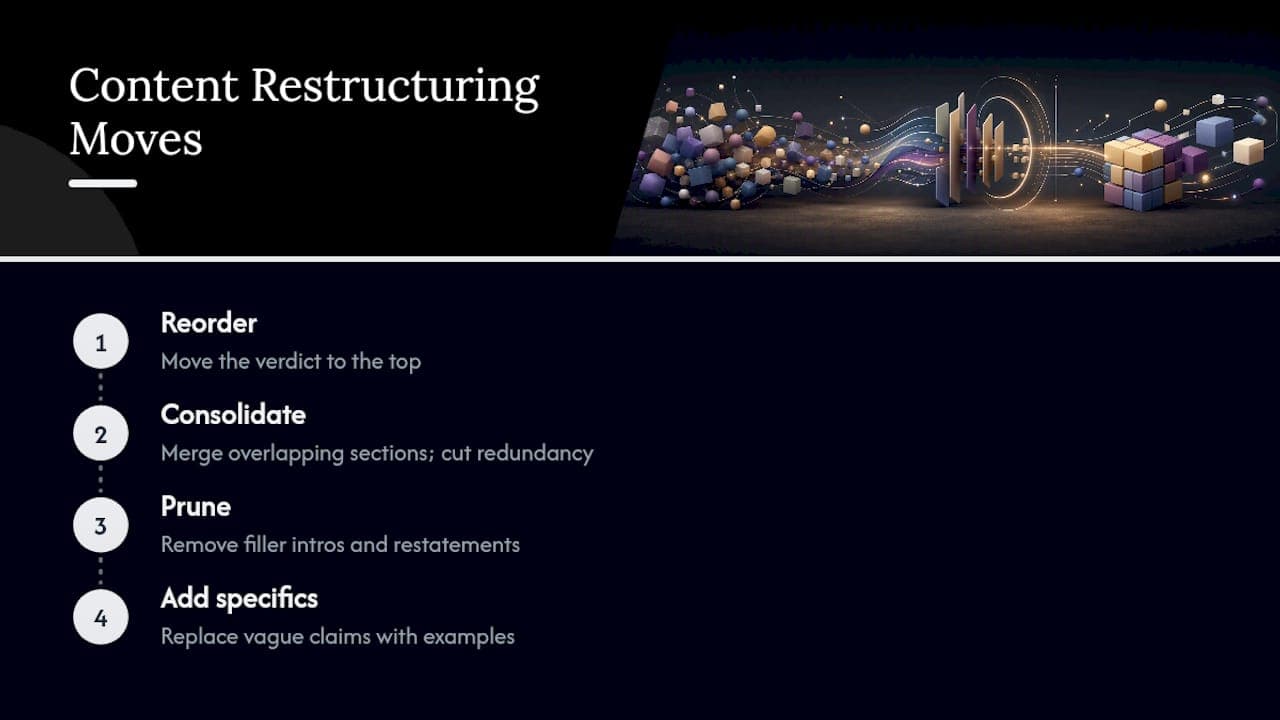
Reordering moves existing content into a different sequence without changing the words much. This matters when an AI draft buries the answer in paragraph four instead of paragraph one, which happens constantly because models tend to build up to a conclusion instead of leading with it. Move the verdict to the top, push supporting detail down.
Consolidating merges overlapping sections that say the same thing twice in slightly different words, another common AI habit. If your draft has a section on "benefits" and another on "advantages" that repeat each other, combine them and cut the redundant one entirely.
Pruning removes sections that add length without adding value: throat-clearing introductions, restated conclusions, or generic filler paragraphs that could apply to any topic. AI drafts often pad word count this way, especially in intros and closings.
A fourth, less discussed move is specificity injection during restructuring: while you reorder or prune, replace vague claims with concrete detail. If a paragraph says "many businesses have seen results," and you're already touching that sentence, that's the moment to add a real example or cut the sentence outright. Doing this alongside structural changes, rather than as a separate pass, saves time and catches more instances.
Restructuring makes sense when the underlying research and facts are sound but the presentation reads mechanically. Rewriting from scratch makes more sense when the content is factually thin or the argument doesn't hold together, no amount of sentence-level editing fixes a weak premise.
Three questions decide which path to take:
Is the detector score close to passing or far from it? If a detector flags 60% of a document as likely AI-generated, targeted paraphrasing of flagged sections plus a humanize pass usually closes the gap. If it flags 95%, the draft may need a structural rebuild, not a patch.
Does the piece already answer the reader's question? If the core information is useful but buried or repetitive, restructure. If the piece dances around the topic without committing to a clear answer, that's a content problem restructuring won't fix.
How much time do you have relative to the stakes? A student paper facing a plagiarism check and an academic integrity review needs more thorough restructuring than a marketing email that just needs to sound less robotic before it goes out. Match your effort to what's actually on the line.
The clearest sign restructuring is enough: a native speaker who reads it once flags awkward phrasing but not confused logic. The clearest sign you need a rewrite: the reader has to reread a paragraph to figure out what it's arguing.
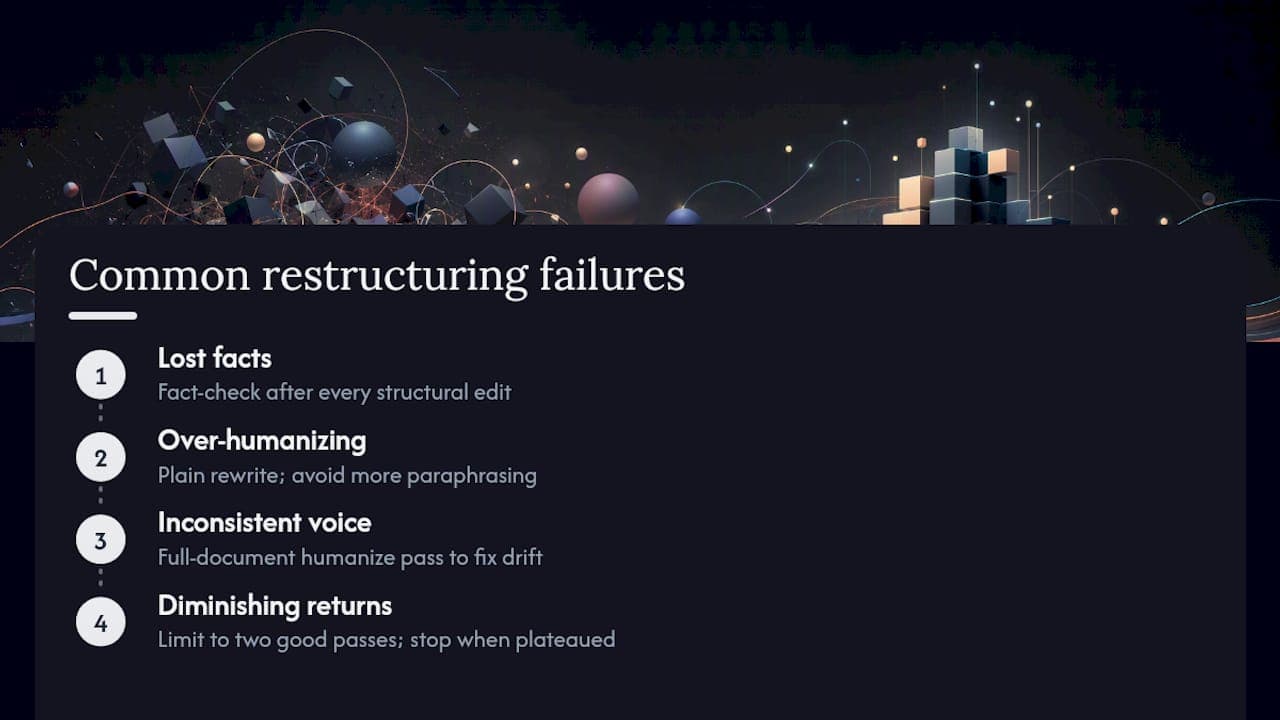
The most common failure is losing facts while chasing rhythm. Editors trim a sentence to break up monotony and accidentally cut the one number that made the paragraph credible. The fix is simple but easy to skip under deadline pressure: run a fact-checking pass after every structural edit, not just once at the end.
The second failure is over-humanizing into incoherence. Aggressive rewriting to avoid detector patterns can produce grammatically strange sentences or drop transitions a reader actually needs to follow the logic. If a paragraph reads awkwardly after editing, that's not a detector problem anymore, it's a readability problem, and it needs a plain rewrite, not more paraphrasing.
A third challenge is inconsistent voice across a document edited in pieces. If you paraphrase flagged paragraphs individually without rereading the whole piece afterward, tone shifts become obvious, formal in one section, casual in the next. This is exactly why the full-document humanize pass in the editorial workflow matters: it's the step that catches tonal drift the paragraph-by-paragraph pass misses.
The fourth challenge is diminishing returns. Teams sometimes run five or six humanize passes chasing a perfect detector score, and each additional pass adds risk of introducing new errors or stripping remaining personality from the text. Two passes, done well, beat six passes done anxiously. If the score has plateaued and a native reader can't spot the seams, stop.
Detector score is the obvious metric, but it's not the only one that matters. A document can score well on a detector and still read poorly, which defeats the purpose if the goal is genuine reader value rather than just clearing a filter.
Track three things side by side: the detector score before and after, a readability score (Flesch-Kincaid or similar), and a subjective read-aloud test where you ask whether a stranger would guess this was AI-assisted. Chasing the detector number in isolation is less valuable than increasing genuine originality and reader value, a good process improves all three metrics together, not just the one that's easiest to automate.
Engagement signals take longer to show up but matter more long-term. Time on page, scroll depth, and comment quality tend to improve when restructuring adds real specificity rather than just shuffling sentence structure. A paragraph with a genuine example holds attention longer than one with generic filler, regardless of how it scores on any detector.
If you're restructuring content for search performance rather than just detection, pair the humanize pass with a look at how humanized content affects SEO outcomes, since search engines and AI detectors sometimes respond to overlapping but not identical signals. A document that reads naturally to a person usually performs better on both fronts, but it's worth checking rather than assuming.
A marketing team publishing a weekly blog post found their AI-drafted articles kept getting flagged by both their internal plagiarism checker and their audience, who left comments noting the content felt "off" without being able to say why. The fix wasn't a bigger rewrite budget. It was moving the banlist and sentence-variance rules into the prompt stage, so the first draft needed far less correction. The paraphrase-then-humanize sequence on the remaining flagged paragraphs closed most of the gap.
An academic writing context tells a similar story. A student using AI drafting tools for research summaries ran into repeated flags from plagiarism software, not because content was copied, but because the phrasing pattern matched known AI outputs closely enough to trigger suspicion. Restructuring the flagged paragraphs with genuine first-person reasoning, explaining why a source mattered rather than just summarizing it, resolved the flags because the reasoning itself became harder to template.
Professional editors have long used what amounts to an "anchor" technique for this: a unique specific, an actual proprietary number, a genuine detail, a real observation, that no detector or paraphraser can reproduce because it doesn't exist anywhere else to copy. That's the throughline across both examples above. The teams that succeeded didn't just rearrange sentences. They added something a template couldn't generate on its own.
Most guides treat detection scores like the finish line. They're not. A document can score perfectly human and still read like nobody. The teams that get the best results treat the detector score as a symptom, not the disease, if your prose is generic and your sentences are uniform, you'll score poorly on detectors and fail to hold a reader's attention, because both problems come from the same root cause: a lack of specificity.
The tradeoff nobody likes to admit: aggressive humanization, done fast, sometimes introduces grammar quirks or strips out a fact that mattered. Automation is excellent at fixing rhythm and phrasing patterns. It's not reliable at knowing which number in your document is load-bearing. That judgment call still needs a person, every time, before anything goes out the door.
Where automation genuinely earns its place is the mechanical layer, sentence variance, banlist enforcement, em-dash counting. Where it falls short is judgment. Use it for the first, and never skip a human pass for the second.
— Tilen
Semihuman.ai plugs directly into steps three and four of the workflow above: the full-document humanize pass and the final verification check. Instead of manually hunting for banned phrases, uniform sentence lengths, and leftover em-dashes across a long draft, the tool applies restructuring and keyword integration in one pass, then gives you a document ready for a final fact-check rather than another round of manual line edits.
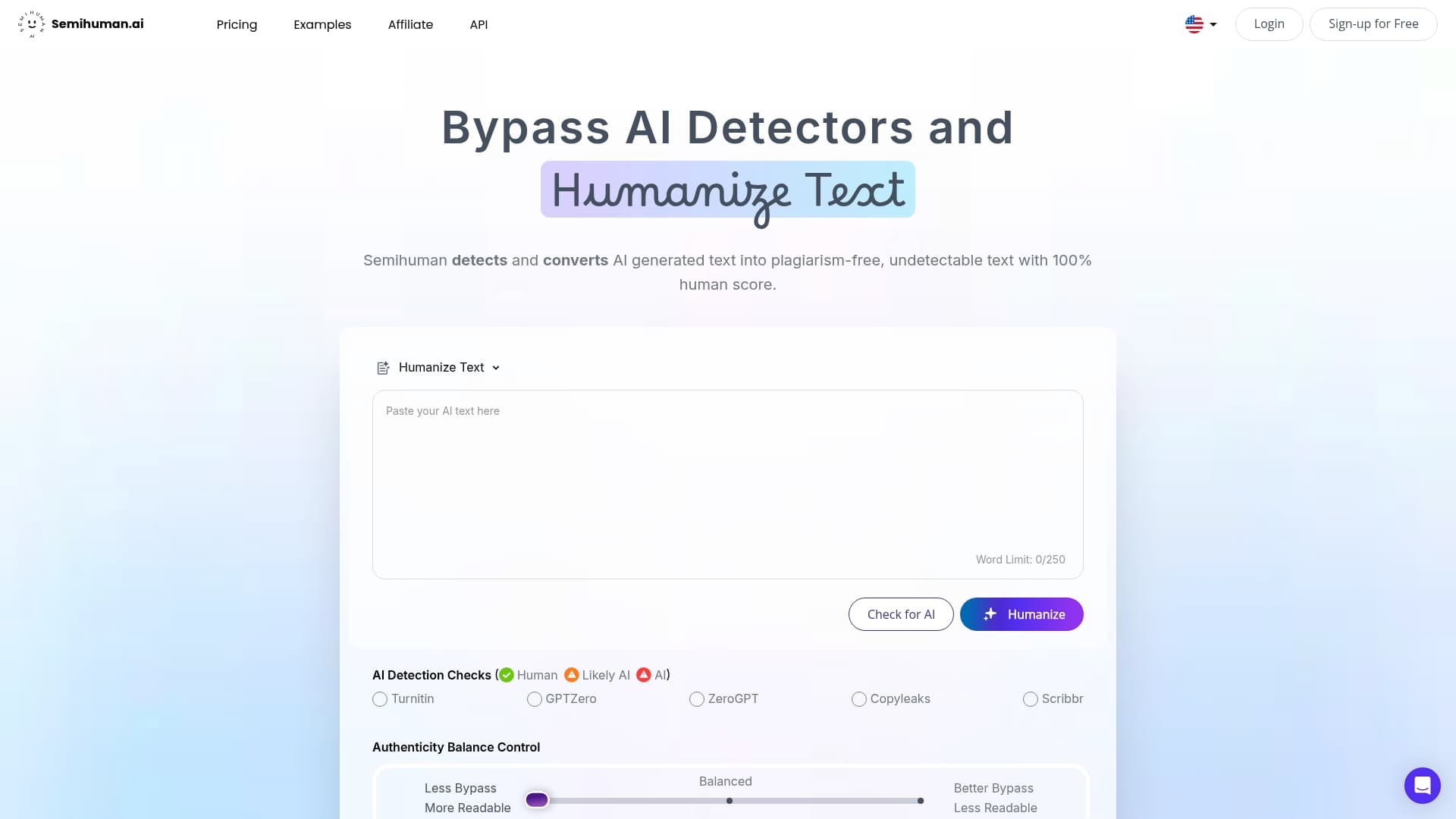
The platform works through a web interface for one-off documents or an API for teams running this process at volume, marketing agencies editing client drafts, SEO teams processing content regularly, or students checking a single paper before submission. Both routes apply the same restructuring logic: detect AI patterns, rebuild sentence structure, and integrate target keywords without awkward manual insertion under deadline pressure.
If you're at the paraphrase stage of the workflow, the AI text paraphraser handles flagged-paragraph rewrites specifically. If you're closer to publishing and need a final detector check, AI-proof writing covers that verification step. For the full restructuring and keyword pass described above, start with the SEO text generator and run your next draft through it before you publish.
The Postibo guide on humanizing AI content backs the prompt-level rules and burstiness guidance throughout this piece. The OutrightCRM breakdown on paraphrasing versus humanizing supports the two-pass workflow recommendation. Eyesift's guide to rewriting AI text informed the read-aloud and first-person anchoring advice. HubSpot's piece on AI content humanization grounds the ethics and disclosure points in the perspective section. For broader strategic context on AI in content planning, see this overview of AI's role in content strategy.
Run a banlist find-and-replace, cap em-dashes, and insert sentence-length variation, all doable in under 30 minutes without a full rewrite.
Not reliably. Paraphraser-only approaches often leave detection scores largely unchanged because they swap words without changing sentence structure or rhythm.
Both, but prompt-level rules should come first. Baking banlists and sentence-variance rules into the prompt reduces detector flags more effectively than fixing them after the fact.
No. Tools handle mechanical restructuring, sentence variance, keyword integration, and banlist enforcement well, but fact-checking and judgment calls about what to keep still need a human pass.
Time estimates for restructuring a moderately sized article include a few minutes for regeneration, around a quarter of an hour for targeted paraphrasing, about ten minutes for a humanize pass, and fact-checking time varies depending on the content.



Start
Humanizing
for Free!
Humanize