
Loading...

Use a short curated shortlist (brainwriting, SCAMPER, Crazy 8s, mind mapping, reverse brainstorming, round robin) matched to your team size and goal, then pick one facilitation recipe below and run a 45 minute hybrid session with a clear synthesis step. Short sessions suit quick, single problem sprints; longer sessions fit multi phase innovation work. What follows covers the shortlist, a full catalog of 18 exercises grouped by purpose, ready to run facilitation templates, and guidance for remote and human plus AI brainstorming.
TL;DR:
- Matching the right facilitation technique to group size and problem type is crucial to avoid wasted time and ensure productive idea generation.
- Structuring sessions with individual phases before open discussion increases originality and reduces production blocking, especially when using prompts like SCAMPER.
- Using shared digital tools, asynchronous submissions, and delayed idea reveal can boost idea quality and engagement in remote or hybrid environments.
- Incorporating specific rules, roles, and follow-up actions, such as ownership assignments, prevents ideas from being forgotten after the session.
- AI support works best when used as a supplementary resource that participants rework or extend, rather than accepting suggestions passively.
Most sessions fail not because the technique is wrong, but because the wrong technique got picked for the group and the clock. Match the method to your headcount, your timeline, and whether you need breadth or depth, and the rest of the session takes care of itself.
These six cover the two axes that matter most: how much structure a group needs to speak up, and how much visual or verbal output the task demands. A quiet engineering team drowning in a backlog benefits from brainwriting's silence. A five person creative team staring at a stale product benefits from Crazy 8s and its forced constraint. Reverse brainstorming earns its place whenever a team has spent an hour going in circles: asking "how would we guarantee this fails" often unlocks more than another round of "how do we succeed" ever does.
Pick one method before the meeting starts, not during it. Groups that decide format on the fly waste the first ten minutes debating process instead of generating ideas.
Each exercise below includes what it needs, how long it runs, and where it tends to break. Group size and timing are starting points, adjust for your room and your deadline.
Warm ups
Divergent written methods
Visual and structuring methods
Role and perspective methods
Analytic and evaluation prompts
Fast exploration
Pro Tip: Never let a group vote on ideas the moment they finish generating them. A five minute silent break between divergence and evaluation reduces the anchoring effect of whoever spoke last.
The most common failure across all 18 methods is the same: skipping the individual phase and jumping straight to open discussion. That single shortcut reintroduces production blocking and evaluation apprehension, the two process losses that structured written phases exist to prevent. A close second failure is running evaluation and generation in the same breath, which kills half the ideas before anyone has time to develop them.
A session lives or dies on four decisions made before anyone opens their mouth: the rules, the agenda, the roles, and the synthesis method. Skip any one of these and ideas pile up with nowhere to go.
State the ground rules out loud at the start of every session:
Assign roles before the session, not during it. A facilitator runs the agenda and keeps time. A timekeeper calls out transitions so the facilitator can stay focused on the room. A synthesizer clusters ideas as they come in rather than waiting until the end. A scribe captures everything verbatim, since paraphrasing during a fast session loses nuance.
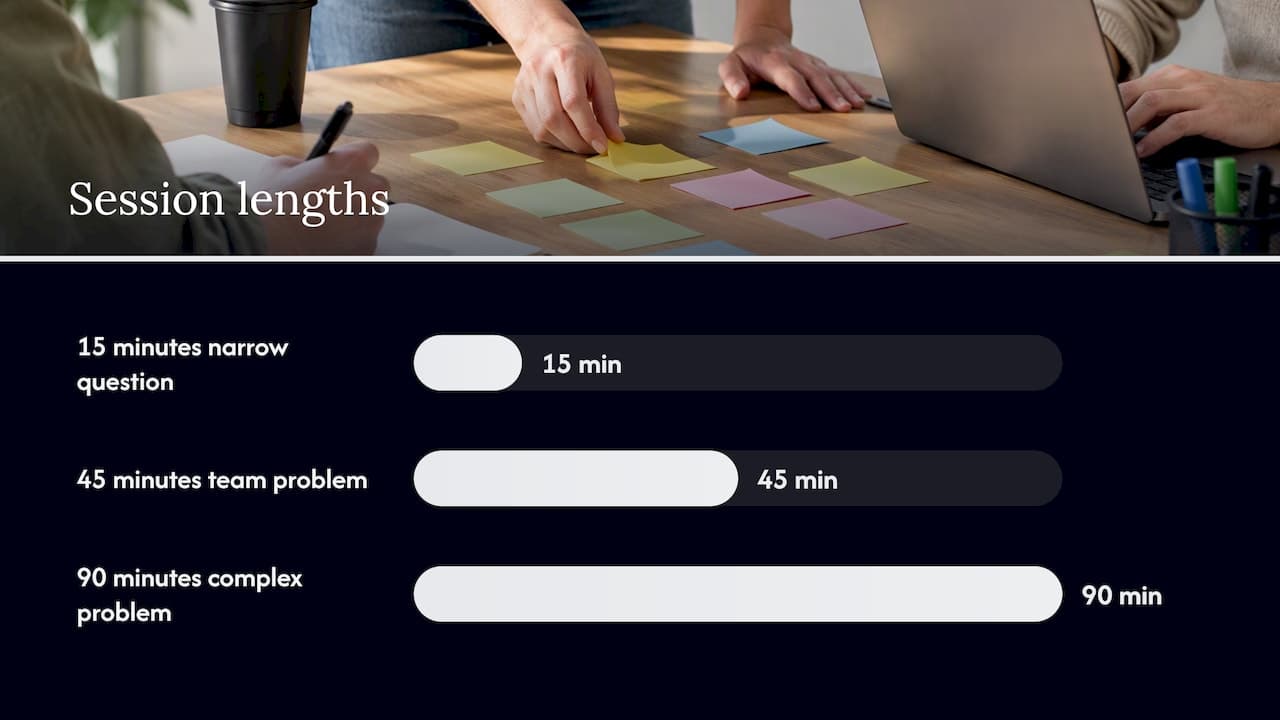
| Session length | Best for | Structure |
|---|---|---|
| 15 minutes | A single, narrow question with a small group | 2 min framing, 5 min silent writing, 5 min share and cluster, 3 min pick top ideas |
| 45 minutes | A standard team problem with 5 to 10 people | 5 min framing, 10 min individual ideation, 15 min group sharing and building, 10 min clustering, 5 min dot vote |
| 90 minutes | A complex, multi part problem needing multiple methods | 10 min framing and warm up, 20 min individual ideation, 20 min group round robin, 20 min SCAMPER or reverse brainstorming on top ideas, 15 min affinity mapping, 5 min next steps |
Synthesis is where most sessions quietly fail. Affinity mapping turns a wall of sticky notes into named themes. Dot voting lets each participant place a fixed number of votes on their favorite ideas, surfacing group consensus without a long debate. How Now Wow adds a feasibility lens on top of the vote. Whatever method you choose, end every session by assigning an owner and a date to at least one idea. An idea with no owner is a note, not a decision.
Remote brainstorming needs a tool that replaces the whiteboard and the sticky note, not a video call layered on top of a spoken meeting. Match the technique to the tool rather than forcing every exercise into a single platform.
Human plus AI brainstorming works best as a "pull" resource rather than a constant stream. Ask a generative AI tool for a batch of alternative framings or SCAMPER style variations only after your team has generated its own ideas independently, then require every participant to rework or extend any AI suggestion before it counts as a group idea. Research comparing solitary humans to human AI dyads found the pairs outperformed individuals on fluency, flexibility, novelty, and value as a group, but also flagged a risk of "smart loafing," where a person leans on the AI's output instead of contributing their own thinking. Forced elaboration is the fix: no idea moves forward until a human has changed or built on it. Marketing teams exploring this pairing can find grounded examples of AI supporting creative workflows without replacing the human judgment calls that make a campaign work.
Pro Tip: Feed an LLM a narrow prompt like "list five ways a budget conscious customer would solve this differently" rather than an open "give me ideas," since narrow prompts produce material a human can actually build on.
The instinct to let a group "just talk it out" is the single most tested and most consistently disproven assumption in brainstorming research. Structure beats spontaneity almost every time it has been measured.
Adding SCAMPER style prompts during individual ideation, then following with a group phase that shares those individual ideas before a final individual round, produced measurably higher originality and flexibility than unstructured discussion. Field study on hybrid brainstorming scaffolds
A study of 94 students found that groups given SCAMPER prompts plus shared awareness of each other's individual ideas scored higher on originality than a control condition, which points to a specific sequence worth copying: individual ideation first, structured prompts second, group sharing third, and a final individual pass to close the loop.
Mixed anonymity is the second lever worth building into a process. Letting people submit ideas anonymously, then revealing top contributors only after evaluation, balanced psychological safety with accountability in field experiments, though the effect was context dependent rather than universal, so it is worth piloting inside your own team before making it a standing rule.
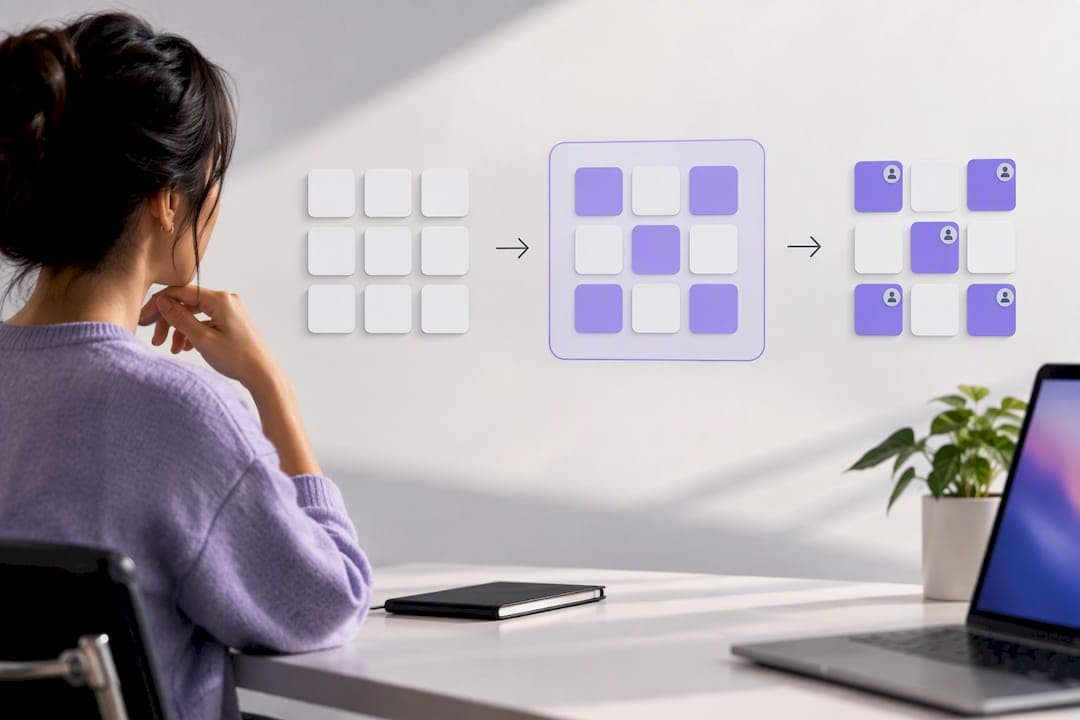
The third finding concerns AI. Human plus AI pairs beat solitary humans on group level creativity metrics, but the individual human in that pair does not automatically perform better, and can perform worse if the AI's suggestions substitute for the person's own effort rather than sparking it. The fix already covered above, forced elaboration on every AI suggestion, is the direct response to that finding, not a general best practice invented separately from it.
These three scripts are built to run as written, no extra preparation required beyond a timer and a shared board or wall space.
SCAMPER checklist: Substitute, Combine, Adapt, Modify, Put to another use, Eliminate, Reverse, run through each letter as a separate one minute prompt against your current best idea.
Three heuristics cover most situations. First, if the room is quiet or hierarchical, start with a written, individual method like brainwriting before opening the floor, since silence protects the ideas that a loud voice would otherwise bury. Second, if the group is stuck rather than silent, reverse the question before adding another technique: "how would we guarantee failure" unsticks more sessions than a fresh ideation method ever does. Third, match session length to decision urgency, not to how much time happens to be on the calendar. A 15 minute sprint with a clear owner beats a 90 minute workshop that ends without one.
The most common failure after a good session is not lack of ideas, it is lack of follow through: ideas get clustered, voted on, and then quietly forgotten because no one wrote down who owns the next step. Document what came out of every session, even a rough list, and revisit it before the next one starts.
— Tilen
The facilitation choices above come from a small set of primary sources worth reading directly. The hybrid brainstorming scaffold study covers the SCAMPER and cognitive group awareness experiment in full. The mixed anonymity field experiments detail how anonymous submission and delayed reveal affected novelty across different team settings. The human and generative AI dyad study breaks down fluency, flexibility, novelty, and value metrics for solitary humans versus AI paired participants.
Brainwriting works well for small, quiet, or hierarchical teams because it gives everyone equal space to contribute in writing before discussion starts. For design heavy problems, Crazy 8s offers a faster, more visual alternative in about eight minutes per round.
A focused single question fits in 15 minutes, a standard team problem needs about 45 minutes, and a complex, multi part challenge benefits from a 90 minute session that combines several methods. Match the length to the decision's urgency rather than to whatever slot is free on the calendar.
Research on hybrid formats favors sequencing individual ideation before group discussion, since this order reduces production blocking and lets SCAMPER style prompts sharpen originality before ideas are shared. A pattern of individual, then group, then individual again tends to outperform either format alone.
No, but AI can supplement it when used as an on demand source of alternative framings rather than a replacement for human thinking. Studies on human and AI paired ideation found pairs outperform solo humans on group creativity metrics, provided people are required to rework or extend any AI suggestion rather than accept it as is.
SCAMPER is a checklist, Substitute, Combine, Adapt, Modify, Put to another use, Eliminate, and Reverse, used to generate new angles on an existing idea or product. It works best as a follow up prompt after an initial round of open ideation rather than as the first exercise in a session.



Start
Humanizing
for Free!
Humanize