
Loading...

Treat AI as a junior writer: it drafts fast, but it needs a human editor to shape that draft into something that sounds like one specific person wrote it. The reliable path runs through a two-stage human-led edit, a strategic pass followed by a humanizing line edit, checked against detector and paraphrase research rather than guesswork. Tools like Semihuman fit into that second stage, helping you verify and refine the result before it goes out the door.
TL;DR:
- Human editing should focus primarily on verifying facts, aligning the draft with your brand voice, and restructuring the content for clarity and impact.
- Reordering paragraphs to lead with specific examples or claims rather than definitions enhances the natural, spoken rhythm of the writing.
- Developing a recognizable voice involves deliberate variation in sentence length, concrete wording, repeated phrases, and intentional imperfection, avoiding over-polishing.
- Using AI detection tools and human review together offers a more reliable way to identify and improve AI-generated drafts, as no single method is foolproof.
- Adapting content for different audiences or formats requires preserving core voice elements while adjusting language and structure, confirmed effective by reading for recognition.
Before touching sentence-level style, run through a short sequence that catches the biggest problems first. Skipping straight to word swaps wastes time on a draft that still has the wrong angle or an unchecked fact buried in it.
This order matters. A paragraph can read beautifully at the sentence level and still fail the piece if it argues the wrong point or opens with the same throat-clearing line every AI model defaults to. Fix structure and substance first, voice second, and verification last.
The strategic edit and the line edit solve different problems, and conflating them is why so many "humanized" drafts still read like a machine wearing a trench coat. Content Marketing Institute recommends treating AI as an instrument, or a junior writer, and feeding it brand voice documentation before applying a two-stage edit to build a distinctive result.
The strategic edit comes first and covers the substance of the piece:
The line edit comes second and covers everything a reader feels rather than lists:
Feeding the AI a short brand voice document, sample paragraphs, and a do/don't list before generation reduces how much line editing you need later, because the draft starts closer to your register. Content Marketing Institute also points to a useful habit here: a deliberate pause between generation and editing, where you question each paragraph instead of accepting it on the first read. Guidance on building reusable voice samples for AI prompts can make this repeatable across a team rather than dependent on one editor's memory.
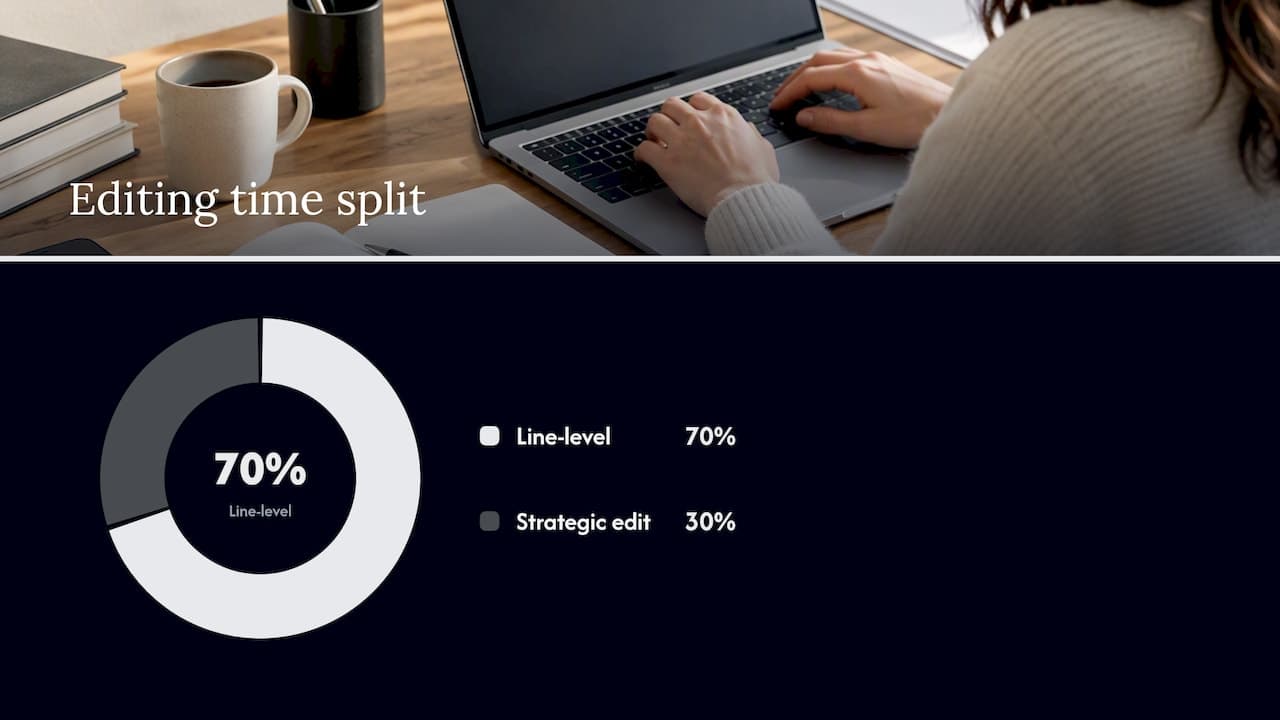
A workable split for most teams is roughly 30% of edit time on strategy and 70% on line-level humanizing, with a senior editor or subject expert handling the strategic pass and a writer familiar with the brand's voice handling the line edit.
Pro Tip: Keep a running document of phrases, rhythms, and idioms unique to your voice or brand, and paste it into your AI prompt every time, so the first draft needs less correction.
Structure is the first lever and the one editors skip most often. AI drafts tend to open with a definition, move through three evenly weighted points, and close with a summary paragraph that restates everything just said. Reorder it: lead with the most specific or surprising point, cut the restated conclusion entirely, and write an opening line drawn from a real detail rather than a category statement.
Cadence does more work than most editors expect. A string of AI sentences often runs twelve to twenty words each, evenly paced, with no fragments and no rhetorical questions. Breaking that pattern, a four-word sentence after a long one, an occasional question thrown at the reader, a sentence that starts with "And" or "But", makes the text sound spoken rather than assembled.
Lexical specificity separates a human voice from a competent summary. "Many businesses use tools to improve efficiency" says nothing; "Marketing teams run their drafts through Grammarly for grammar and Hemingway Editor for clarity before a human ever touches them" says something a reader can picture. Swap abstract nouns for named tools, sensory details, or niche terms specific to the field you're writing in.
Signature markers build recognition over time. A writer or a brand that consistently reaches for the same kind of metaphor, opens arguments the same way, or returns to a particular phrase becomes identifiable across pieces the way a byline would be, even without one.
Over-polishing is its own tell. A draft with zero fragments, zero contractions, and perfectly parallel structure throughout reads as manufactured precisely because real writing rarely achieves that. Reviewing humanized text examples side by side with their AI originals makes this gap concrete rather than theoretical.
Detectors catch a lot, but not everything, and treating a clean scan as proof of quality is a mistake. The NIST GenAI Text-to-Text pilot study found that detectors can often distinguish AI from human-written text, but performance varies by model pairing, and some generators can deceive a given discriminator while others get caught consistently. That variability is the reason a single tool's "pass" is not the end of the process.
Paraphrase research adds a second layer. Findings from ACL's PASTED research show that paraphrasing can shift the statistical signals detectors rely on, and that paraphrase-detection models can still identify reworded spans with strong accuracy when the paraphrase and original stay close in structure. In practice, that means light paraphrasing alone is a weak humanizing strategy compared to genuine structural and lexical rework.
A pragmatic sequence works better than relying on any single check:
If a detector flags a passage, the fix is rarely another round of synonym swapping. Re-edit the structure, add a specific example only a person with direct knowledge would include, or bring in a subject matter expert to sharpen the claim. The Associated Press treats AI output as unvetted source material that requires human review and verification before anything gets published, which is a useful standard to hold your own process to regardless of your industry.
A writing voice, in this context, is the consistent set of structural, lexical, and rhythmic choices that make a piece of content identifiable as coming from a specific person or brand, even without a byline. It shows up in which words you reach for, how long your sentences tend to run, what you choose to leave out, and the small habits readers start to recognize across multiple pieces.
This matters for three practical reasons. First, generic AI output reads interchangeably with thousands of other generic AI drafts on the same topic, which gives readers and search engines no reason to prefer your version. Second, a recognizable voice builds trust over time the way a familiar byline does: readers return because they know what they're getting. Third, distinct voice is increasingly a proxy for authenticity, since both readers and automated systems treat generic, overly smooth text as a signal of low effort.
The goal of the two-stage workflow described above is not to disguise that AI was involved in drafting. It is to make sure the published piece reflects actual human judgment, specific knowledge, and a consistent point of view, the things a reader is actually looking for when they choose to keep reading past the first paragraph.
Before you can edit AI drafts into your voice, you need a clear sense of what that voice actually sounds like. A few exercises make that concrete rather than abstract.
Write the same short paragraph three ways: as a text message to a friend, as a formal memo, and as your natural publishing voice. Comparing the three reveals which habits are genuinely yours and which are borrowed formality you don't need.
Collect five pieces you've written that got a strong reaction, positive or critical, and mark every sentence that sounds distinctly like you rather than like generic prose. Patterns usually emerge fast: a tendency toward short declarative sentences, a habit of opening with a question, a preference for concrete examples over abstractions.
Keep a running list of words and phrases you catch yourself avoiding or overusing. Both tell you something: avoided words often don't match your register, and overused ones are early signature markers worth keeping deliberately rather than editing out.
Finally, rewrite one AI-generated paragraph a day for a week without any tool's help, timing yourself at under five minutes. Speed forces instinct over deliberation, which tends to surface your real voice faster than a slow, careful rewrite does.
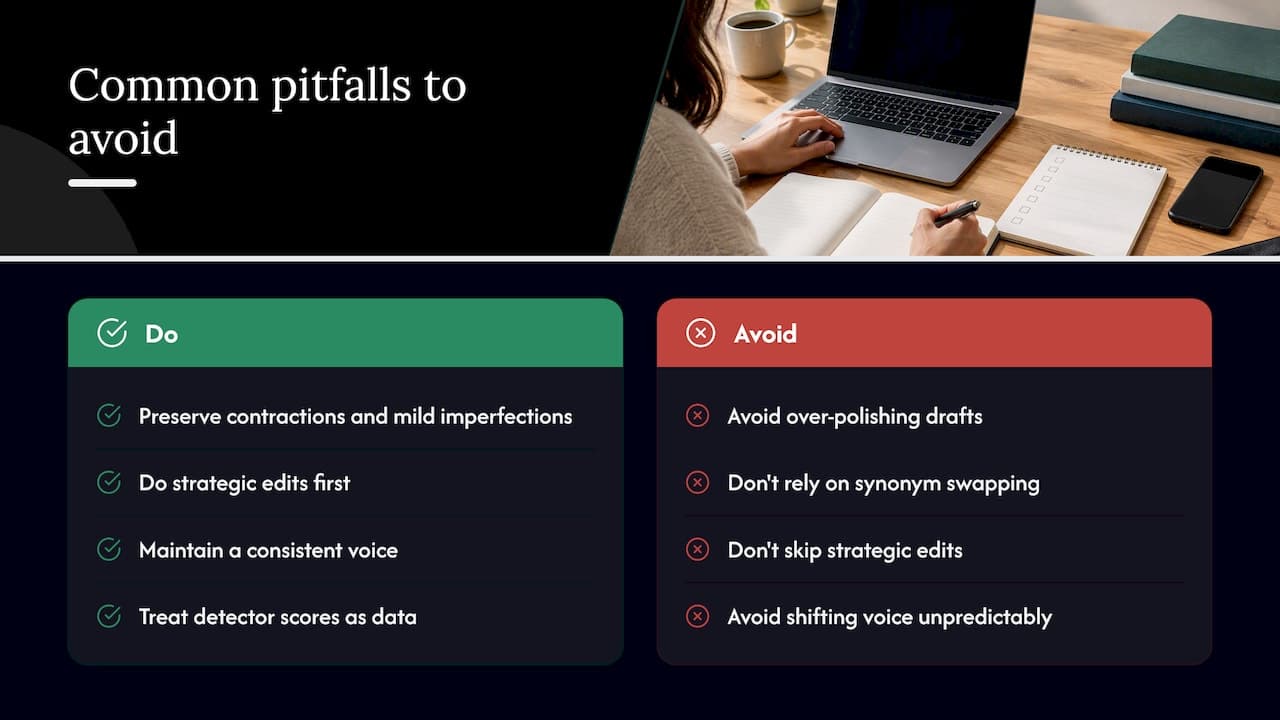
The most common mistake is over-polishing. Editors chasing a "clean" draft often remove every fragment, every contraction, and every mild imperfection, which produces prose that is technically correct and reads exactly like the AI output it started as.
A second pitfall is relying on synonym swapping as a humanizing strategy. Replacing "utilize" with "use" a dozen times changes vocabulary without changing structure, rhythm, or substance, and paraphrase-detection research shows that kind of surface rewrite is often still identifiable because the underlying sentence shapes stay the same, as ACL's findings on paraphrase detection suggest.
A third is skipping the strategic edit entirely and jumping straight to line-level style. A beautifully voiced paragraph that argues the wrong point, or states an unverified fact, fails regardless of how natural the sentences sound.
A fourth is inconsistency: using a sharp, informal voice in one piece and a stiff, corporate one in the next. Readers and brand audiences build trust through repetition, and a voice that shifts unpredictably reads as unreliable rather than versatile.
Last, treating a single AI detector pass as final proof of quality ignores what the NIST pilot study actually found: detector performance varies by pairing, so one clean score is a data point, not a guarantee.
A technical blog post with a distinct voice often leans on precise, specific nouns and short declarative sentences, cutting hedging words and stating findings plainly. The voice comes through in what it refuses to over-explain, trusting the reader to keep up.
A marketing email with a strong voice usually reads conversationally, closer to how the writer actually talks, with contractions, short paragraphs, and the occasional direct address that feels personal rather than templated.
Academic or research-adjacent writing develops voice through argument structure rather than informality: the way a writer frames a counterpoint before dismantling it, or returns to the same framing device across a paper, becomes recognizable even within a formal register.
Narrative or feature writing often carries voice through pacing and detail selection, choosing one vivid, specific example over three generic ones, and through sentence rhythm that mimics how the writer would tell the story out loud.
Across all four, the common thread is restraint: a distinct voice usually comes from what a writer consistently chooses to include, cut, or emphasize, not from decoration layered on top of generic prose.
A consistent voice does not mean identical output everywhere. It means a recognizable core that flexes at the edges depending on format and audience.
For a technical audience, keep your core sentence rhythm and signature phrasing, but tighten vocabulary toward precise, field-specific terms and cut any aside that doesn't serve the argument. For a general consumer audience, the same voice can loosen: shorter sentences, more concrete analogies, fewer specialized terms.
Format matters as much as audience. A social post built from a long-form piece should keep the voice's cadence and a signature phrase or two, but drop the structural scaffolding, since a long setup that works in an article reads as filler in three sentences. An email needs more direct address than a blog post does, since the reader expects to be spoken to rather than informed at a distance.
The practical test: read the adapted piece next to the original. If a reader who knows your work would still recognize it as yours despite the format change, the adaptation succeeded. If it reads like a different person wrote it, the adaptation went too far and stripped the signature elements that make the voice identifiable in the first place.
AI drafts fast, but judgment is still a human job, and the editors who treat the two stages above as a checklist rather than a formality end up with noticeably better, more trustworthy output. We built the workflow in this piece around that belief: strategy first, voice second, verification always. Semihuman exists to support the line-edit and verification stages specifically, giving editors a practical way to humanize a draft and check it before it goes out.
— Tilen
Running the workflow above by hand works, but it is slower than it needs to be when you're producing content at volume. Semihuman detects AI-origin patterns in a draft, restructures and humanizes the text to read naturally, and integrates target keywords along the way, which covers much of the line-edit and verification stages in one pass.
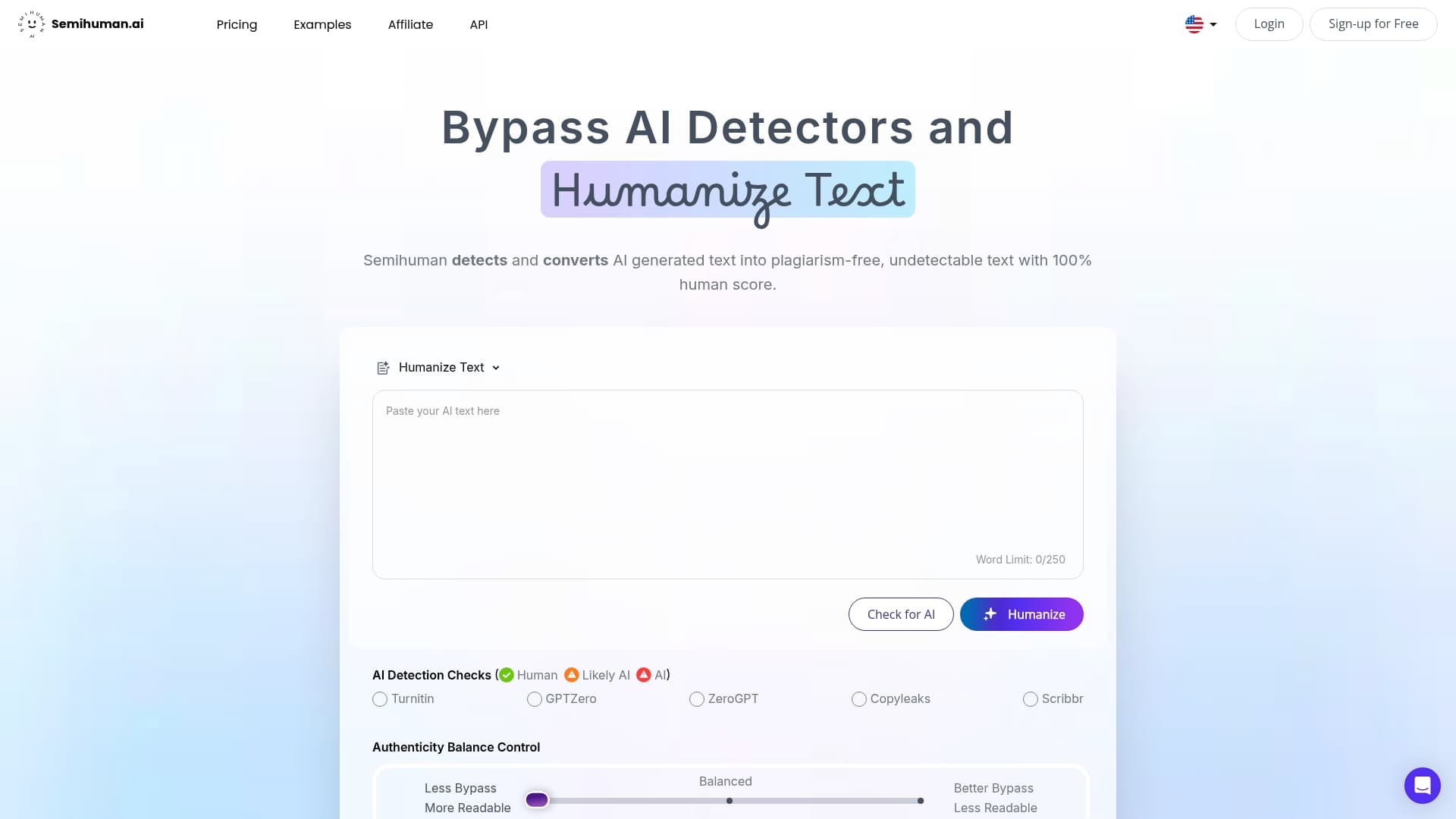
If you're an individual writer or small team, the Free, Basic, and Pro plans cover most workflows. If you need to integrate humanization into a larger content pipeline, the Developer, Business, and Enterprise options give you API access to automate the process across your team.
No single detector catches everything consistently. The NIST GenAI Text-to-Text pilot study found that detectors can distinguish human from AI content in many cases but performance varies, so combining a detector scan with human review gives a more reliable read than relying on one tool alone.
Disclosure norms vary by publication and industry, but the Associated Press treats AI output as unvetted material that needs human verification before publishing, which is a reasonable baseline even outside journalism. Check your own organization's editorial policy for the specific disclosure standard that applies to you.
Paraphrasing shifts some of the statistical signals detectors use, but research from ACL's PASTED research shows paraphrase-detection models can identify paraphrased spans with high accuracy when paraphrases stay close in structure. Structural and lexical rework, not simple synonym swapping, is the more durable approach.
Heavily templated AI output or highly technical topics may need more strategic time before the line edit even starts.
Read it aloud. Sentences that all run the same length, lack contractions, or close with a tidy restated summary are the clearest giveaways, and a short detector and human-reviewer check afterward confirms what your ear already caught.



Start
Humanizing
for Free!
Humanize