
Loading...

The fastest way to find a writing community is to decide what you need from it first, then pick one place that matches. If you need to show up and get words down, join an accountability group. If you need honest feedback on a manuscript, join a critique group. Most people who drift away from writing groups did not fail at community. They joined the wrong kind.
This guide covers where to look, how to tell a good group from a noisy one, and how to make the first month count. It is written for US readers, but the online options work from anywhere.
Practitioners tend to split writing communities into two camps. Accountability communities focus on showing up to write and hitting word counts. Critique communities prioritize editorial improvement. Scribophile's own structure reflects that split, with separate areas for different needs, so it pays to explore how a platform is organized before you commit.
The mismatch is the common trap. Bring a half-finished chapter to a group built for quiet co-writing and you will get polite encouragement, not edits. Show up to a rigorous critique circle when you only want to rebuild a daily habit and the process will feel like homework.
Ask yourself three questions:
Write the answers down. They become your filter for everything below.
If your problem is consistency, start here. Shut Up & Write! is a free global community that runs writing sessions online and in-person events in many cities. The format is simple: you write in timed sprints alongside other people, with no feedback and no pressure to share. It is open to adults aged 18 and over.
That simplicity is the point. You do not need a finished piece or a thick skin, just a laptop and an hour.
Other accountability options worth knowing about by type:
If you want to build the habit underneath all this, our piece on psychology-backed writing routines for busy writers pairs well with any accountability group.
Critique is where a community changes your writing, and it is also where entry bars matter most. Scribophile is one of the largest online critique communities and has been running for over 18 years. Its model is a feedback loop: you earn karma points by critiquing other members' work, and you spend them to post your own. That keeps the exchange fair and makes sure every writer who posts has also given something back.
Poets & Writers makes the same case from the literary-organization side. Writing is a solitary art, but writers crave honest, respectful feedback and a community of peers to share the blank page with. Its Groups platform is built around that idea.
What a good critique community usually has:
See the entry bar as a feature. A group anyone can join instantly and where nobody has to do anything is a group where nothing much happens.
Online communities are convenient, but a local group gives you something screens struggle to replicate: people who keep turning up in the same room. Some options in the US:
If you are choosing where to live, geography matters more than people assume. UNESCO names certain places Cities of Literature, and Iowa City is one of them. The Iowa Writers' Workshop at the University of Iowa pioneered creative writing teaching at the university level, and dozens of creative programs exist there. Cities like this offer independent bookstores, readings and university programs that create informal chances to meet people. You do not need to move, though. Most writers build a perfectly good community from a mix of online and local pieces.
| Online communities | Local groups | |
|---|---|---|
| Access | Any time zone, any schedule | Fixed times and places |
| Niche fit | Easy to find your exact genre | Depends on where you live |
| Cost | Often free; some paid tiers | Often free or low cost |
| Depth of ties | Builds slower, can last across borders | Faster to feel personal |
| Risk | Uneven moderation, lurking is easy | Smaller pool, harder to switch |
A hybrid works well: an online critique community for pages, plus a local or online sprint group to keep you showing up.
Social platforms can also be a doorway. Hashtags like #WritingCommunity on Twitter and Instagram, and #BookTok on TikTok, surface people writing in your genre. One piece of advice from writers who have done this: pick a single platform and stick with it, rather than spreading yourself thin across all of them.
Other starting points:
Spend ten minutes of due diligence. It saves weeks of frustration.
Moderation. Ask whether the community is moderated. Without moderation you can get "feedback dumping": generic, unhelpful or overly harsh comments in place of constructive critique. Good communities publish clear standards and a process for giving feedback, as NaNo 2.0 notes.
Age policy. Many Discord servers and forums set a minimum age, often 13+ or 18+. Check it before you or anyone younger joins.
Primary function. Does the group exist to hit word counts or to improve pages? Match it to your answer from earlier.
Activity level. Look at the last week of posts. Are people replying to each other, or is it a wall of announcements?
Cost and obligations. Are there fees? How many critiques do you owe per post? Can you pause?
Fit with privacy. If you plan to share unpublished work, read the rules on who can see it and who owns it.
Poets & Writers advises writers to look for their people, not just a group. A community is working when you look forward to it and, over time, you notice you are a more consistent and sharper writer.
A common worry is that community will crowd out the quiet time writing needs. Literary history suggests the opposite problem is more likely. Literary Hub's look at creative communities that changed literature points to groups that balanced long stretches of alone time with intense, intimate gatherings. The best groups protect your solitude and give you a safe, structured place to sharpen the work. If a community is eating your writing time, it is too big, too noisy or too frequent for you right now.
If you write for a living, such as blog posts, email, landing pages or social copy, look for communities that match your craft. Copywriting and content strategy circles tend to trade swipe files, review each other's drafts and discuss performance data. You will get more from a group where people ship work weekly than from one built around novels. For marketers who also want to systematize their publishing pipeline, tools for planning and automating content production can complement the human feedback you get from peers. Our posts on copywriting versus content writing and conversational copywriting help define which kind of group to seek out.
We build Semihuman, a tool for detecting AI-generated text and rewriting it so it reads naturally. That gives us a particular view of writing communities.
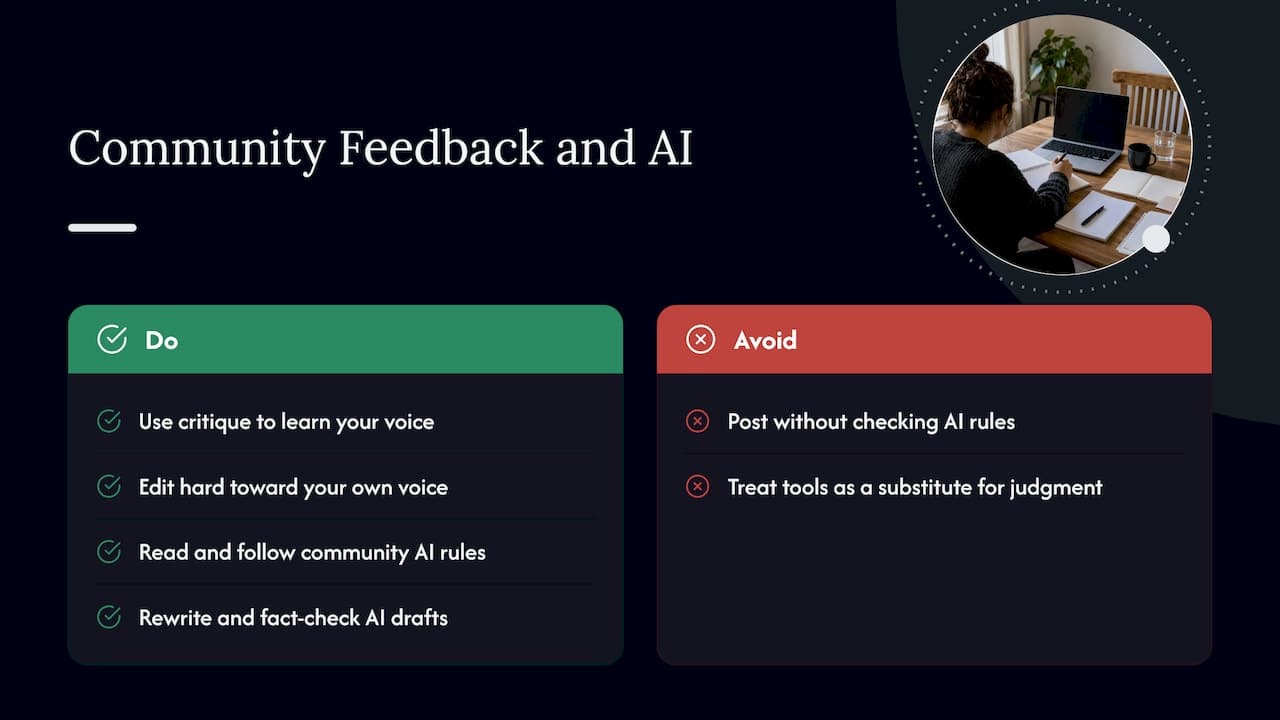
Many of the writers, marketers and students we work with now draft with AI at some stage. The question we hear is how to keep a draft sounding like a person wrote it. A community is a good answer, because real readers notice flat rhythm, generic phrasing and passages that could have been written by anyone. That feedback is hard to automate.
Our advice is practical. Use a critique group to learn what your own voice sounds like, then edit hard toward it. Read the community's rules on AI-assisted work before you post, since some groups limit it or require disclosure, and follow them. If you use AI to draft, do the human work of rewriting and fact-checking, and treat any tool, ours included, as support for your editing and not a substitute for your judgment. Strong, original writing also pays off with readers; we cover why in content originality for marketers.
— Tilen
If your workflow includes AI-assisted drafts, we can help you refine them before they reach a critique partner, an editor or a client. Semihuman restructures text for natural readability, supports keyword integration for SEO and offers a free plan to try it. Compare the Free, Basic and Pro plans on our plans page, or look at the API options for developers and teams if you want to build it into your own process. Whatever you use, check your school's, publisher's or community's policy on AI use first.
Start online with a free accountability group like Shut Up & Write! or a peer-critique site like Scribophile. Then check your local library, bookstore and literary center for in-person groups. Social hashtags and Discord servers are good for finding people who write your genre.
Pick one community that matches your need, either accountability or critique, and commit to it for 30 days. Give feedback before you ask for it and show up on a regular schedule. Community grows from repeated contact, not one big introduction.
Open groups let you join with a sign-up. Selective ones may ask for a writing sample, a short interview or a commitment to critique others first. Read the entry requirements, prepare your best short piece and introduce yourself briefly.
It depends on the platform. Check who can read your posts, how the community moderates, and what the terms say about ownership before you share anything. Many groups offer private or members-only areas, and unmoderated spaces are where harsh or unhelpful feedback is most likely.




Start
Humanizing
for Free!
Humanize