
Loading...

An evergreen blog post answers a question that readers will still be asking years from now, and it keeps drawing organic search traffic long after you hit publish. Its value compounds as rankings stabilize and links accrue. Below you will find practical steps for choosing topics, writing the post, and keeping it fresh.
TL;DR:
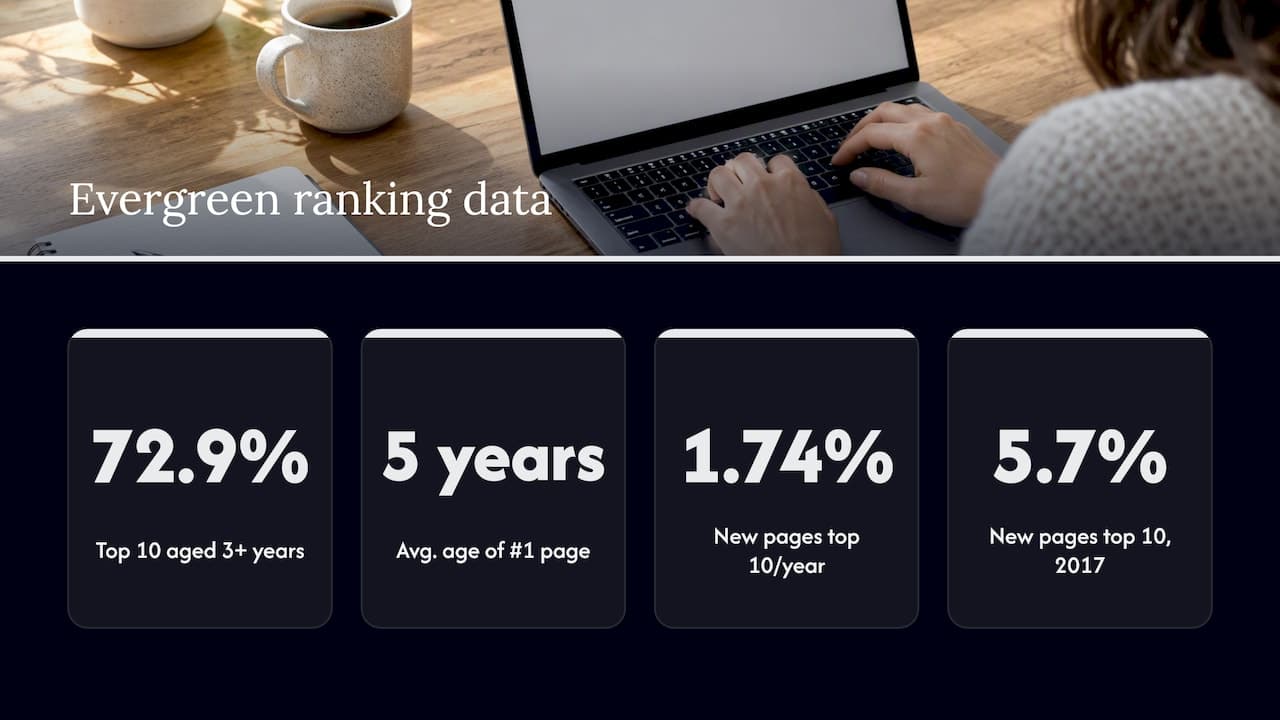
- Ahrefs data from 2025 found that 72.9% of Google’s top 10 pages are over three years old, while the average number one page is five years old.
- Choose topics with steady search interest and answers that survive change; avoid dated headlines and advice tied to a single tool or price.
- Lead each section with its direct answer, use question style headings, and keep examples, links, metadata, and structured data aligned with the page’s actual subject.
- Review pages when traffic falls or rankings shift, then update stale facts, fill gaps against current results, repair links, and promote the page again.
Two terms get mixed up. An evergreen topic is a subject with steady, long-term demand. An evergreen post is the piece you build on that topic, and it only stays evergreen if you keep it accurate. Ahrefs describes evergreen topics as those with consistent, stable demand, and it notes that the content built on them needs ongoing maintenance.
Compare "how to write a cover letter" with "best cover letter trends this spring." The first question will be asked next year and the year after. The second expires with the season. A guide to setting up a mortgage budget lasts. A reaction to this week's rate announcement does not.
Run any topic through a quick semantic stability test:
If several answers are no, treat the topic as trending and plan it as a short-lived post. Watch for these red flags:
Evergreen posts work like savings accounts. Each month they collect a little more traffic, a few more backlinks, and a little more topical authority, and those gains feed each other. A post that earned its first links early on may rank more easily later, which is why one strong piece often outperforms a dozen quick reactions.
The ranking data points the same way. Older pages dominate the results that matter:
According to 2025 Ahrefs data on 1.3 million keywords, 72.9% of pages in Google's top 10 are more than three years old, and the average #1 page is five years old. Age and ranking stability travel together, so a post you maintain has time on its side.
The same research found that only 1.74% of newly published pages reach the top 10 within a year, down from 5.7% in 2017. A new post is not going to win overnight, and your plan should reflect that.
This changes how you budget your effort. Instead of measuring a post by its initial traffic, judge it over the longer term. Publish fewer pieces, make each one genuinely complete, and reserve part of your calendar for upkeep. A blogger who regularly publishes durable posts and refreshes the best of them may build a steadier traffic base than one who publishes disposable posts. Return on investment arrives late, so patience is part of the strategy.
For a broader view of how blog content fits into search strategy, this 2026 guide to blog content in SEO is a useful outside read. And if you are weighing authority signals, our piece on building authority through content covers how trust and rankings reinforce each other.
Some formats age far better than others. Each of the following has a track record of lasting:
Some formats are a poor fit. Roundups of "best tools this year" and news commentary age quickly. If your audience wants current recommendations, build a stable explainer on how to choose a tool, then link out to a separate, dated list. Visuals also help posts last because they make dense steps easier to scan, a point we cover in how visuals boost engagement and SEO.
Pro Tip: Repurpose one evergreen post into a short video script, a checklist download, and a newsletter series, then link them all back to the original.
Repurposing playbooks like this one show how a single post can feed several channels.
Picking the right topic prevents most evergreen failures. Start with demand, not inspiration, and use a repeatable process:
Pro Tip: Write down the one-sentence answer to your topic before you outline. If the sentence needs a date or a product name to make sense, the topic is probably not evergreen.
A short example: a gardening blogger weighing "best seed catalog deals this month" against "how to start tomatoes from seed." The first loses value quickly. The second answers the same beginner question every spring for years, so it earns the slot.
Once you have the topic, the writing process decides whether the post lasts. Work through it in order.
Start each section with the answer. Put the direct answer in the first sentence under every H2, then explain. This inverted pyramid at the section level helps readers scan and helps search engines and AI summaries lift a clean answer.
Write question-style headings. Phrase H2s the way people search, such as "How long should you rest dough?" rather than "Dough rest time." These match queries and extract well into featured snippets.
Keep the language timeless. Avoid "this year," "recently," "the latest version," and walkthroughs of one app's current screens. When you need an example, pick one that will still make sense later, and describe the principle behind any tool you mention.
Optimize on the page.
Write like a person. If you use AI to draft, edit hard. Add real examples, trim filler, and make sure the voice sounds like you. Our notes on enhancing authenticity in blogging and what Google's helpful content direction means for 2026 explain why this matters for long-term rankings.
Before you publish, run this checklist:
| Step | What to do | Why it extends the life of the post |
|---|---|---|
| Answer first | Lead each section with the direct answer | Easier to scan and to extract |
| Question headings | Match real search phrasing | Aligns with queries and snippets |
| Timeless language | Remove dates and platform-locked steps | Slower to go out of date |
| Honest schema | Match markup to the page's main content | Avoids mismatched signals |
| Pre-publish check | Verify links, metadata, accessibility | Fewer fixes later |
Evergreen does not mean maintenance-free. Content decay is the gradual loss of traffic and rankings as information ages and competitors improve. Ahrefs treats decay as a measurable risk and recommends watching top-performing pages for significant year-over-year traffic declines. Many practitioners use a significant year-over-year traffic drop as a signal to review a page, but treat that as a prompt to investigate, not a rule that proves a problem.
Watch these signals:
When a page flags, follow a refresh workflow:
A sensible rhythm depends on how fast the subject moves. Practitioners often suggest reviewing fast-moving topics more frequently than medium- or slow-moving topics. For a deeper walkthrough of the process, this SEO content update workflow pairs well with the steps above.
Not every page deserves rescue:
Most evergreen posts that fail do not fail because the topic was wrong. They fail because the writing is generic. A draft that could have been written by anyone, about anything, gives readers no reason to trust it and gives other sites no reason to link to it. Durable posts carry a recognizable voice, a concrete example only a practitioner would know, and honest attribution for every claim.
When a draft starts with AI, treat it as raw material. Restructure the argument so it follows your logic, add a first-person detail or a local example, name your sources, and cut anything that sounds like a brochure. Our team has seen that lightly edited machine text reads flat, and flat text rarely earns links. We built our tool for this editing stage: it humanizes drafts, restructures passages, and works your keywords in naturally. A workable flow is draft, humanize, publish, then monitor and refresh. For more on using AI responsibly, see our piece on AI content for blogs.
— Tilen
We built Semihuman for the editing step that makes drafts last: humanizing AI text, restructuring it so it reads naturally, and integrating keywords without stuffing. That saves time when you maintain a library of posts and need each refresh to sound like you.

Pick a post that is slipping, run it through, and see how it reads.
An evergreen blog post covers a topic with steady, lasting demand and stays useful long after publication. It avoids dates, news hooks, and platform-locked steps. Ahrefs notes that the topics behind it need ongoing maintenance to stay competitive.
Lead with the answer, promise one clear benefit in the headline, and use specific examples instead of general claims. Keep sentences varied and cut anything that does not help the reader. A catchy post is usually just a clear one.
Yes, because older, maintained pages tend to hold stable rankings. Ahrefs data from 2025 found that 72.9% of top 10 pages are over three years old. Evergreen posts also collect backlinks over time, which strengthens that stability.
A guide such as "How to Write a Cover Letter" is a classic example, since the core advice changes slowly and people search for it all year. Checklists, explainers, and FAQ pages follow the same pattern. A post on this week's news is the opposite.



Start
Humanizing
for Free!
Humanize